Is Buying a House Without a Deposit Possible in 2026?
Yes, buying a house without a deposit is entirely possible in 2026. However, zero-down options—often referred to as 100% Loan-to-Value (LTV) mortgages—occupy a specialized niche in the market. Historically, zero-deposit loans were widely available prior to 2008, when some lenders even offered up to 125% LTV. Following stricter regulations, high-LTV lending dropped dramatically. For instance, while loans over 95% LTV made up 6.1% of the market in 2007, they fell to less than 0.5% in recent years.
Today, zero-deposit products represent less than 1% of the overall market. Yet, demand remains strong. In 2024, the market experienced a 32% jump in zero-deposit home loans, rising to 622 loans worth £197 million compared to 470 loans the previous year. Lenders evaluate these applications under strict scrutiny. To secure a 100% mortgage, you must meet exact lender criteria, including flawless credit checks, verified income, and proof of budget management.
To explore the wider landscape of financing options available to you, check out our guide on Home Loans or review this deep dive into 0% deposit mortgages guide to learn more about industry standards.
Types of No-Deposit Mortgages
When looking at zero-down mortgages, products fall into two primary categories: government-backed government loans and specialized 100% LTV products offered by private lenders.
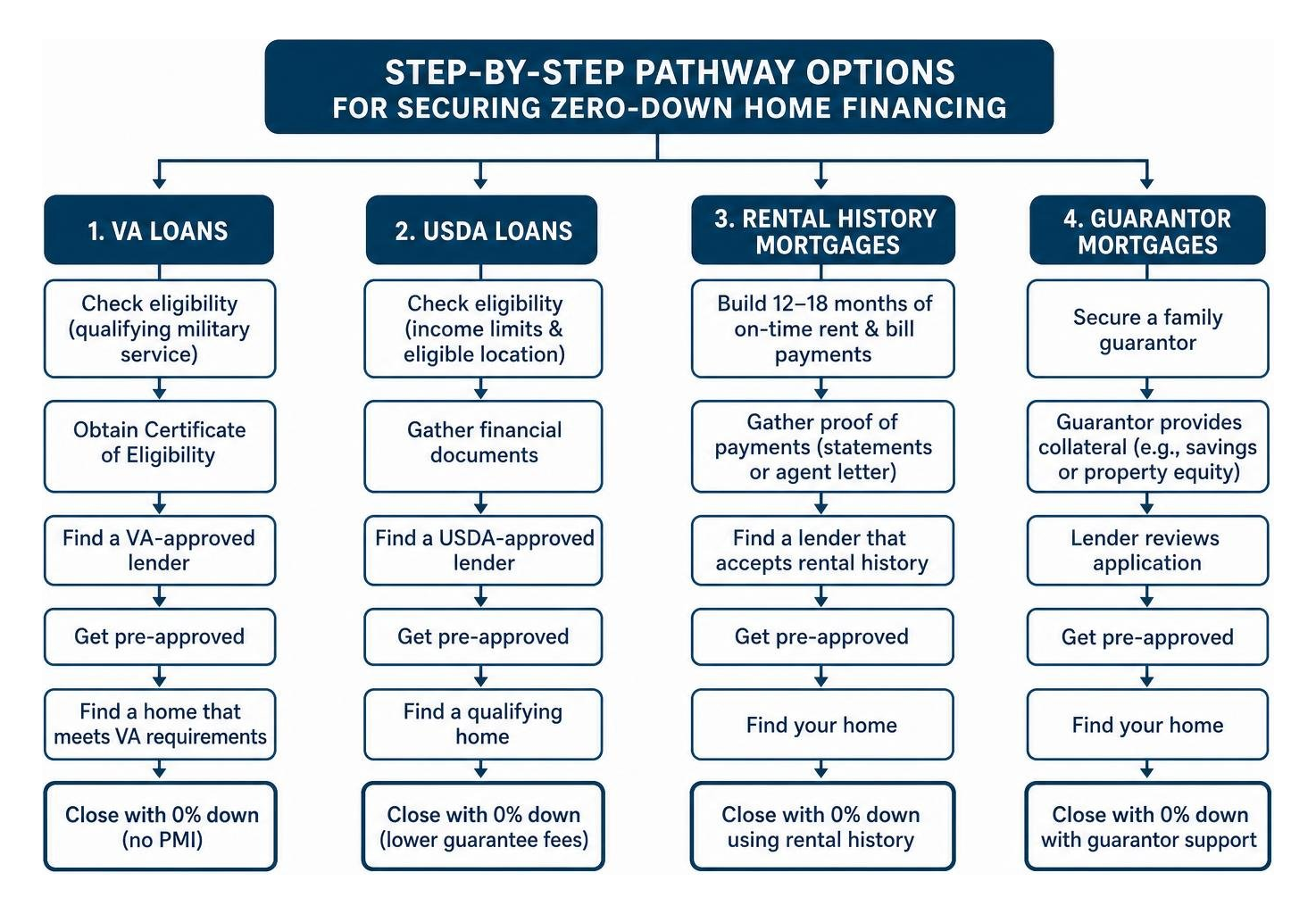
- VA Loans: Offered to active-duty service members, veterans, and surviving spouses, VA Home Loans allow you to finance 100% of the home purchase price with zero down payment and no monthly private mortgage insurance (PMI).
- USDA Loans: Designed for rural and qualifying suburban homebuyers, USDA Home Loans offer 100% financing backed by the U.S. Department of Agriculture, subject to income thresholds and geographical boundaries.
- Track Record and Rental-Based Mortgages: These products allow renters to use a clean history of rental payments to qualify for a zero-down loan without needing a family guarantor.
- Guarantor & Family Springboard Mortgages: These loans require a family member to secure the debt using their own savings or property equity as collateral.
How Rental History Helps in Buying a House Without a Deposit
One of the most significant developments for prospective homeowners is the formal recognition of rental track record. For years, long-term renters paid high monthly rent prices but struggled to save a cash lump sum for a deposit.
Under modern rental-verification guidelines, lenders allow you to leverage 12 consecutive months of prompt rent and household bill payments as proof of affordability. To qualify, you generally must show:
- At least 12 to 18 consecutive months of on-time rental payments within the last 18 months.
- Bank statements or formal letting agent statements proving no missed or late payments.
- That your prospective monthly mortgage payment will not exceed your current monthly rental payments.
By converting demonstrated rental reliability into credit trust, these products bridge the gap for buyers trapped in the rental cycle.
Key Pathways to Zero-Down Homeownership

Navigating the route to homeownership without cash savings comes down to matching your personal background with the right specialized mortgage program.
| Program Type | Down Payment Required | Primary Requirement | Key Benefit |
|---|---|---|---|
| VA Loans | 0% | Qualifying military service | No PMI, competitive interest rates |
| USDA Loans | 0% | Income limits & eligible location | Zero down, lower guarantee fees |
| Guarantor Mortgages | 0% | Family collateral (10% standard) | Enables purchase without cash |
| Shared Ownership | 5% of share | Income eligibility limits | Requires far less upfront deposit |
Government-Backed Zero-Down Programs
Government-backed programs are the gold standard for zero-down home purchases because they eliminate the down payment requirement while offering competitive interest rates.
VA Loans
For eligible military personnel, VA loans represent an exceptional home-financing option. They offer zero down payment, require no ongoing monthly mortgage insurance, and impose flexible credit requirements. While there is a one-time VA funding fee (ranging from 1.25% to 3.3% depending on usage and down payment), this fee can be rolled directly into the total loan amount.
USDA Loans
Many buyers are surprised to learn that suburban locations often qualify for USDA financing. USDA home loans require no money down and are aimed at low-to-moderate-income buyers purchasing homes in designated rural or suburban areas. USDA loans charge an upfront guarantee fee along with an affordable annual fee (0.35% of the loan balance), making them very cost-effective over time.
Guarantor and Family-Assisted Mortgages
If you do not qualify for military or geographical government programs, turning to family support is another established route to buying a house without a deposit.
- Guarantor Mortgages: A family member (usually a parent) agrees to take on legal liability for the mortgage payments if you default.
- Family Springboard Accounts: Rather than giving you a non-refundable gift, a family member places a deposit (typically 10% of the property purchase price) into a specialized, locked savings account held by the lender. After a set period (usually 3 to 5 years) of prompt mortgage payments, the funds are returned to the family member with interest.
- Joint Borrower Sole Proprietor (JBSP): This structure allows a family member to add their income to your mortgage application to boost your total borrowing capacity. Crucially, they are listed on the mortgage but not on the property title, preventing unnecessary tax liabilities.
Pros, Risks, and Qualifications for 100% Mortgages

While getting into a home without saving thousands up front is appealing, 100% LTV financing comes with strict qualification rules and specific financial risks that every buyer must evaluate.
Who Qualifies for No-Deposit Home Financing?
Because the lender takes on 100% of the financial risk when funding a property without a deposit, underwriting standards are rigorous.
- Income Thresholds & Ratios: Lenders generally look for a stable household income (often starting around £24,000–£25,000 annually or equivalent local baselines). Furthermore, underwriting rules generally require keeping your total monthly debt payments—including your new mortgage, car loans, and credit cards—at or below a 35% debt ratio relative to your gross monthly income. Total borrowing is usually capped at 4.5 times your annual household salary (though key workers may access up to 5 times income).
- Job Stability: Applicants usually need permanent employment contracts or a clean 2-year track record of self-employment. Civil servants and stable professionals are often viewed favorably.
- Credit History: You must present a clean credit history. A single missed payment on a utility bill or loan within the last 6 to 12 months can lead to a direct rejection on zero-deposit applications.
- Manual Underwriting: If you have non-traditional credit or lack a standard credit score, manual underwriting allows lenders to review alternative payment records—such as rent, cell phone, and insurance payments. Learn more in this detailed breakdown on How to Buy a House With No Credit.
The Hazards of Buying a House Without a Deposit
Before committing to a zero-deposit loan, you must understand the financial risks involved:
- Negative Equity: This occurs when property market values decline, leaving you owing more on your mortgage than the property is worth. For example, if you purchase a home for £300,000 with a 100% mortgage and home values fall by 5%, your home is now worth £285,000, but your debt remains at £300,000. Negative equity makes it difficult to sell or remortgage until property values recover.
- Higher Interest Rates: Lenders offset the risk of high-LTV lending by charging higher interest rates. For comparison, a 95% LTV loan might carry an interest rate around 4.81%, whereas a 100% LTV mortgage rate could range higher (typically 5.29% to 5.95% or more).
- Remortgage Barriers: When your initial fixed-rate term expires, if you have not accumulated equity, you may be unable to switch to a lower interest rate with another lender. This could leave you paying your current lender’s higher Standard Variable Rate (SVR).
Smart Alternatives to Zero-Deposit Mortgages

If a pure zero-deposit mortgage is not the right fit for your circumstances, several close alternatives offer lower risk and fast entry onto the housing ladder.
Low-Deposit Loans and Down Payment Assistance
Taking a step from a 0% deposit to a 3.5% or 5% deposit opens up a far wider range of competitive mortgage deals.
- FHA Mortgages: An ideal choice for buyers with modest savings, FHA Home Loans require a minimum down payment of just 3.5% and accept credit scores down to 580.
- Down Payment Assistance (DPA) Grants: State Housing Finance Agencies offer programs providing low-income and first-time buyers with grants or 0% interest deferred second loans to cover down payments and closing costs.
- Seller Concessions: You can negotiate with the property seller to pay a portion of your upfront closing costs (often between 3% and 6% of the purchase price depending on the loan type), significantly reducing the net cash you need at closing. Read more about legal strategies in How To Buy A House With No Money Down Legally.
- Specialist Low-Deposit Products: Fixed dollar products require a flat £5,000 or 2% deposit, giving buyers a manageable alternative to saving 10% to 20%.
For broader first-time buyer resources, review our dedicated guide for the First Time Home Buyer.
Shared Ownership and Gifted Deposits
- Shared Ownership: Under this scheme, you buy a partial share of a property (typically between 25% and 75%) using a mortgage and pay subsidized rent on the remaining portion. Because you only borrow for your percentage share, your deposit requirement drops significantly. For instance, a 5% deposit on a 25% share (£75,000) of a £300,000 property requires just £3,750 in cash—compared to £15,000 for a 5% deposit on the entire home.
- Gifted Deposits: Many traditional mortgage options accept a cash gift from an immediate family member to cover your down payment. The family member signs a simple gift letter stating the money does not need to be repaid, satisfying standard underwriting requirements.
Frequently Asked Questions About No-Deposit Buying
Can I buy a house without a deposit if I have bad credit?
It is extremely difficult to qualify for a zero-deposit mortgage if you have recent bad credit (such as defaults, late payments, or court judgments). Because 100% LTV mortgages carry maximum risk for lenders, applicants must present clean credit histories. If you have lower credit scores, options like FHA financing (which accepts scores down to 500–580 with a down payment) or building credit over 6 to 12 months before applying offer a much higher chance of success.
Does buying with no deposit mean I need zero cash overall?
No. “No deposit” means you do not need upfront cash for the purchase price of the home, but it does not mean “zero costs.” You still need a cash budget—typically between $3,000 and $8,000 (or £3,000 to £5,000)—to cover non-loan expenses such as legal/conveyancing fees, home inspections, property appraisals, and moving costs. Combining zero-down loans (like VA or USDA) with seller concessions is the primary strategy to bring total out-of-pocket costs near zero.
How can a mortgage broker help me find a no-deposit deal?
Because no-deposit mortgages account for less than 1% of the active loan market, finding these products independently can be challenging. A specialized mortgage broker provides:
- Whole-of-Market Access: Direct lines to niche lenders offering rental track-record products and family-assisted structures.
- Pre-Application Affordability Checks: Stress-testing your debt-to-income ratios before formal submission to safeguard your credit file.
- Underwriting Expertise: Guidance through manual underwriting requirements or alternative payment documentation.
Conclusion
Buying a house without a deposit in 2026 is no longer an out-of-reach dream reserved only for a lucky few. Whether you qualify for zero-down government programs like VA and USDA loans, leverage a clean 12-month rental track record, or utilize family-assisted springboard options, multiple paths exist to help you move out of the rental cycle and step onto the property ladder.
However, entering the housing market without cash savings requires careful planning. You must account for upfront closing expenses, maintain strict financial discipline, and manage the long-term impacts of loan-to-value ratios and interest rates.
At Capital Home Mortgage, we take pride in being a direct, full-service mortgage lender. With our in-house processing and underwriting, fast approvals, and dedicated loan officer support, we simplify the complex world of home financing. Whether you qualify for a zero-down loan or want to explore low-deposit options, our team is here to guide you every step of the way.
Explore our full range of flexible financing options on our Home Loans page, and let us help turn your homeownership goals into reality today!