How Construction Home Loans Help Finance a New Build
Construction home loans provide short-term funding to build a house, then often convert into a regular mortgage when the work is done. Instead of receiving all funds at closing, your builder is paid in stages, called draws, as work reaches approved milestones.
Before applying, plan for the basics:
- Choose a licensed, insured builder and finalize plans, permits, and a line-item budget.
- Prepare financial records, income proof, and assets for your down payment.
- Expect lenders to review your credit, debt-to-income ratio, the home’s appraised future value, and the building contract.
- Build in time and budget reserves for delays or cost changes.
These loans usually last 6 to 12 months during construction. Interest-only payments are common while the home is being built, but rates and qualification rules can be stricter than for a standard mortgage.
I am Dale Gremillion, a manager at Capital Home Mortgage with more than 26 years of experience supporting mortgage operations and borrower guidance across construction home loans and other financing options. Next, let’s look at how a construction loan differs from the mortgage you may use after the home is complete.
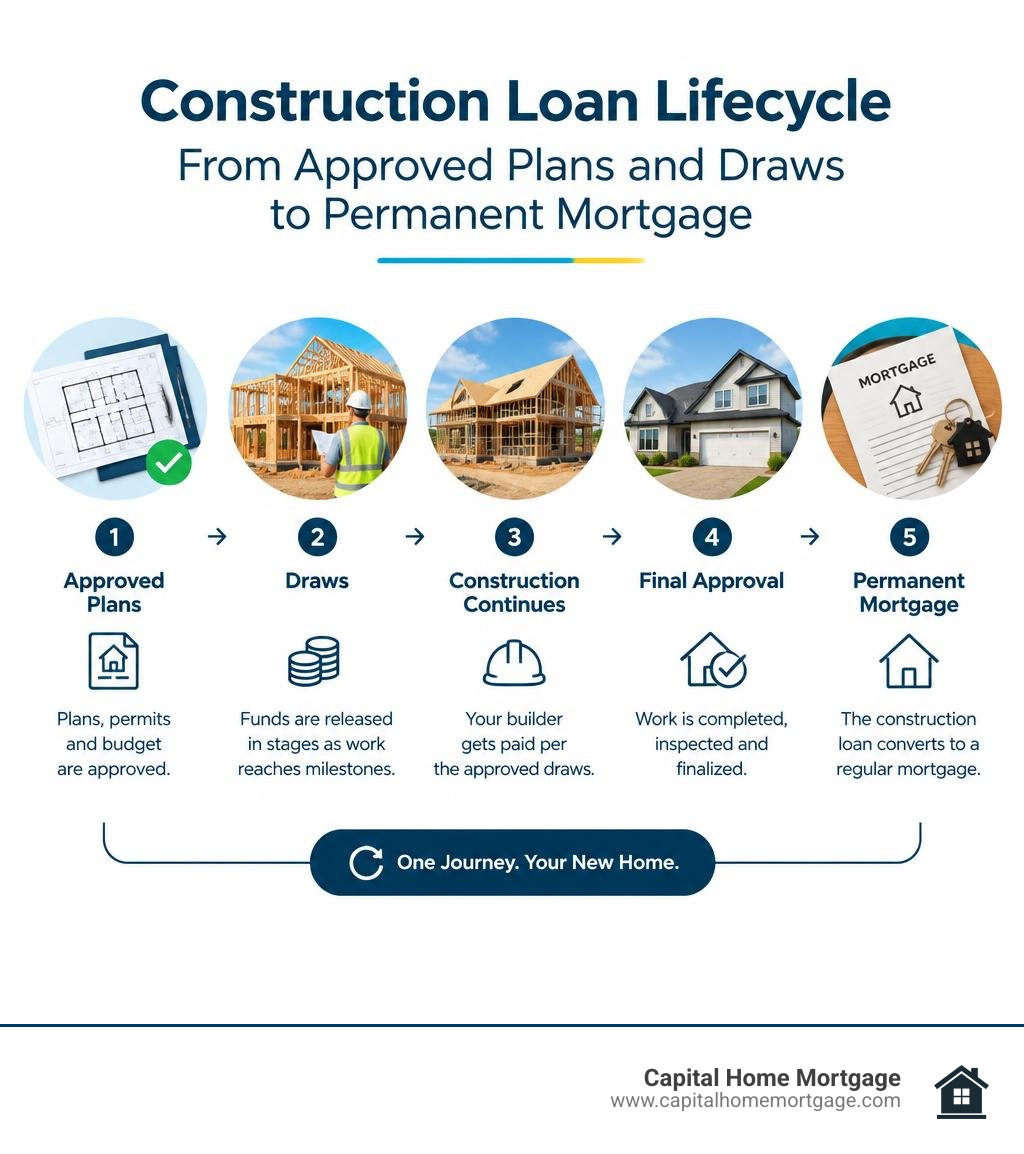
Construction home loans terms explained:
Understanding Construction Home Loans vs. Traditional Mortgages
When buying an existing property, financing is straightforward: the lender provides a single lump sum to the seller at closing, and you begin repaying principal and interest over 15 to 30 years. The completed structure serves as immediate collateral.
Construction loans operate under an entirely different financial framework. Because the home does not yet exist, the lender takes on higher collateral risk. To manage this exposure, lenders disburse funds incrementally across the build rather than handing over the entire loan amount on day one.
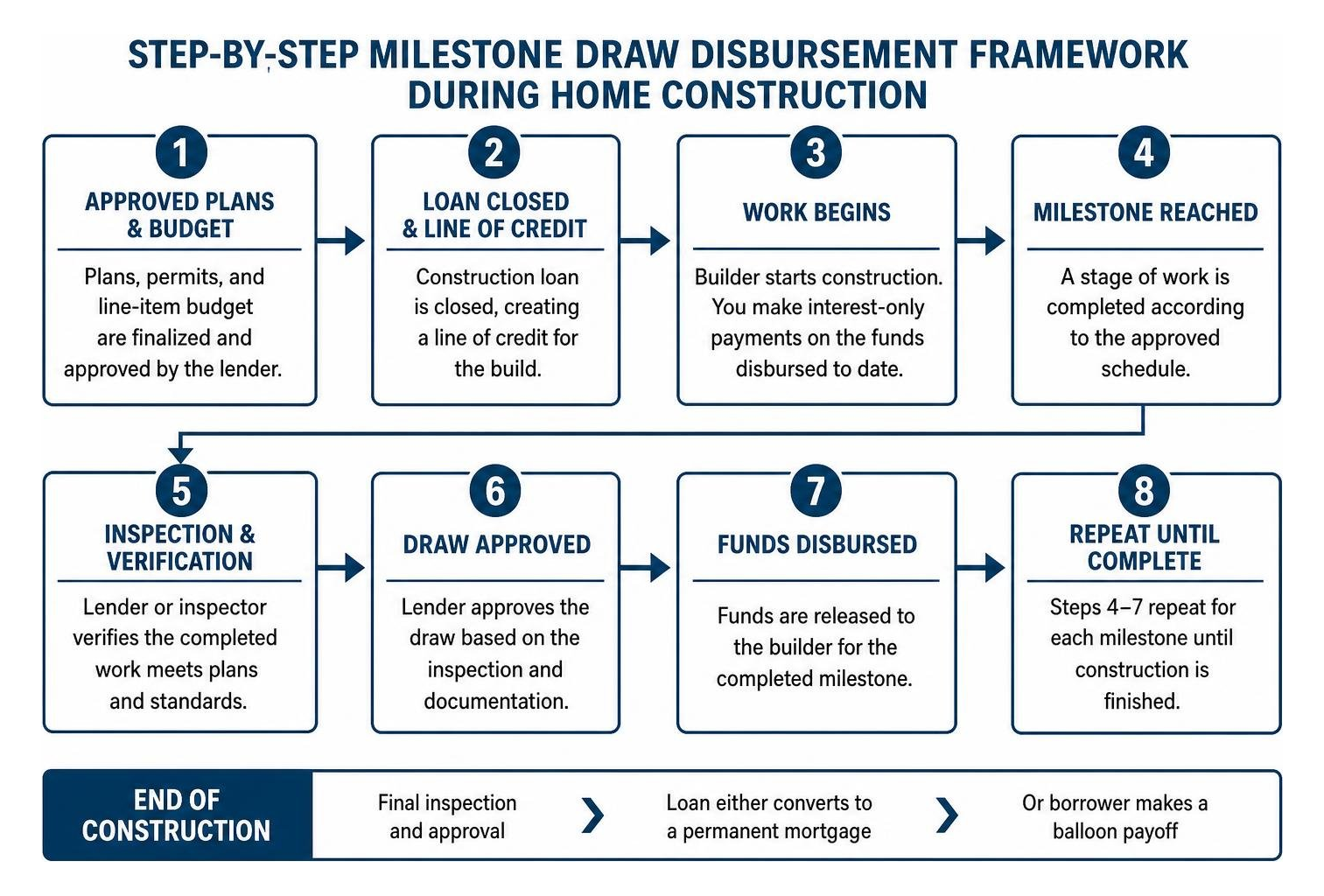
These loans function as short-term lines of credit spanning 6 to 12 months. During the construction phase, borrowers typically make interest-only payments calculated strictly on the total funds disbursed to date. If your builder has only drawn $75,000 for foundation work out of a total $400,000 budget, you only pay monthly interest on that $75,000.
Interest rates on construction loans are typically variable—often pegged to the prime rate—and sit about one percentage point higher than traditional long-term mortgages. Once construction wraps up, the loan either rolls over into a permanent mortgage or requires a full balloon payment, depending on the structure chosen.
| Feature | Construction Home Loan | Traditional Mortgage |
|---|---|---|
| Loan Term | 6 to 12 months (short-term) | 15 to 30 years (long-term) |
| Disbursement Method | Staged draws based on completion milestones | Single lump-sum disbursement at closing |
| Payment Structure | Interest-only payments on drawn balances | Full principal + interest amortization |
| Interest Rates | Variable; typically ~1% higher than market | Fixed or adjustable; standard consumer rates |
| Collateral | Vacant land + future “subject-to” value | Fully completed, existing home and lot |
| Underwriting Focus | Borrower credit + builder credentials & blueprints | Borrower credit, income, and property appraisal |
How Construction Draw Schedules and Inspections Work
A construction draw schedule outlines when funds are released to your general contractor. These payments align with physical completion phases:
- Site Preparation & Foundation: Clearing, excavation, footings, and slab pouring.
- Rough Framing & Sheathing: Wall framing, roof trusses, subflooring, and exterior wrap.
- Mechanical Rough-Ins: Plumbing lines, electrical wiring, and HVAC ductwork.
- Drywall & Insulation: Sheetrock hanging, taping, mudding, and thermal insulation.
- Interior Finishes: Cabinetry, trim, flooring, countertops, and painting.
- Final Completion: Fixture installations, exterior landscaping, and final grading.
Before any money changes hands, an independent building inspector evaluates the site. Expect four to six inspections throughout the life of your project. If an inspection confirms that the rough framing matches the approved architectural plans, the lender authorizes the release of that specific draw. This structure protects you from paying for incomplete or substandard work while ensuring the project stays on schedule.
Major Types of Construction Home Loans
Selecting the right loan product prevents unnecessary refinancing expenses and administrative hurdles down the road.

1. Construction-to-Permanent Loans (One-Time Close)
A construction-to-permanent loan combines the interim construction line of credit and the permanent 30-year mortgage into a single financing package. You close once, pay a single set of closing costs, and lock in your permanent rate structure upfront. Once the final certificate of occupancy is issued, the interim balance rolls directly into a long-term mortgage. To understand the transition, review how a construction loan automatically turns into a mortgage.
2. Construction-Only Loans (Two-Time Close)
A construction-only loan covers solely the 6-to-12-month building phase. Once construction finishes, the entire balance comes due as a balloon payment. You must either pay the balance in cash or apply for a brand-new permanent mortgage to pay off the construction lender. While this option allows flexibility if you want to shop for different permanent rates later, it requires going through underwriting twice and paying two sets of closing fees.
3. Owner-Builder Construction Loans
Owner-builder loans are tailored for borrowers acting as their own general contractor. Because managing a build requires specialized trade coordination, lenders reserve these products almost exclusively for licensed, insured professional contractors who build their personal primary residences.
4. Specialized Government-Backed Construction Programs
For borrowers seeking lower down payment thresholds, government-backed programs offer attractive pathways. Look into how FHA construction loans work for first-time builders, which allow combined land and construction financing with as little as 3.5% down. Qualified veterans can also explore zero-down construction options through the U.S. Department of Veterans Affairs.
Core Borrower Eligibility and Documentation Requirements
Because the home isn’t built yet, qualification standards for construction financing are more stringent than those for standard home purchases.
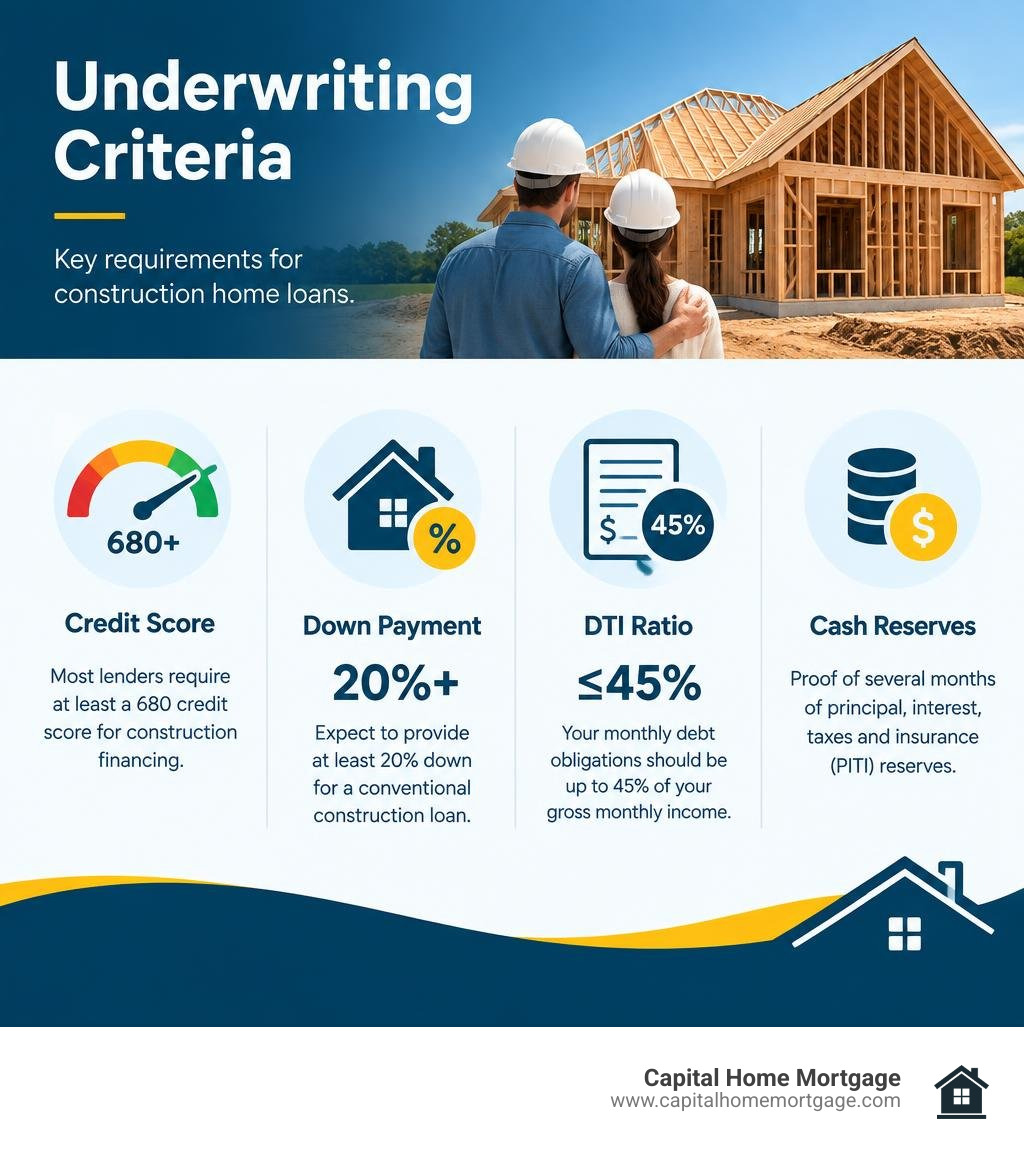
- Credit Score: While standard conventional loans may accept scores down to 620, most lenders require a credit score of at least 680 for construction financing. A stronger score helps you secure better rates and offsets perceived project risks.
- Debt-to-Income (DTI) Ratio: Your DTI ratio reflects your monthly debt obligations divided by your gross monthly income. Most lenders accept a maximum DTI of up to 45%, factoring in your future mortgage payment along with existing auto loans, student loans, and minimum credit card dues.
- Down Payment: Expect to provide a down payment of at least 20% for a conventional construction loan. This cash equity serves as a financial buffer against cost overruns.
- Cash Reserves: Lenders often ask for proof of several months’ worth of principal, interest, taxes, and insurance (PITI) reserves held in liquid accounts after closing.
Key Financial Documentation Checklist
To verify your financial profile, gather the following paperwork:
- Two years of signed federal tax returns (including 1099s and W-2s)
- Most recent 30 to 60 days of pay stubs
- Two to three months of checking, savings, and investment account statements
- Complete asset documentation for down payment funds and closing costs
- A complete schedule of existing real estate owned (if applicable)
Project and Builder Approval Guidelines
Your financial standing is only half of the equation; lenders also thoroughly evaluate the project itself and the builder executing it. Before approving financing, our team assesses:
- General Contractor Licensing and Credentials: Lenders verify active state licensing, adequate commercial general liability coverage, and worker’s compensation insurance. We recommend reviewing tips on finding the right builder to construct your home before signing a contract.
- Architectural Blueprints and Specifications: A complete set of dimensioned plans, engineering calculations, and detailed finish schedules.
- Line-Item Construction Budget: A detailed breakdown categorizing costs for foundation, framing, roofing, mechanicals, fixtures, and labor.
- Building Contract: A signed agreement specifying whether the build is fixed-price or cost-plus, complete with clear milestone benchmarks and change-order procedures.
- Municipal Permits: Approved zoning permits, building authorizations, and environmental clearances.
Securing Competitive Rates on Construction Home Loans

Interest rates on interim construction financing fluctuate based on the broader economic environment and the Federal Reserve’s rate posture. Because these loans carry higher administration costs—such as scheduling inspections, processing lien waivers, and managing draw disbursements—rates typically sit higher than standard 30-year fixed mortgages.
To secure the most competitive rate on your construction financing:
- Optimize Your Credit Profile: Paying down revolving credit lines to bring your utilization below 10% can boost your FICO score, unlocking top-tier interest rates.
- Increase Your Cash Equity: Offering a 25% or 30% down payment reduces the lender’s loan-to-cost (LTC) exposure, often qualifying you for rate discounts.
- Choose the Right Program Structure: Locking in a single-close construction-to-permanent loan helps insulate you from interest rate spikes during your build phase.
- Explore Regional and Rural Programs: If your build site sits outside urban centers, consider dedicated agricultural and rural home loan options designed to support acreage properties.
For customized local terms, explore regional financing solutions:
- Construction Home Loans in Texas
- Construction Home Loans in California
- Construction Home Loans in South Carolina
- Construction Home Loans in Minnesota
- Construction Home Loans in Austin, Texas
- Construction Home Loans in Dallas, Texas
Navigating Special Building Scenarios: Land Equity, Delays, and Cost Overruns
Custom builds rarely go 100% according to plan. Weather shifts, material delivery bottlenecks, and unexpected site conditions can challenge even the best-laid timelines.
Using Land Equity as Down Payment Credit
If you already own the building lot, you do not necessarily need to provide an all-cash down payment. The equity in your land can count directly toward your required down payment.
For instance, if you own a lot appraised at $100,000 free and clear, and your total construction cost is $400,000, your total project value is $500,000. Your $100,000 in land equity represents a 20% equity stake, satisfying the down payment requirement without pulling extra cash out of your bank account. If you still owe money on a land loan, the construction loan simply pays off the remaining land balance at closing and rolls it into the total project cost.
Managing Delays and Schedule Disruptions
If weather or permitting delays extend construction past the initial 12-month mark, lenders can issue loan extensions. However, extensions often come with administrative fees and may require an updated appraisal or interest-rate adjustment. Maintain open communication with your builder and your loan officer from day one so potential timeline shifts are addressed before deadlines arrive. Regional requirements can vary significantly—see our guide on qualifying for a construction loan in Florida for an example of local considerations.
Mitigating Cost Overruns with Contingency Reserves
Material price changes and unforeseen soil conditions can drive up expenses quickly. To protect the project, lenders typically require a contingency reserve of 5% to 15% built into the overall budget. If your budget is $350,000, a 10% contingency adds $35,000 to cover unexpected structural modifications, change orders, or material adjustments without stalling progress.
Frequently Asked Questions About Building Loans
Can I use land I already own toward my down payment?
Yes. Lenders recognize your lot equity as collateral credit. If you own the land outright, its full appraised market value applies toward the equity requirement of the overall loan-to-value (LTV) calculation. If you still have an outstanding balance on the property, the construction loan pays off that lien at closing, and any remaining net equity is credited toward your down payment.
What happens if the home build takes longer than 12 months?
If your build encounters unexpected delays, contact your lender immediately. Most institutions provide 30- to 90-day loan extensions, though they may charge a modest extension fee. During an extended term, you continue making interest-only payments on the drawn balance while your builder finishes the remaining milestones.
What insurance policies are mandatory during the build phase?
Lenders require several specific policies prior to the first draw release:
- Builder’s Risk Insurance: Protects the physical structure, uninstalled materials, and supplies against fire, theft, vandalism, and storm damage throughout the build.
- General Contractor Liability: Protects against on-site workplace injuries and property damage.
- Flood Hazard Insurance: Required if the building envelope resides within a federally designated Special Flood Hazard Area (SFHA).
- Standard Homeowners Hazard Insurance: When construction completes and the final certificate of occupancy is issued, you transition the policy to a traditional homeowner’s policy before permanent loan conversion.
Conclusion
Financing a new home build requires clear planning, coordinated budgets, and a lending partner who understands the nuances of the custom construction process. From setting up realistic draw schedules to managing land equity and milestone inspections, every step works best when handled with experienced guidance.
At Capital Home Mortgage, we operate as a direct, full-service mortgage lender. With our in-house processing and underwriting, we maintain end-to-end control over your file—providing fast approvals, dependable draw management, and a smooth transition into your permanent mortgage.
When you are ready to turn your architectural plans into reality, reach out to our team to explore construction home loan options tailored to your budget and build schedule. Visit our main portal at Capital Home Mortgage or review our chattel home loans for manufactured home placement. Let’s build your dream home together.