The Average Down Payment for Mobile Home Buyers: 2026 Data and Historical Trends
For most manufactured home buyers, the average down payment ranges from 0% to 10% when using a real property mortgage, while personal property chattel loans typically require 5% to 20% down. Government-backed programs such as FHA, VA, and USDA loans can reduce that requirement to 0% to 3.5%, and conventional options like Fannie Mae MH Advantage and Freddie Mac CHOICEHome may allow as little as 3% down.
Purchasing a manufactured home is one of the most accessible paths to homeownership in the United States. According to Manufactured Housing Industry Statistics 2026 | Gitnux, the manufactured housing industry contributes billions to the national economy while offering modern, energy-efficient housing at a fraction of the cost of site-built homes.
Historically, financing for manufactured homes followed a split model. Buyers either took out specialized personal property loans with steep down payment requirements or paid entirely in cash. Over the past decade, however, expanded government backing and revised conventional guidelines have aligned manufactured home mortgages closer to traditional residential financing. Reviewing recent manufactured housing market trends shows that buyer demand has surged as traditional home prices have climbed, prompting lenders to offer more flexible low-down-payment programs.
| Feature | Manufactured Home | Site-Built Home |
|---|---|---|
| Average Purchase Price | $85,000 – $160,000 | $400,000 – $450,000 |
| Typical Down Payment (%) | 0% – 10% (Mortgage) / 10% – 20% (Chattel) | 3% – 20% |
| Average Upfront Cash Required | $0 – $16,000 | $12,000 – $90,000 |
| Average Cost per Square Foot | ~$101 | ~$150 – $220+ |
| Primary Loan Types | FHA, VA, USDA, Conventional, Chattel | FHA, VA, USDA, Conventional, Jumbo |
Benchmark Figures: Analyzing the Average Down Payment for Mobile Home Purchases vs. Site-Built Properties
When looking at verified data from 90+ Mobile Home Industry Statistics | 2026 Verified Data, the median down payment for a mobile home loan reached 0% in recent years due to heavy utilization of government-backed loan programs like FHA, VA, and USDA financing. In fact, over 58% of federally insured manufactured home loans were backed by FHA programs offering low down payments.
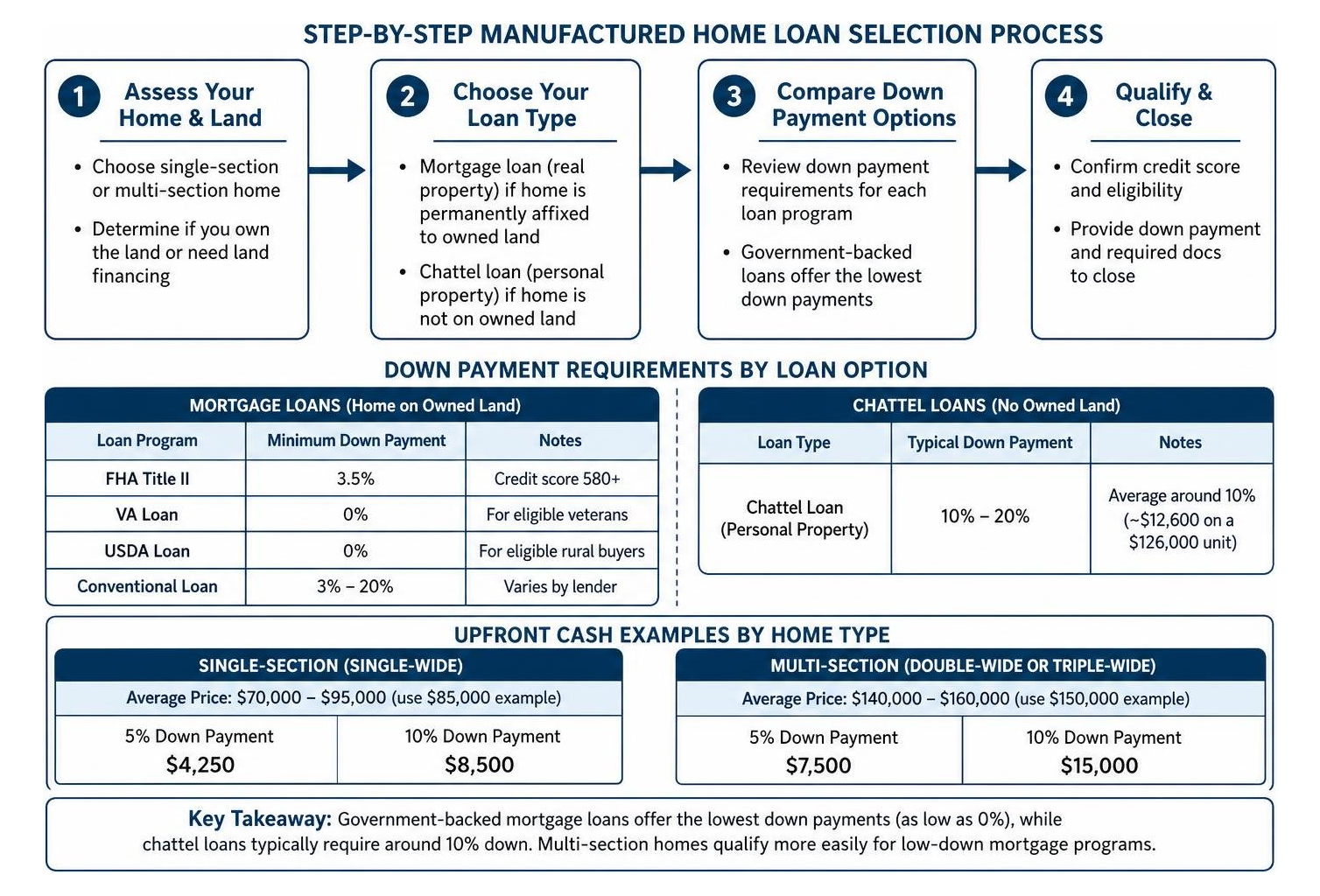
Even when buyers opt for standard personal property financing without land, down payments typically average around 10% (roughly $12,600 on an average $126,000 unit). In contrast, buying a median-priced site-built home often requires $20,000 to $80,000 upfront. Manufactured homes average roughly $101.20 per square foot—about 30% to 50% cheaper per square foot than site-built homes—which significantly lowers the total dollar amount needed for your loan-to-value (LTV) ratio.
Single-Section vs. Multi-Section: How Unit Size Influences Upfront Capital
The overall purchase price of your manufactured home directly dictates the cash required at closing. Manufactured homes primarily fall into two structural categories:
- Single-Section (Single-Wide): These homes average between $70,000 and $95,000 before site setup. A 5% down payment on an $85,000 single-section home equals $4,250, while a 10% down payment requires $8,500.
- Multi-Section (Double-Wide or Triple-Wide): Multi-section homes offer larger layouts, averaging between $140,000 and $160,000. A 5% down payment on a $150,000 double-wide is $7,500, whereas a 10% down payment amounts to $15,000.
Because multi-section homes are more frequently installed on permanent foundations and titled as real property, they qualify more easily for 3% to 3.5% down mortgage programs, balancing out their higher retail price.
Down Payment Requirements Across Major Mobile Home Financing Options
How much you need to put down depends heavily on the loan program you select and whether you own the land underneath your home.
Government-Backed Mortgages: FHA, VA, and USDA Guidelines
Government-insured loans provide some of the lowest down payment barriers for manufactured housing:
- FHA Title II Loans: If your manufactured home is permanently affixed to land you own (or are purchasing simultaneously), an FHA Title II loan requires a minimum down payment of just 3.5% with a credit score of 580 or higher.
- FHA Title I Loans: These loans finance the home alone, the lot alone, or both together. For a home-only loan, Title I guidelines generally require a minimum down payment of 5%.
- VA Loans: Eligible military service members, veterans, and surviving spouses can finance an eligible manufactured home with 0% down through the Department of Veterans Affairs.
- USDA Rural Development Loans: Qualified buyers purchasing manufactured homes in designated rural areas can access 100% financing, eliminating the down payment entirely. For buyers seeking non-traditional routes, exploring our guide on buying a home with zero down payment can provide actionable pathways.
Conventional Programs: Fannie Mae MH Advantage and Freddie Mac CHOICEHome
Fannie Mae and Freddie Mac have created conventional mortgage programs specifically tailored to modern manufactured homes:
- Fannie Mae MH Advantage: Allows down payments as low as 3% (up to 97% LTV) for primary residences. The home must feature architectural details similar to site-built homes, such as specific roof pitches, covered porches, and permanent masonry foundations.
- Freddie Mac CHOICEHome: Offers 95% standard LTV financing (5% down) or up to 97% LTV (3% down) when paired with affordable lending options or secondary financing programs.
Both programs require the home and land to be titled together as real estate under state law.
Chattel Personal Property Loans vs. Real Property Mortgages
If you plan to place your home in a land-lease community or on rented property, a real estate mortgage cannot be used. Instead, you will use a chattel loan.
As outlined in the research white paper Manufactured-housing consumer finance in the United States, chattel loans treat the structure as movable personal property (similar to a vehicle or boat). Because personal property poses higher collateral risk for lenders, down payment requirements typically range from 5% to 20%, and interest rates can be higher than standard mortgage rates. At Capital Home Mortgage, our specialized chattel loan financing solutions help buyers navigate these requirements with transparent terms and direct underwriting.
| Feature | Chattel Loan (Personal Property) | Real Property Mortgage |
|---|---|---|
| Minimum Down Payment | 5% to 20% | 0% to 5% |
| Land Ownership | Not required (Leased land/park) | Required (Owned or buying land) |
| Titling | Personal property / Motor vehicle title | Real estate deed |
| Average Loan Term | 15 to 20 years | 15 to 30 years |
| Interest Rates | Higher (typically 7% – 12%+) | Lower (standard market rates) |
Key Factors Influencing Your Down Payment and Interest Rates

Your down payment amount does not exist in a vacuum. It interacts directly with your credit score, debt-to-income (DTI) ratio, and final interest rate.
Credit Score, Loan Terms, and How Down Payment Size Affects Rates
A higher down payment reduces the lender’s financial risk, which frequently translates into lower interest rates and reduced monthly costs:
- Credit Score Tiers: Borrowers with credit scores above 680 often qualify for minimum down payments (3% to 5%). If your credit score falls between 500 and 579, FHA guidelines require at least a 10% down payment.
- Avoiding HPML Triggers: Chattel loans and low-down-payment loans can easily cross the threshold of Higher-Priced Mortgage Loans (HPML), which may require mandatory escrow accounts and additional appraisal reviews. A larger down payment helps keep your APR below HPML thresholds.
- Loan Term Impact: Comparing 15-year versus 30-year terms is critical. Reviewing current 30-year mortgage rates for manufactured homes shows how spreading payments over three decades lowers monthly commitments, while exploring verified 30-year mobile home loan options can help you match down payment size with your long-term budget.
First-Time Buyers, Repeat Purchasers, and Down Payment Assistance Programs
First-time mobile home buyers often put down between 0% and 5%, relying heavily on state and local assistance programs. Repeat buyers, who often bring equity from a previous home sale, tend to make average down payments of 15% to 20%.
Many state Housing Finance Agencies (HFAs) provide down payment assistance (DPA) grants or forgivable second liens covering 3% to 5% of the purchase price for manufactured homes titled as real property. These funds can fully cover the down payment for eligible FHA or conventional borrowers.
Evaluating Cash Buys and Regional Market Variations
A notable segment of the manufactured home market operates entirely without debt. Historically, between 40% and 60% of all used mobile home transactions and roughly 30% of new homes are bought with cash or seller financing. Cash purchases skew overall market metrics by bringing the down payment to 100% upfront for those individual sales.
Geographic location also influences upfront costs. When exploring options for financing a manufactured home in Texas, buyers benefit from expansive land availability and competitive retail pricing. Conversely, securing Arizona manufactured home loans often involves higher land-lease community demand, which shifts more buyers toward chattel loans or specialized real-property conversions.
Beyond the Down Payment: Total Upfront and Site Preparation Expenses
When budgeting for a manufactured home, the purchase price down payment is only part of the equation. Setting up a home properly involves essential site preparation and regulatory steps.
Budgeting Hidden Setup Costs and Site Prep
According to industry data from Manufactured Housing Industry Trends & Statistics – MHInsider, nearly 70% of new manufactured homes are placed on private property, while 30% go into planned communities.
- Buying Raw Land: If you are purchasing land separately, raw land loans typically require 10% to 20% down.
- Zoning and Site Clearing: Clearing brush, grading soil, and ensuring zoning compliance can cost between $2,000 and $8,000.
- Community Security Deposits: If placing your home in a manufactured home community, expect to pay first and last month’s lot rent plus a security deposit (ranging from $800 to $2,500 total).
Delivery, Foundation, Skirting, and Utility Hookup Fees
Before moving in, you must account for delivery and structural setup costs:
- Delivery and Transport: Many retailers include delivery within a certain radius, but transport beyond 50 miles can cost $1,000 to $5,000.
- Permanent Foundation / Pier & Anchor: A standard pier-and-beam system costs roughly $4,000 to $8,000, while a full concrete slab or basement foundation runs between $10,000 and $25,000.
- Skirting and Steps: Essential for insulation and HUD Code compliance, skirting typically costs $1,500 to $3,500.
- Utility Hookups: Connecting electric, municipal water/sewer, or drilling a well and installing a septic system can range from $5,000 to $20,000 depending on location.
- Permitting & Inspections: Local building permits and inspection fees generally range from $500 to $2,000.
Frequently Asked Questions About Manufactured Home Down Payments
What is the minimum down payment required for a manufactured home?
The minimum down payment depends on the loan type:
- 0% Down: VA loans and USDA Rural Development loans.
- 3% Down: Fannie Mae MH Advantage and Freddie Mac CHOICEHome.
- 3.5% Down: FHA Title II loans (with a minimum credit score of 580).
- 5% to 20% Down: FHA Title I personal property loans and standard chattel loans.
Can you use land equity instead of a cash down payment?
Yes. If you already own land free and clear or have built substantial equity in it, many mortgage programs (including FHA Title II and conventional loans) allow you to use your land equity as your down payment. The land is appraised alongside the new home, and its value is credited directly toward your upfront equity requirement, often eliminating the need for out-of-pocket cash.
Do manufactured home down payment requirements differ if placing the home on leased land?
Yes. If you place a manufactured home on leased land inside a mobile home park or community, you cannot use standard real property mortgages (like FHA Title II or conventional Fannie Mae loans). You will typically use a chattel loan or an FHA Title I loan, which generally require a minimum down payment between 5% and 20% of the home’s purchase price.
Conclusion
Understanding manufactured home costs and down payment requirements empowers you to make confident, budget-conscious decisions. Whether you are using a 0% down government program, putting 3% down on real property, or structuring a 10% down payment on a chattel loan, manufactured housing remains one of the most practical and affordable routes to achieving homeownership.
At Capital Home Mortgage, we manage the entire mortgage process from start to finish. Our in-house processing and underwriting ensure fast loan approvals, reliable on-time closings, and personalized loan officer guidance through every step of your purchase. Contact our team today to explore your financing options and find the perfect loan for your new home.