
Your Amortization Table Shows Where Every Mortgage Dollar Goes
An amortization table for home loan repayment shows each scheduled payment, how much goes to interest, how much reduces your principal balance, and what you still owe afterward. To use it, find your current payment row, compare the principal and interest amounts, and watch the remaining balance to measure payoff progress and growing home equity.
Early payments usually send more money to interest because interest is calculated on your highest loan balance. Over time, the interest charge falls and more of the same principal-and-interest payment goes toward the loan itself. This is why a 30-year mortgage can feel slow at first, but the table makes the path to payoff clear.
I am Dale Gremillion, a manager at Capital Home Mortgage with more than 26 years of experience supporting home loan operations and borrowers across purchase and refinance programs. I use the details in an amortization table for home loan planning to help make loan costs, payment choices, and payoff goals easier to understand.
Understanding Mortgage Amortization and the Monthly Payment Formula
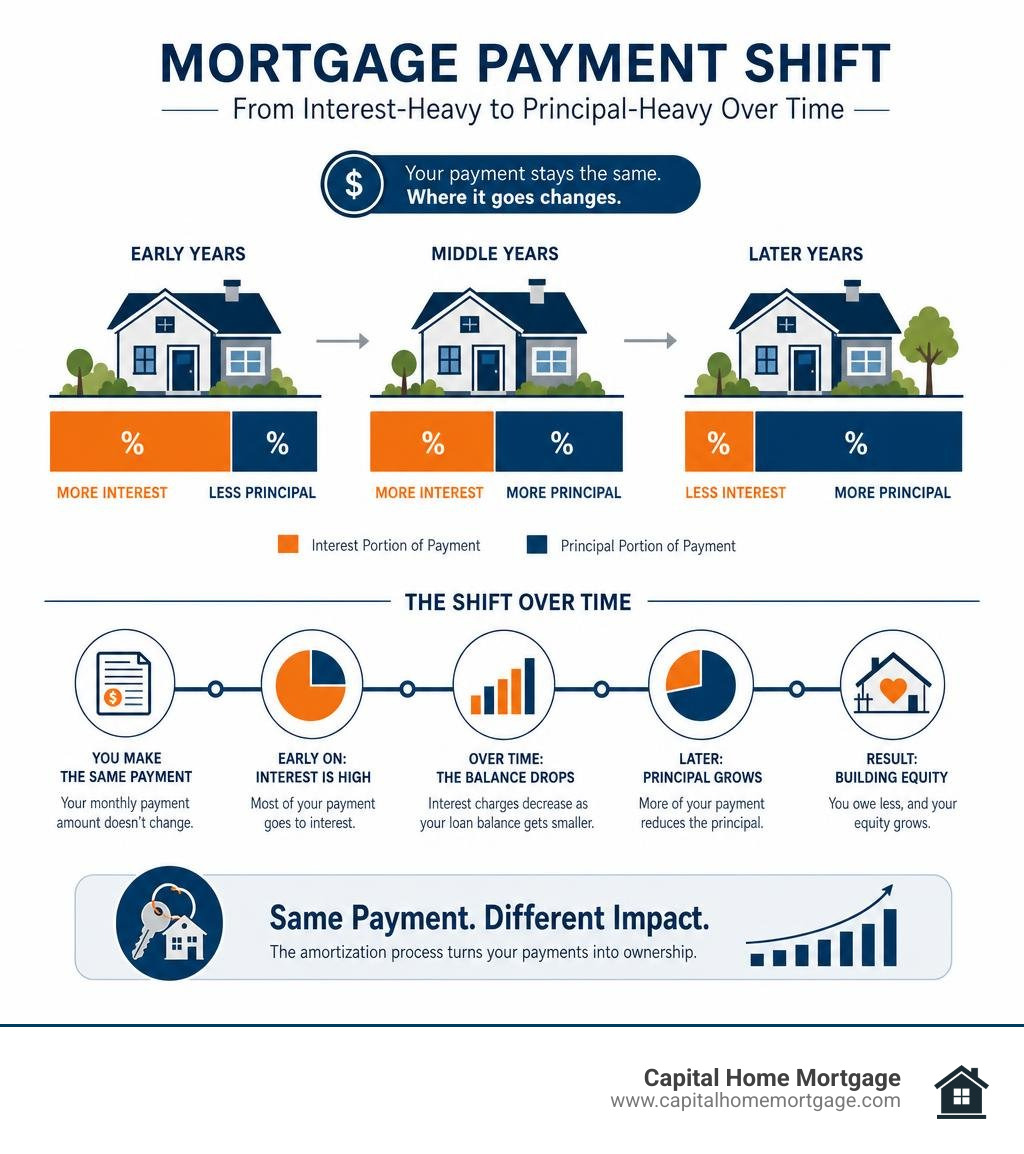
Mortgage amortization is the systematic repayment of loan debt through structured, periodic installments over a predetermined period. Each payment you make is split into two primary components: interest charges paid to your lender for borrowing the capital, and principal reductions that directly reduce your outstanding loan balance.
For fixed-rate mortgages, the total monthly principal-and-interest payment stays identical from your very first payment to your last. However, the internal distribution of that payment changes drastically over the life of the loan. In the beginning, the vast majority of your monthly installment is consumed by interest. As the loan balance slowly decreases, the interest charged each month shrinks, allowing a larger percentage of your payment to chip away at the actual principal.
To see how loan terms reshape this repayment trajectory, consider a side-by-side comparison of a 15-year versus a 30-year mortgage for a $300,000 balance:
| Loan Scenario | Monthly Principal & Interest | Total Interest Paid Over Life of Loan | Total Cost of Loan |
|---|---|---|---|
| $300,000 at 7.00% (30-Year Fixed) | $1,995.91 | $418,527 | $718,527 |
| $300,000 at 6.25% (15-Year Fixed) | $2,572.52 | $163,054 | $463,054 |
| $400,000 at 6.00% (30-Year Fixed) | $2,398.20 | $463,352 | $863,352 |
| $100,000 at 4.50% (15-Year Fixed) | $764.99 | $37,699 | $137,699 |
As the numbers demonstrate, borrowing $300,000 over 30 years at 7.00% results in $418,527 in interest alone—substantially more than the original amount borrowed. Understanding these numbers helps you choose the right product, and learning how to calculate monthly mortgage payments fast by using a calculator empowers you to take control of your financial planning early.
The Math Behind Your Monthly Mortgage Payment
Your monthly principal and interest payment is determined using a standard mathematical formula applied across fixed-rate loans:
$$M = P \frac{r(1 + r)^n}{(1 + r)^n – 1}$$
Where:
- M = Total monthly payment
- P = Original loan principal amount
- r = Monthly interest rate (annual interest rate divided by 12 months)
- n = Total number of scheduled monthly payments (loan term in years multiplied by 12)
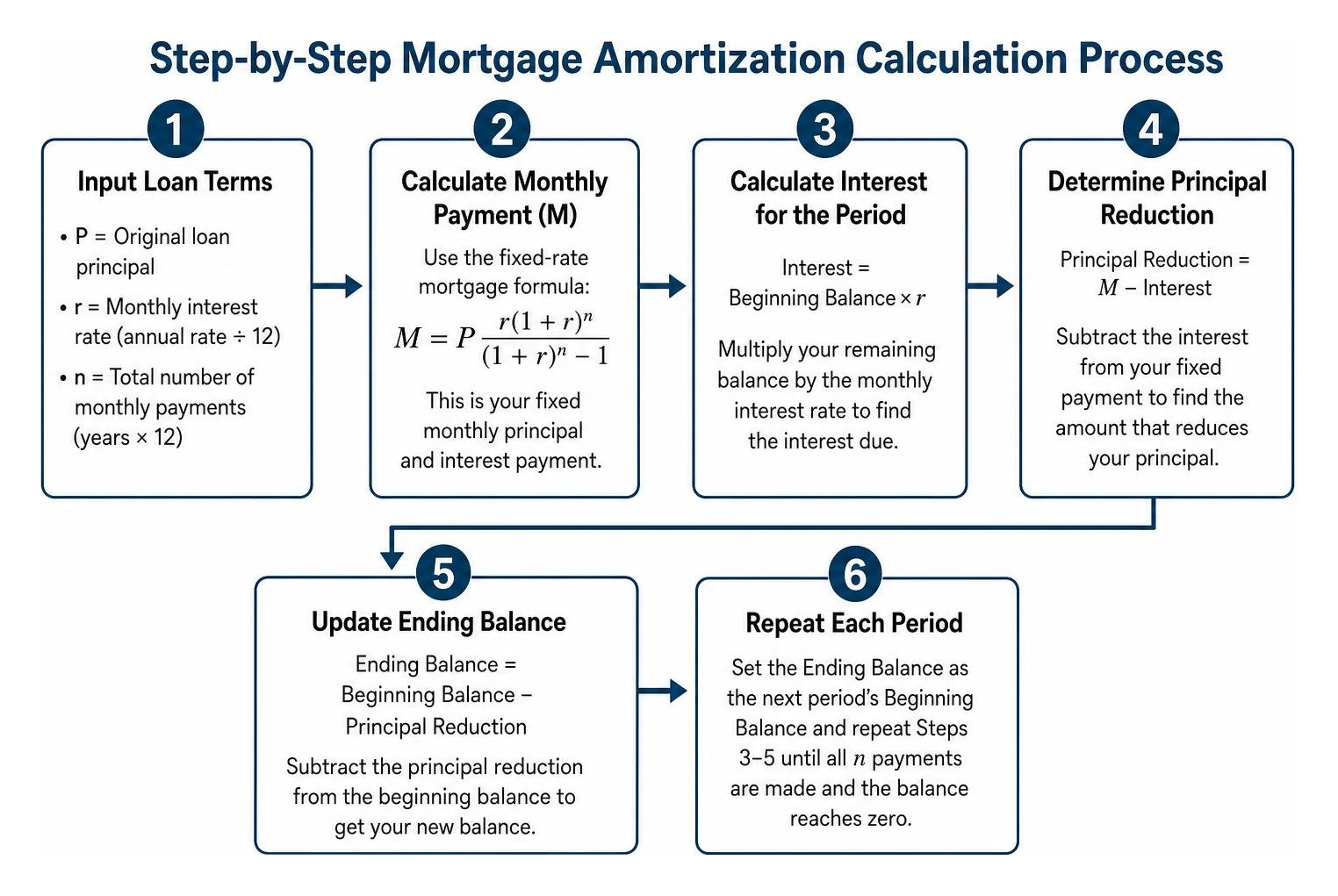
When running the numbers on a free loan amortization schedule generator, the tool applies this exact formula. It computes your fixed monthly obligation and generates a full schedule by multiplying your remaining balance by the periodic monthly rate to find the interest due, subtracting that interest from your fixed payment to determine the principal reduction, and updating your ending balance month after month.
Why Early Mortgage Payments Favor Interest Over Principal
A common frustration for new homeowners is opening their mortgage statements after a year of consistent payments only to find their outstanding principal balance barely moved.
This happens because interest is calculated directly against the outstanding loan balance at the start of every billing cycle. When your loan balance is at its absolute peak—such as during the first few years of repayment—the interest accrued each month is also at its peak.
For example, on a $280,000 30-year loan at a 6.75% interest rate, your monthly principal-and-interest payment is $1,816.20. In month one, the interest charge alone amounts to $1,575.00, leaving just $241.20 to reduce the principal balance. Similarly, on a $400,000 30-year mortgage at 6.10%, a borrower will pay approximately $145,439 in total payments over the first five years, yet the principal balance drops by only $27,326. The remaining $118,113 goes straight toward financing charges.
Whether you secure financing through standard conventional home loans or government-backed alternatives, this front-loaded amortization curve applies across all traditional fixed-rate products.
How to Read and Analyze an Amortization Table for Home Loan Repayment

An amortization schedule provides a clear month-by-month financial breakdown of your home loan. By learning how to read this schedule, you can see exactly when equity builds up, track remaining balances, and plan out your long-term debt payoff.
Key Columns Found in an Amortization Table for Home Loan Tracking
A standard amortization table organizes your repayment schedule across several core columns:
- Payment Number / Date: Identifies the chronological payment period, ranging from payment 1 to payment 360 on a 30-year term.
- Monthly Payment: The total fixed amount due each cycle for principal and interest.
- Principal Applied: The portion of your monthly payment allocated toward decreasing your loan balance.
- Interest Paid: The cost charged by the lender for the privilege of borrowing the remaining funds that month.
- Total Interest to Date: A running cumulative total of all interest fees paid since the loan originated.
- Remaining Ending Balance: The updated principal balance carried forward into the next billing cycle.
Note on Escrow: That a pure amortization table tracks only your principal and interest (P&I). If your monthly mortgage billing statement includes property taxes, homeowners insurance, flood coverage, or private mortgage insurance (PMI), those escrow reserves are added on top of your amortized P&I payment.
Identifying the Principal-Interest Crossover Point
The “crossover point”—often referred to as the amortization tipping point—is the exact calendar month when the portion of your payment applied to principal becomes larger than the portion going to interest.
For a standard 30-year fixed-rate mortgage at prevailing interest rates, this tipping point typically does not occur until year 18 or 19. For nearly two decades, the lender receives the larger share of every payment dollar you submit.
By contrast, shorter loan terms accelerate this timeline substantially. When you utilize complete guide to 15 year FHA loan options and rates or 15-year conventional structures, the crossover point typically arrives within year 3 or 4. Because the debt must be fully satisfied in half the time, the required monthly payment is higher, forcing more capital into principal reduction right from the start.
Strategic Methods to Accelerate Debt Payoff and Save on Interest
You do not have to follow the slow, 30-year amortization schedule set by your lender. By making targeted extra principal payments, you can change your loan’s amortization curve, cut years off your repayment timeline, and keep tens of thousands of dollars in your pocket.

Extra Monthly and Biweekly Principal Reductions
Every dollar you pay over your required monthly principal-and-interest payment goes directly toward reducing your principal balance—provided you specify to your servicer that the extra funds should be applied as a principal reduction.
Lowering your principal balance immediately reduces the amount of interest calculated for the following month, creating a compounding savings effect that shortens your loan term.
Consider the measurable impact of adding extra principal payments to a $300,000 30-year mortgage at 7.00% (baseline monthly payment: $1,995.91; baseline total interest: $418,527):
- Adding $100 Extra Per Month: Shortens the loan payoff term by roughly 4 years and saves over $40,000 in lifetime interest.
- Adding $500 Extra Per Month: Reduces your total loan term from 360 months down to 264 months (cutting 8 full years off the loan) and saves $141,843 in interest.
- Adding $1,000 Extra Per Month: Accelerates payoff down to 220 months (shaving off over 11.5 years) while saving an incredible $207,483 in total interest.
To model these strategies based on your specific budget, explore an interactive mortgage amortization calculator tool with extra payments.
Another reliable strategy is setting up an accelerated biweekly payment schedule. Instead of submitting 12 monthly payments per year, you pay half of your monthly payment every two weeks. Because there are 52 weeks in a year, you end up making 26 half-payments, which equals 13 full monthly payments annually. That single extra payment each year can cut 4 to 6 years off a standard 30-year mortgage without requiring major adjustments to your monthly budget.
Using an Amortization Table for Home Loan Refinancing Decisions
An amortization table is also an essential tool for evaluating whether to refinance your home. When market rates drop, reviewing an updated schedule helps you weigh the monthly savings against the upfront closing costs.
Refinancing makes the most financial sense when you are still in the early, interest-heavy years of your mortgage. However, be mindful of resetting the clock. If you have already paid 10 years on a 30-year mortgage, refinancing into a new 30-year loan resets your amortization schedule back to Year 1, putting you right back into the heaviest interest phase.
To maximize your long-term savings, consider refinancing the remaining balance into a 15-year or 20-year term. Compare options using our mortgage refinance tools and stay up to date on mortgage rates to confirm that your new loan terms lower your total financing costs over time.
Factors Influencing Loan Amortization and Pitfalls to Avoid
How your loan amortizes depends on your interest rate, loan term, payment frequency, and the underlying structure of your loan product. Knowing these details helps protect your hard-earned home equity.
Loan Structure and Interest Rate Variations
- Loan Term Length: Longer loan terms (such as 30 years) offer lower, more manageable monthly payments by spreading the principal across 360 months. The tradeoff is a significantly slower principal reduction curve and much higher total interest costs. Shorter terms (such as 15 years) raise the monthly payment but speed up equity growth and lower overall interest charges.
- Interest Rate Fluctuations: Fixed-rate mortgages maintain a completely predictable amortization table for the life of the loan. In contrast, Adjustable-Rate Mortgages (ARMs) feature a fixed interest rate for an introductory period (commonly 5, 7, or 10 years) before adjusting periodically based on market indices. When an ARM adjusts, the lender recalculates the entire amortization schedule using the new interest rate and the remaining loan term, which can cause your monthly payment to jump unexpectedly.
- Loan Balances and Recasting: If you make a significant lump-sum principal reduction—such as applying an inheritance or proceeds from selling an asset—some lenders allow you to “recast” your mortgage. While regular extra payments shorten your loan term while keeping your monthly payment the same, a mortgage recast recalculates your amortization schedule using the new, lower balance. This reduces your required monthly payment while keeping your original interest rate and payoff date intact.
Risks of Negative Amortization and Payment Caps
Standard home loans follow a positive amortization schedule, where each payment reduces the remaining principal balance until it reaches zero. However, certain unconventional or legacy loan products feature negative amortization.
Negative amortization occurs when your scheduled monthly mortgage payment is less than the interest accrued during that billing cycle. The unpaid interest is then added directly onto your outstanding principal balance. As a result, you owe more money each month despite making every required payment on time.
This problem often arises in payment-option adjustable-rate mortgages with minimum payment options or strict payment caps that prevent monthly payments from adjusting upward alongside rising interest rates. If the interest rate increases quickly but the payment cap prevents your installment from covering the new interest charges, the unpaid interest gets added to your principal.
To safeguard your financial future, work with experienced direct lenders who prioritize fully amortizing loan products like conventional, FHA, VA, and USDA financing.
Frequently Asked Questions About Mortgage Amortization
What is the fastest way to shorten a mortgage amortization schedule?
The fastest way to shorten your amortization schedule without refinancing is to make consistent, additional principal payments. You can accomplish this by adding a set amount to your monthly payment, making a lump-sum payment whenever you receive bonuses or tax refunds, or switching to an accelerated biweekly payment schedule. Applying an extra $100 to $500 directly to your principal each month can shave between 4 and 8 years off a standard 30-year mortgage and save tens of thousands of dollars in interest.
Does an amortization schedule include property taxes and homeowners insurance?
No. Standard amortization schedules track only pure principal and interest (P&I) payments. Out-of-pocket housing expenses often include property taxes, homeowners hazard insurance, flood insurance, and Homeowners Association (HOA) fees. While these expenses are typically collected alongside your monthly mortgage payment and held in an escrow account, they are third-party costs that do not reduce your loan balance or change your loan’s amortization schedule.
How does an amortization table help track private mortgage insurance removal?
Under the Homeowners Protection Act of 1998, borrowers with conventional loans can request the cancellation of Private Mortgage Insurance (PMI) once their loan-to-value (LTV) ratio drops to 80% of the home’s original purchase price, with mandatory automatic termination occurring at 78% LTV. By referencing your amortization table, you can pinpoint the exact month and year your balance will reach that 80% threshold, helping you plan ahead to eliminate your monthly PMI premiums.
Conclusion
Understanding your amortization schedule is one of the most practical steps you can take to manage your home loan effectively. When you see exactly how your monthly payment is split between principal and interest, you can make smarter choices about making extra payments, refinancing when market rates shift, and building home equity on your own terms.
At Capital Home Mortgage, we are dedicated to helping you navigate the home financing process with clarity and confidence. As a direct, full-service mortgage lender, we handle our processing and underwriting in-house across our complete lineup of home loan options. This approach allows us to deliver clear guidance, competitive terms, on-time closings, and dedicated loan officer support every step of the way.
Take control of your home financing strategy today. Use our interactive mortgage calculator to generate your personalized repayment schedule, and reach out to our team to find the best loan program for your long-term financial goals.


