
Why 15-Year Manufactured Home Mortgage Rates Matter More Than Ever in 2026
If you’re comparing 15-year mortgage rates for a manufactured home, here’s a quick snapshot of what to expect in 2026:
| Loan Type | Typical Rate | Term | Best For |
|---|---|---|---|
| Conventional (real property) | 6.75% – 7.50% | 15–30 yrs | Owned land, strong credit |
| FHA Title II (real property) | 6.50% – 7.50% | Up to 30 yrs | Low down payment, 580+ score |
| VA (real property) | 6.50% – 7.25% | Up to 30 yrs | Eligible veterans, 0% down |
| USDA (real property) | 6.75% – 7.50% | Up to 30 yrs | Rural areas, 640+ score |
| Chattel loan (personal property) | 7.50% – 12.00% | 15–25 yrs | Leased land, park homes |
The bottom line: A 15-year real property mortgage on a manufactured home typically runs between 6.50% and 7.50% in 2026 — significantly lower than chattel loans on leased land, which can reach 12% or higher.
Manufactured homes now make up a meaningful share of the U.S. housing market, and it’s easy to see why. Factory-built homes cost far less per square foot than site-built homes — yet they’ve appreciated nearly as fast. Between 2000 and 2024, manufactured homes on owned land appreciated 211.8%, almost matching the 212.6% appreciation of site-built homes.
But here’s where many buyers stumble: the financing decision often matters more than the purchase price itself. The gap between a high-rate chattel loan and a well-structured 15-year real property mortgage can add up to tens of thousands of dollars over the life of the loan. Choosing the right program, the right term, and the right lender makes an enormous difference.
That’s exactly what this guide is here to help you do.
I’m Dale Gremillion, a mortgage professional with over 26 years of experience at Capital Home Mortgage, where I’ve helped countless buyers navigate 15-year mortgage rates for manufactured homes and find the loan structure that fits their goals. Whether you’re buying your first manufactured home or refinancing an existing loan, I’ll walk you through everything you need to make a confident, informed decision.
Understanding 15 Year Mortgage Rates Manufactured Home Buyers Can Expect
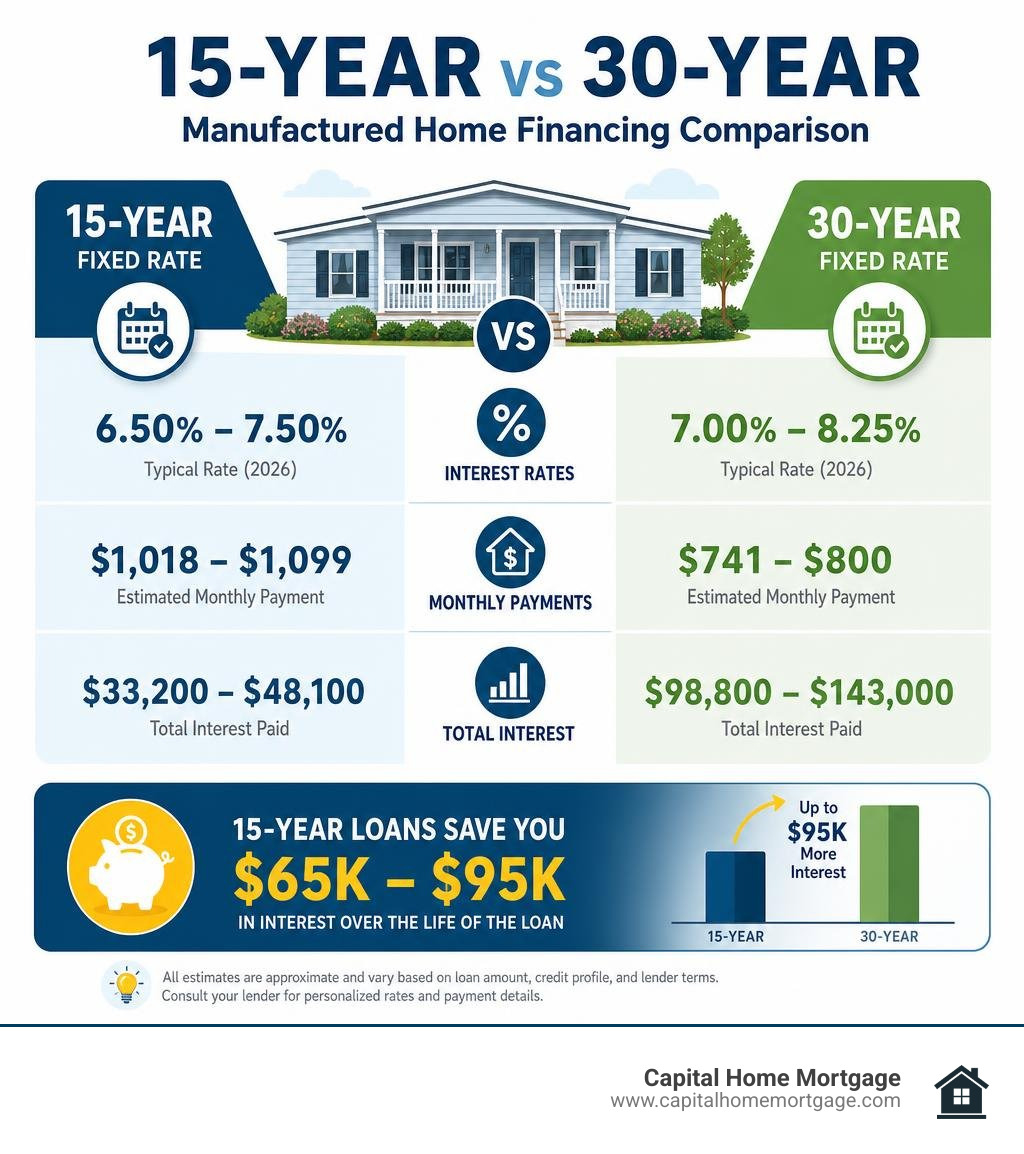
When you look at 15 year mortgage rates manufactured home borrowers receive in 2026, you will quickly notice that factory-built housing financing operates differently than standard site-built residential mortgages. As of early 2026, baseline manufactured home mortgage rates start around 6.75% for top-tier borrowers who classify their homes as real property on land they own.
Because a 15-year fixed loan represents significantly less risk to mortgage lenders than a 30-year term, interest rates are typically 0.50% to 0.75% lower than 30-year loans on the exact same property. Lenders get their principal returned twice as fast, which reduces their long-term risk and translates directly into interest savings for you.
However, the specific rate you lock in depends heavily on how the property is titled. If your manufactured home is classified as real property attached to a permanent foundation, you can secure rates that closely align with site-built homes (median around 6.63% to 7.88%). On the other hand, if you finance the home as personal property via a chattel loan, average interest rates jump to roughly 8.00% to 12.00%, with median chattel rates sitting near 9.50%.
How 15 Year Mortgage Rates Manufactured Home Terms Compare to 30-Year Options
Choosing a 15-year term instead of a 20- or 30-year term is one of the most effective ways to slash your borrowing costs. While a 30-year term provides a lower monthly payment, it requires you to pay compound interest over three decades. A 15-year term accelerates your amortization schedule, meaning every monthly payment sends a much higher percentage toward reducing your principal balance from day one.
To see the financial impact in action, let’s look at a comparative breakdown of a $100,000 loan amount across different repayment terms and loan structures:
| Loan Program & Term | Interest Rate | Monthly Principal & Interest | Total Interest Paid | Total Cost of Loan |
|---|---|---|---|---|
| 15-Year Fixed Real Property Mortgage | 6.75% | $885 | $59,286 | $159,286 |
| 20-Year Fixed Real Property Mortgage | 7.25% | $790 | $89,697 | $189,697 |
| 30-Year Fixed Real Property Mortgage | 7.50% | $699 | $151,717 | $251,717 |
| 15-Year Chattel Loan (Personal Property) | 10.00% | $1,075 | $93,435 | $193,435 |
| 20-Year Chattel Loan (Personal Property) | 9.50% | $932 | $123,707 | $223,707 |
As the numbers show, choosing a 15-year real property mortgage saves you $92,431 in total interest compared to a 30-year mortgage at 7.50%, and saves $34,149 compared to a 15-year chattel loan. Even though your monthly principal and interest payment is $186 higher on the 15-year real property mortgage compared to the 30-year option ($885 vs. $699), you achieve full debt freedom in half the time and keep almost six figures in your pocket.
Real Property vs. Personal Property Classification
Why is there such a massive gap between real property mortgage rates and personal property chattel rates? It all boils down to legal classification and collateral security.
When you purchase a manufactured home from a dealer or private party, it defaults to personal property status. The home receives a title certificate from your state department of motor vehicles, much like an RV or a automobile. Personal property loans—commonly known as chattel loans—carry higher interest rates because the lender’s security interest attaches only to the physical structure itself, which can theoretically be moved or detached.
To qualify for traditional 15-year mortgage financing with standard interest rates, you must convert the home from personal property into real property through a process known as title retirement:
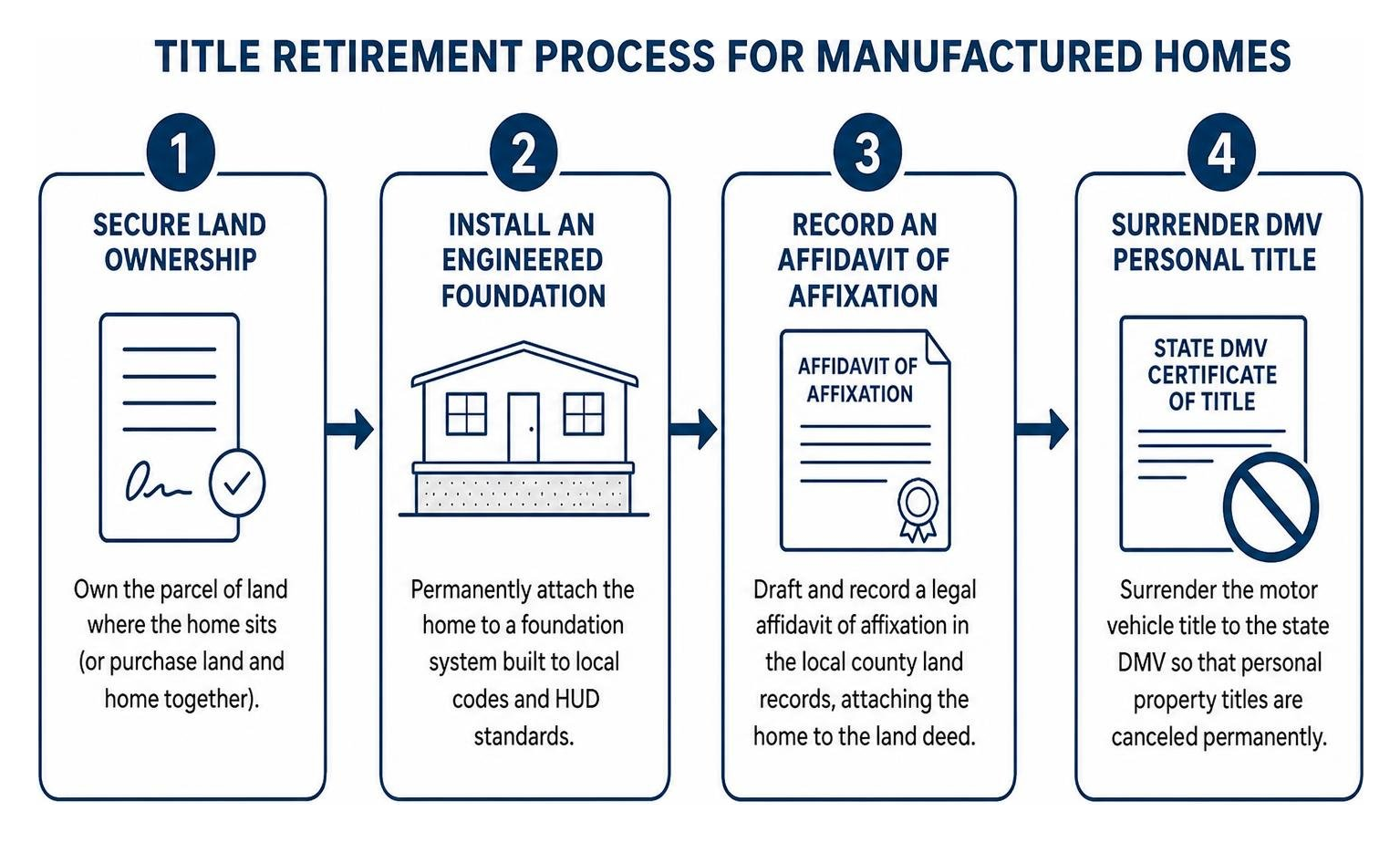
- Secure Land Ownership: You must own the parcel of land where the home sits (or purchase the land and home together in a single loan transaction).
- Install an Engineered Foundation: The home must be permanently attached to a foundation system constructed in accordance with local building codes and HUD standards.
- Record an Affidavit of Affixation: You draft and record a legal affidavit of affixation in the local county land records, legally attaching the home to the land deed.
- Surrender DMV Personal Title: You surrender the motor vehicle title to the state department of motor vehicles so that personal property titles are canceled permanently.
Completing title retirement generally takes between 30 and 90 days and costs between $500 and $2,000 in administrative and recording fees. However, performing this process grants you access to real estate taxes instead of personal property taxes and lowers your interest rate by 2.00% to 4.00% or more. For more insight on these rate structures, check out Manufactured Home Interest Rates | Loans 2026.
Loan Programs Offering 15-Year Terms for Manufactured Housing
Not every mortgage program handles factory-built housing the same way. When seeking a 15-year loan, you can select from government-backed programs, conventional mortgage initiatives, or chattel loans depending on your property’s setup. Reviewing How Long Can You Finance a Mobile Home? 10–30 Years highlights how these options vary by term duration and land status.
Government-Backed Loans: FHA, VA, and USDA
Federal loan programs provide some of the best pathways for securing low 15-year fixed interest rates on manufactured homes. At Capital Home Mortgage, our direct underwriting allows us to approve and process these government-backed options efficiently:
- FHA Title II Loans: FHA Title II loans represent the gold standard for real property manufactured housing. They offer 15-year fixed terms with down payments as low as 3.5% for borrowers with credit scores of 580 or higher (or 10% down for scores between 500 and 579). Interest rates typically fall between 6.50% and 7.50%. FHA Title II requires both an upfront mortgage insurance premium (1.75%) and an annual mortgage insurance fee, but the lower interest rate routinely yields lower overall financing costs than chattel loans.
- VA Manufactured Home Loans: For qualifying military service members, veterans, and surviving spouses, VA loans provide extraordinary terms. You can finance a manufactured home on owned land over a 15-year period with 0% down payment, no monthly private mortgage insurance (PMI), and competitive interest rates (6.50% to 7.25%). VA loans require a one-time funding fee, which can be wrapped directly into the total loan balance.
- USDA Rural Development Loans: If your manufactured home sits in a designated rural area, USDA loans allow eligible low-to-moderate-income buyers to secure 15-year financing with 0% down. USDA programs require the home to be brand-new (or recently built and continuously occupied as real property) and placed on a permanent foundation.
Borrowers exploring regional eligibility can learn more by viewing our guide on the Best Loan Options for Buying a Manufactured Home in Florida.
Conventional Mortgages and Chattel Financing
If government insurance options don’t match your goals, conventional loan programs and specialized chattel options fill the gap:
- Fannie Mae MH Advantage & Freddie Mac CHOICEHome: These government-sponsored enterprise programs treat qualifying manufactured homes nearly identical to site-built homes. If the home features architectural design elements—such as higher roof pitches, covered porches, dormers, and integrated garages—you can secure a 15-year conventional fixed mortgage with down payments as low as 3% and credit scores starting at 620.
- FHA Title I Loans: Unlike Title II, FHA Title I programs finance manufactured homes when you lease the land (such as in a manufactured home park community). Title I caps loan terms at 20 years for single-section homes and offers 15-year terms for lot-only acquisitions. Maximum loan limits for home-and-lot combinations are capped at $237,096 for multi-width units.
- Personal Property Chattel Loans: Offered by specialized portfolio lenders, chattel loans finance only the physical home. While chattel loans close fast (often in 3 to 5 weeks) and avoid land title retirement paperwork, they carry higher interest rates (7.50% to 12.00%+) and shorter maximum repayment terms (15 to 20 years).
Buyers researching southwestern markets can explore specific state guidelines via Arizona Manufactured Home Loans and read additional context in Mobile Home 30 Year Mortgage: What You Need to Know in 2026 | MobileHomeBiz.
Qualification Requirements and Property Standards
Qualifying for a 15-year manufactured home loan requires meeting underwriting standards for both your personal finances and the physical dwelling.
Factors Affecting 15 Year Mortgage Rates Manufactured Home Borrowers Face
When underwriters evaluate your application, several core financial metrics dictate your exact interest rate pricing:
- Credit Score Thresholds: Credit score requirements start at 580 for FHA Title II, 620 for standard conventional financing, and 640 for USDA programs. Higher credit scores (720+) earn lower risk-adjustment pricing, which can drop your 15-year interest rate by up to 1.50 percentage points.
- Debt-to-Income (DTI) Ratios: Because 15-year mortgages carry larger monthly principal payments than 30-year terms, underwriters closely monitor your DTI ratio. Most mortgage programs cap total debt obligations (housing payment plus credit cards, auto loans, and student loans) at 43% of your gross monthly income, though automated underwriting systems occasionally allow DTIs up to 50% for borrowers with high cash reserves.
- Loan-to-Value (LTV) Ratios: Putting more money down reduces the lender’s exposure. While minimum down payments range from 0% (VA/USDA) to 3.5% (FHA) and 3% (conventional), contributing a 10% to 20% down payment eliminates or reduces monthly mortgage insurance requirements and lowers your overall interest rate.
You can monitor current regional pricing trends by visiting Texas Mortgage Rates.
Property Standards, Foundations, and HUD Compliance
Even if you possess top-tier credit and income, the property itself must meet strict federal and agency requirements to qualify for a 15-year real property mortgage:
- HUD Code Compliance (Post-June 15, 1976): The structure must be built after June 15, 1976, adhering to the federal Manufactured Home Construction and Safety Standards enforced by HUD. Pre-1976 “mobile homes” are strictly ineligible for mainstream mortgage financing. Every section of the home must retain its original red HUD certification label (tag) affixed to the exterior side.
- Permanent Foundation Certification: The home must sit on an engineered foundation system that meets HUD’s Permanent Foundations Guide for Manufactured Housing. Dry-stack cinder blocks on dirt do not qualify. An independent licensed engineer must inspect and certify that the concrete footings, piers, and tie-down anchors meet local load-bearing and wind-uplift requirements.
- Property Size and Location: Homes must generally measure at least 400 square feet for single-wide models (though some conventional programs prefer multi-section units of 600+ sq. ft.). The unit must be installed on owned land, transported directly from the manufacturer or dealer lot to the site, and never previously installed on another residential site (for conventional programs).
For deeper details on setup costs and site prep requirements, refer to the Modular & Manufactured Home Financing Guide 2026.
Monthly Payment Calculations and Total Interest Savings
Understanding how a 15-year fixed term builds home equity quickly is essential when evaluating factory-built housing. Because manufactured homes on owned land appreciate over time, paying down principal rapidly accelerates your net worth creation.
Sample Payment Scenarios ($50k, $75k, $100k)
To see how monthly principal and interest payments scale, let’s examine three common purchase scenarios assuming a 15-year real property fixed mortgage rate of 6.75%:
Scenario 1: $50,000 Loan Amount
- Term: 15 Years
- Interest Rate: 6.75%
- Monthly Principal & Interest: $442
- Total Interest Paid: $29,643
- Total Cost: $79,643
Scenario 2: $75,000 Loan Amount
- Term: 15 Years
- Interest Rate: 6.75%
- Monthly Principal & Interest: $664
- Total Interest Paid: $44,465
- Total Cost: $119,465
Scenario 3: $100,000 Loan Amount
- Term: 15 Years
- Interest Rate: 6.75%
- Monthly Principal & Interest: $885
- Total Interest Paid: $59,286
- Total Cost: $159,286
(Note: Payment amounts above represent principal and interest only. Total monthly payments will also include property taxes, homeowners insurance, and any applicable mortgage insurance premiums.)
When structuring your household budget, keep in mind key monthly housing expenses:
- Principal and interest loan balance
- Real estate property taxes (or personal property taxes for unattached units)
- Hazard and flood insurance premiums
- Monthly lot rent fees (if residing in a leased land community)
- Homeowners association (HOA) dues
To test different down payments and terms for your specific project, use the interactive Mobile Home Loan Calculator or review real-world deal structures in Finance a $75000 Mobile Home Explained: Costs, Steps, and Pitfalls | MobileHomeBiz.
Common Pitfalls to Avoid in Manufactured Home Financing
Navigating factory-built home loans presents distinct traps that can derail your mortgage approval if you aren’t careful. Here are the top mistakes we see buyers make—and how to avoid them:
- Applying with Lenders Who Don’t Specialize in Manufactured Housing: Industry statistics show that roughly 50% of manufactured home loan applications face denial, compared to just 10% for site-built homes. A major reason for this gap is that borrowers inadvertently submit applications to mortgage lenders who do not offer manufactured housing products or lack direct underwriting access. Working with direct direct lenders like Capital Home Mortgage eliminates this hurdle.
- Failing to Retire the DMV Personal Title: Assuming your home automatically counts as real property just because it sits on land you own is a costly error. If you fail to complete the official title surrender process with your state DMV, lenders will treat the loan as a high-rate chattel transaction.
- Ignoring Foundation Engineering Certifications: Ordering standard home appraisals without obtaining an engineered foundation certification can halt closing. Always confirm early that an engineer has certified the permanent concrete foundation system.
- Attempting to Finance Pre-1976 Homes: Homes built before June 15, 1976 do not comply with HUD codes and cannot be financed through FHA, VA, USDA, or conventional loan programs.
For state-specific instructions on structuring your transaction properly, read How to Finance a Mobile Home in Texas.
Frequently Asked Questions about 15-Year Manufactured Home Mortgages
Can I get a 15-year mortgage on a manufactured home on leased park land?
No, traditional real property mortgages (which offer 15-year fixed rates around 6.50% to 7.50%) require land ownership and permanent attachment. If your home resides on leased land inside a mobile home park or community, the property remains classified as personal property. In that scenario, your primary financing option is a 15-year personal property chattel loan or an FHA Title I loan. Chattel loans carry higher interest rates (7.50% to 12.00%+), and you must account for monthly park lot rents ($350 to $850+ per month) when calculating your maximum DTI qualifying ratio.
How do 15-year manufactured home rates compare to site-built home rates?
When a manufactured home is titled as real property, attached to an engineered permanent foundation, and located on owned land, 15-year mortgage rates are nearly identical to site-built home rates—typically within 0.25% to 0.50% of standard benchmark rates. The minor pricing difference reflects slightly higher investor risk premiums. However, if the home remains classified as personal property, chattel interest rates can be 2.00% to 5.00% higher than traditional site-built home loans.
What credit score and down payment are needed for a 15-year manufactured home loan?
Credit score and down payment thresholds vary by loan program:
- VA Loans: 0% down payment required; minimum credit score typically 620 (though no federal minimum exists).
- USDA Loans: 0% down payment required; 640 minimum credit score.
- FHA Title II Loans: 3.5% down payment for credit scores of 580 or higher (10% down required for scores between 500 and 579).
- Conventional (MH Advantage): 3% down payment required; 620 minimum credit score.
- Chattel Loans: 5% to 10% down payment required; credit scores generally accepted between 620 and 650+.
Conclusion
Securing competitive 15-year mortgage rates for a manufactured home comes down to three key steps: owning the underlying land, permanently attaching the home to an engineered foundation system, and retiring the personal property DMV title. By converting your home into real property, you unlock access to low fixed interest rates ranging from 6.50% to 7.50% across FHA, VA, USDA, and conventional mortgage channels.
Choosing a 15-year loan term allows you to eliminate decades of compound interest, build real property equity rapidly, and secure complete home ownership in half the time of a standard 30-year term.
At Capital Home Mortgage, we process and underwrite our home loans in-house, giving you quick approvals, clear guidance, and dedicated support from start to finish. When you’re ready to explore current rates and lock in the ideal term for your property, explore our options for Texas Manufactured Home Loans or contact our experienced mortgage team today to get started!


