
How to Use a Home Mortgage Rate Calculator to Plan Your Budget
To estimate your monthly payment with a home mortgage rate calculator, input your loan amount (purchase price minus your down payment), interest rate, and loan term to calculate your base principal and interest. To establish a realistic budget, add estimated monthly property taxes, hazard insurance, and private mortgage insurance (PMI) to determine your full monthly housing cost. Using a free mortgage calculation tool allows you to plug in real-world figures and immediately see how distinct variables—from your down payment size to local tax assessments—shift your bottom line.
Key Inputs Required for an Accurate Home Mortgage Rate Calculator
To generate an accurate payment estimate, a calculation tool relies on a standard mathematical amortization formula:
$$M = P \frac{r(1+r)^n}{(1+r)^n – 1}$$
Where:
- M = Total monthly principal and interest payment
- P = Principal loan amount
- r = Monthly interest rate (annual rate divided by 12)
- n = Total number of monthly payments (loan term in years multiplied by 12)
To feed this formula correctly, you need to collect several core data points:
- Purchase Price: The agreed-upon sales price of the property.
- Down Payment: The upfront cash you contribute toward the purchase, expressed as a dollar amount or percentage of the purchase price.
- Interest Rate: The fixed or initial adjustable rate offered by your lender.
- Loan Duration: The length of time you have to repay the loan, typically 15, 20, or 30 years.
- Credit Tier: Your credit score range, which directly impacts the interest rate and mortgage insurance pricing available to you.
Understanding PITI: Principal, Interest, Taxes, and Insurance
Many first-time buyers make the mistake of budgeting only for principal and interest. In reality, your actual housing outlay usually consists of four combined elements known as PITI:
- Principal: The portion of your payment that directly reduces your outstanding loan balance.
- Interest: The fee charged by the lender for borrowing the capital.
- Taxes: Real estate or property taxes assessed by your county and municipality to fund local infrastructure, emergency services, and public schools. Nationally, property taxes average around 1.1% of a home’s value per year, though this varies widely by state and county.
- Insurance: Hazard/homeowners insurance, which protects against structural damage, natural disasters, and personal liability. Across the U.S. in 2026, standard hazard insurance premiums average roughly $1,400 to $1,800 annually depending on regional weather risks.
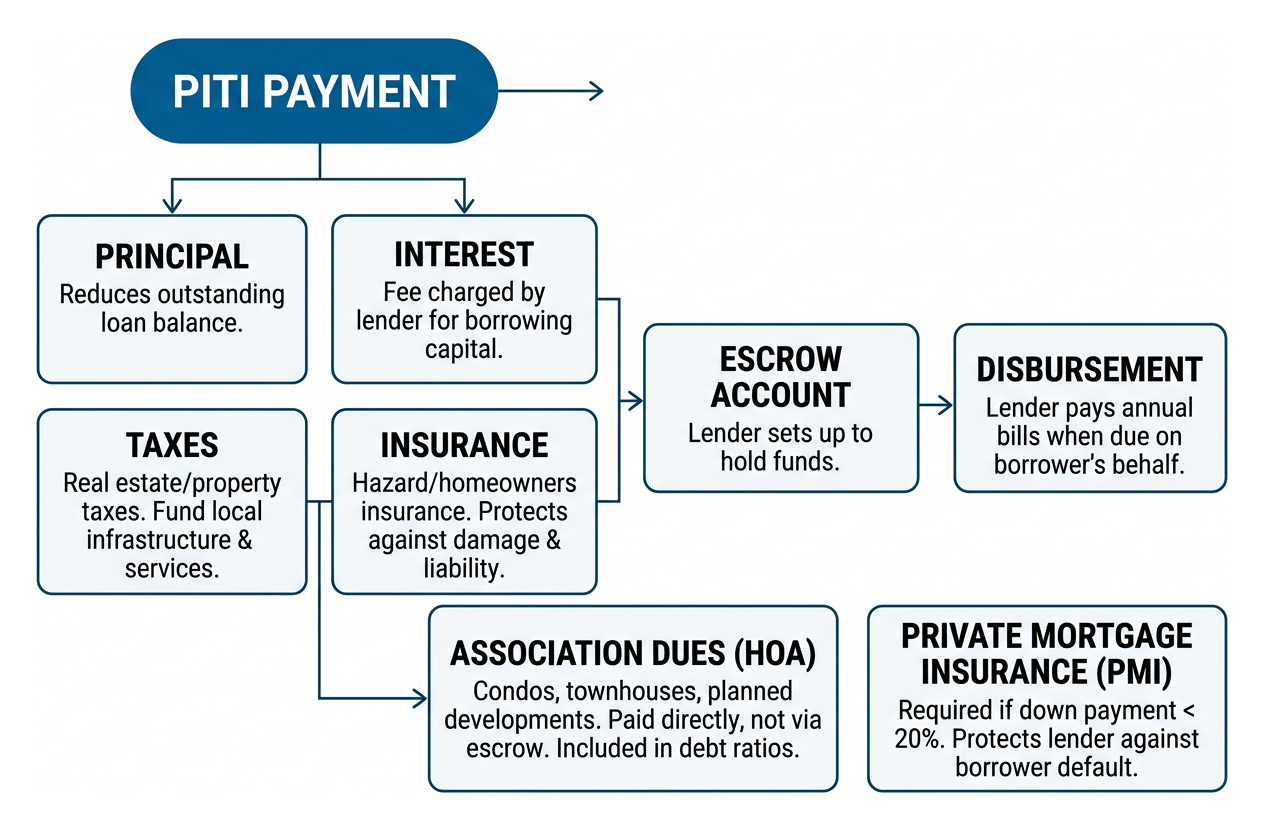
When you secure a mortgage, your lender typically sets up an escrow account. Each month, you pay 1/12th of your estimated annual property taxes and homeowners insurance along with your principal and interest. We hold these funds in escrow and disburse the payments on your behalf when local bills come due. Additionally, if you buy a condominium, townhouse, or property within a planned unit development, you may need to account for Homeowners Association (HOA) dues. While HOA fees are generally paid directly to the association rather than through escrow, lenders still include them when evaluating your total debt ratios.
Managing Private Mortgage Insurance (PMI) and Down Payment Rules
If you put down less than 20% on a conventional loan, lenders require Private Mortgage Insurance (PMI). This coverage protects the lender against loss if a borrower defaults on their payments.
PMI typically costs between 0.46% and 1.50% of the original loan balance each year, depending on your credit score and down payment percentage. For instance, on a $320,000 loan balance, an annual PMI rate of 0.75% translates to $2,400 per year, adding $200 directly to your monthly payment.
Fortunately, conventional PMI is not permanent. Under the federal Homeowners Protection Act of 1998, you have clear paths to eliminate this expense:
- Borrower-Requested Cancellation: You can submit a written request to cancel PMI once your principal balance reaches 80% of the home’s original appraised value, provided you have a good payment history.
- Automatic Termination: Your servicer must automatically terminate PMI once your loan balance is scheduled to reach 78% of the original property value, as long as your payments are current.
- Reappraisal for Equity Gains: If home values in your neighborhood rise substantially or you make major home renovations, you can pay for a new appraisal to verify that your loan-to-value (LTV) ratio has dropped below 80%, allowing for early PMI removal.
Loan Terms, Amortization, and Total Interest Costs
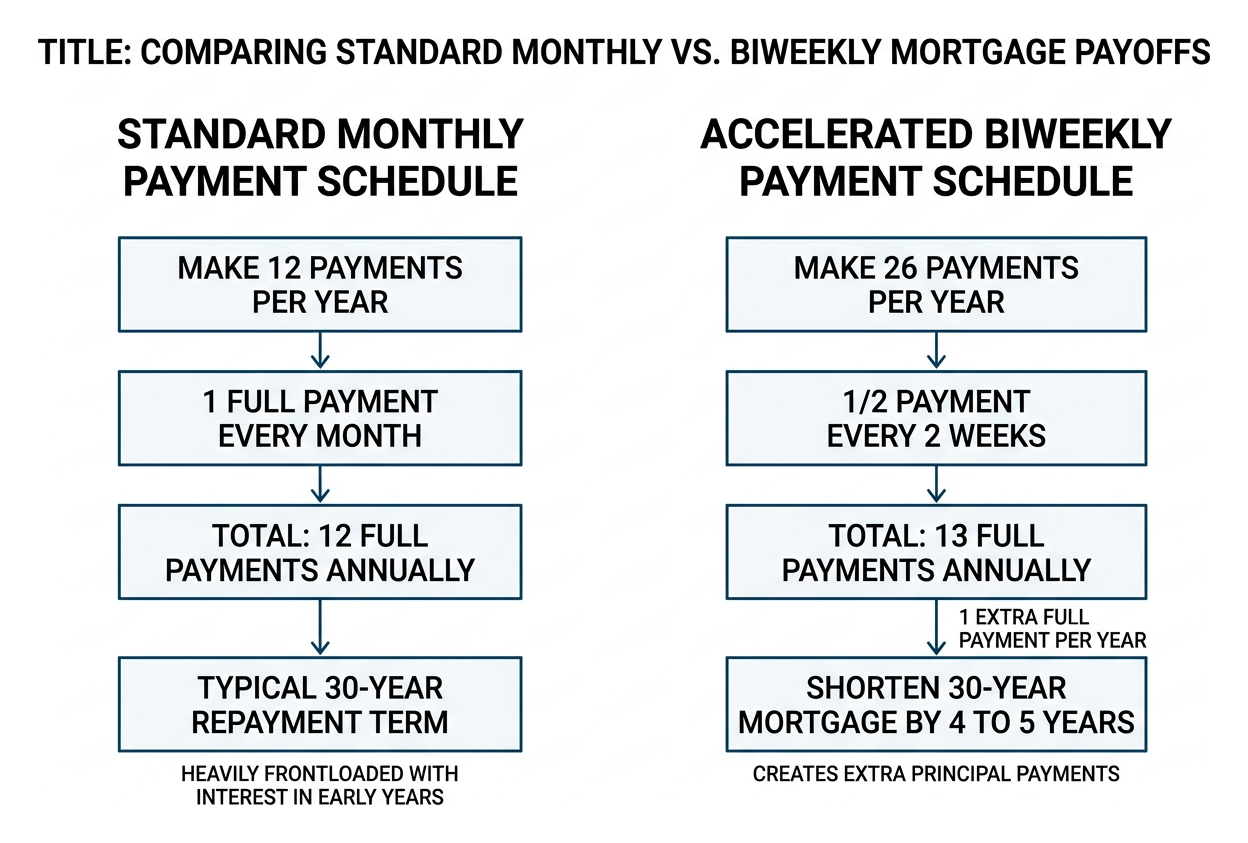
When you examine an amortization schedule, you will notice that loan repayment is heavily frontloaded with interest. In the early years of a 30-year mortgage, the vast majority of every monthly payment goes toward interest charges, while only a small slice chips away at the principal. As your balance declines over time, that ratio gradually flips, accelerating your home equity growth in the second half of the term.
Using a Home Mortgage Rate Calculator to Compare 15-Year vs. 30-Year Loans
Choosing between a 15-year and a 30-year mortgage requires balancing monthly cash flow flexibility against long-term interest savings. While a 30-year fixed-rate mortgage accounts for roughly 70% to 90% of all residential home loans due to its accessible monthly payments, a 15-year loan dramatically reduces the total cost of ownership.
Consider a comparison for a $320,000 loan balance across both term structures:
| Loan Option | Interest Rate | Monthly Principal & Interest | Total Interest Paid Over Loan Term | Total Lifetime Cost |
|---|---|---|---|---|
| 30-Year Fixed | 6.80% | $2,086.11 | $431,000.73 | $751,000.73 |
| 15-Year Fixed | 6.15% | $2,725.59 | $170,606.31 | $490,606.31 |
| Difference | -0.65% | +$639.48 / mo | -$260,394.42 | -$260,394.42 |
Choosing the 15-year term requires an extra $639.48 per month, but it eliminates 15 years of debt and saves over $260,000 in pure interest.
Accelerated Payoff: Extra Payments and Biweekly Schedules
If the mandatory higher monthly payment of a 15-year loan feels too restrictive, you can create your own accelerated payoff plan on a 30-year loan without locking yourself into higher contractual payments.
- Adding Extra Principal Monthly: Adding a modest extra amount directly to your principal each month produces massive compounding savings. On a $320,000, 30-year loan at 6.80%, adding just $150 per month toward the principal shaves more than four years off your term and saves over $65,000 in lifetime interest.
- Biweekly Payment Strategy: Instead of making 12 standard monthly payments per year, you pay half of your monthly payment every two weeks. Because there are 52 weeks in a year, you end up making 26 half-payments—equal to 13 full payments annually. That single extra payment each year can shorten a 30-year mortgage by four to five years without requiring major budget adjustments.
Assessing Affordability, Credit Scores, and Current Market Rates

Understanding what a lender will approve versus what you can comfortably afford are two very different assessments. As market rates fluctuate around historical averages, testing different pricing scenarios helps protect you from taking on a mortgage that stretches your household finances too thin.
The 28/36 Rule and Determining Purchasing Power
Mortgage underwriters assess loan affordability primarily through Debt-to-Income (DTI) ratios. A classic underwriting benchmark is the 28/36 rule:
- Front-End Ratio (28%): Your total monthly housing expenses (PITI + HOA) should not exceed 28% of your gross pre-tax monthly income.
- Back-End Ratio (36%): Your total monthly debt obligations (housing costs plus student loans, auto loans, minimum credit card payments, and personal loans) should not exceed 36% of your gross monthly income.
For example, if your household earns an annual gross income of $100,000, your monthly gross income is $8,333:
- Maximum Housing Budget (28%): $8,333 × 0.28 = $2,333 per month
- Maximum Total Debt Budget (36%): $8,333 × 0.36 = $3,000 per month
If your existing monthly consumer debts equal $500, your allowable housing payment under the back-end cap would be $2,500 ($3,000 − $500). Underwriters use the lower of the two limits to determine your baseline eligibility. While select loan programs allow higher DTI caps (often up to 43%–50% with compensating factors), staying close to the 28/36 standard leaves healthy breathing room for unexpected expenses, retirement contributions, and lifestyle spending.
How Credit Scores and Closing Costs Impact Your Final Payment
Your credit score directly dictates the interest rate tier you qualify for. Lenders price loans using risk-based adjustments, meaning higher credit scores receive lower base interest rates and cheaper private mortgage insurance premiums.
- 760+ FICO: Prime pricing tier with the lowest available interest rates and minimal PMI premiums.
- 700–759 FICO: Highly competitive rates, slightly higher PMI multipliers.
- 640–699 FICO: Moderate adjustments; borrowing costs increase, making government-backed options like FHA loans worth evaluating.
- 580–639 FICO: Higher interest rate tiers; conventional financing becomes costlier, often directing borrowers to FHA programs.
Beyond your monthly rate, buyers must budget for closing costs, which typically range between 2% and 5% of the total loan amount. These fees cover loan origination, third-party appraisals, title search and insurance policies, prepaid escrow reserves, and municipal transfer taxes. Exploring online mortgage calculator resources helps you estimate upfront closing outlays alongside your recurring payments so you aren’t surprised at the closing table.
Loan Types and Specialized Financing Options
Choosing the right loan structure is just as critical as finding the right property. Different mortgage programs cater to distinct credit profiles, property types, and down payment capabilities.

Comparing Government-Backed and Conventional Mortgages
- Conventional Loans: These loans adhere to standards set by Fannie Mae and Freddie Mac. They allow down payments as low as 3% for first-time buyers (or 5% for repeat buyers) with credit scores starting at 620. Once you reach 20% equity, you pay no mortgage insurance.
- FHA Loans: Insured by the Federal Housing Administration, these programs are ideal for borrowers rebuilding credit or managing higher debt ratios. FHA loans permit down payments of 3.5% with a credit score of 580 or higher. However, they require both an Upfront Mortgage Insurance Premium (UFMIP) of 1.75% and an annual Mortgage Insurance Premium (MIP) that typically lasts for the entire loan term if you put down less than 10%.
- VA Loans: Guaranteed by the Department of Veterans Affairs, these loans provide unmatched benefits to active-duty military personnel, veterans, and eligible surviving spouses. VA loans offer 100% financing (zero down payment required), no monthly private mortgage insurance, and competitive interest rates, offset only by a one-time VA funding fee (which can be rolled into the loan or waived for service-connected disabilities).
- USDA Loans: Backed by the U.S. Department of Agriculture, USDA loans support suburban and rural homebuyers meeting specific household income limits. They offer 100% financing with low annual guarantee fees, making homeownership accessible in designated rural zones.
- Jumbo Mortgages: When a loan amount exceeds local conforming loan limits, it falls into non-conforming jumbo territory. These loans generally require larger down payments (typically 10% to 20%), higher credit scores (often 700+), and substantial cash reserves.
Alternative Financing, Refinancing, and Niche Loan Products
Depending on your financial goals and property type, specialized financing options can provide distinct advantages:
- Rate-and-Term Refinance: Allows you to lower your interest rate, change your term length (such as moving from 30 years to 15 years), or eliminate costly mortgage insurance once you build sufficient equity.
- Cash-Out Refinance vs. HELOC: If you want to tap into your accrued home equity, a cash-out refinance replaces your existing first mortgage with a larger balance. Alternatively, a Home Equity Line of Credit (HELOC) acts as a second mortgage, giving you a revolving credit line without resetting the low fixed interest rate on your primary mortgage.
- Assumable Mortgages: Approximately 23% of active residential mortgages (mostly FHA and VA loans) are assumable. This allows a qualified buyer to take over the seller’s existing mortgage balance and locked-in interest rate, which can yield massive monthly savings in higher-rate environments.
- Manufactured Home Lending: If you are purchasing a manufactured home located on leased land or in a dedicated community, standard residential mortgages do not apply. In these scenarios, exploring manufactured home chattel financing provides dedicated personal property loan structures tailored to non-real-estate property titles.
Frequently Asked Questions About Mortgage Calculations
How does a 1% change in interest rates affect my monthly payment?
A 1% increase or decrease in your mortgage interest rate significantly shifts your purchasing power. On a $400,000 loan balance:
- At 6.0%, your monthly principal and interest payment is $2,398.20.
- At 7.0%, your monthly principal and interest payment increases to $2,661.21.
That single percentage point costs an extra $263.01 per month, which adds up to over $94,680 in additional interest over a 30-year term. To keep the exact same monthly payment after a 1% rate hike, you would need to reduce your home purchase budget by roughly $35,000 to $40,000.
Can a mortgage calculator account for property tax and insurance increases?
Standard mortgage tools calculate payments using static current numbers, but your real-world housing costs will change over time. Local tax assessors re-evaluate property values periodically, and insurance carriers adjust annual premiums to match replacement construction costs.
When property taxes or hazard insurance premiums rise, your loan servicer will adjust your monthly escrow payment to cover the shortfall. To ensure long-term affordability, it is wise to leave a 5% to 10% buffer in your housing budget to absorb future escrow increases.
When does refinancing make financial sense compared to a HELOC?
Refinancing your primary mortgage makes sense if you can lower your interest rate enough to recoup all associated closing costs within your expected stay in the property (known as your break-even point).
For example, if refinancing costs $4,000 in closing fees and saves you $200 per month, your break-even period is 20 months ($4,000 ÷ $200). If you plan to stay in the home longer than two years, refinancing delivers net savings.
However, if your goal is simply to pull out equity for home renovations or debt consolidation while you already hold an exceptionally low first-mortgage rate, a HELOC or standalone home equity loan is often the smarter move because it preserves your primary rate.
Conclusion
Calculating your true monthly housing payment is the foundation of a successful, stress-free home purchase. By looking beyond simple principal and interest figures and accounting for property taxes, hazard insurance, PMI, and loan structure details, you can enter the housing market with total financial confidence.
At Capital Home Mortgage, we are a direct, full-service mortgage lender offering a complete suite of loan solutions—including purchase, refinance, construction, renovation, FHA, VA, USDA, jumbo, and reverse mortgages. Because we handle our processing and underwriting in-house, we provide direct communication, fast approvals, on-time closings, and personalized support tailored to your unique financial situation.
Ready to see how the numbers line up for your next purchase or refinance? You can estimate payments with Capital Home Mortgage calculator or reach out directly to one of our dedicated loan officers today to secure your custom rate quote.


