
Calculate Your Full Monthly Mortgage Payment Fast
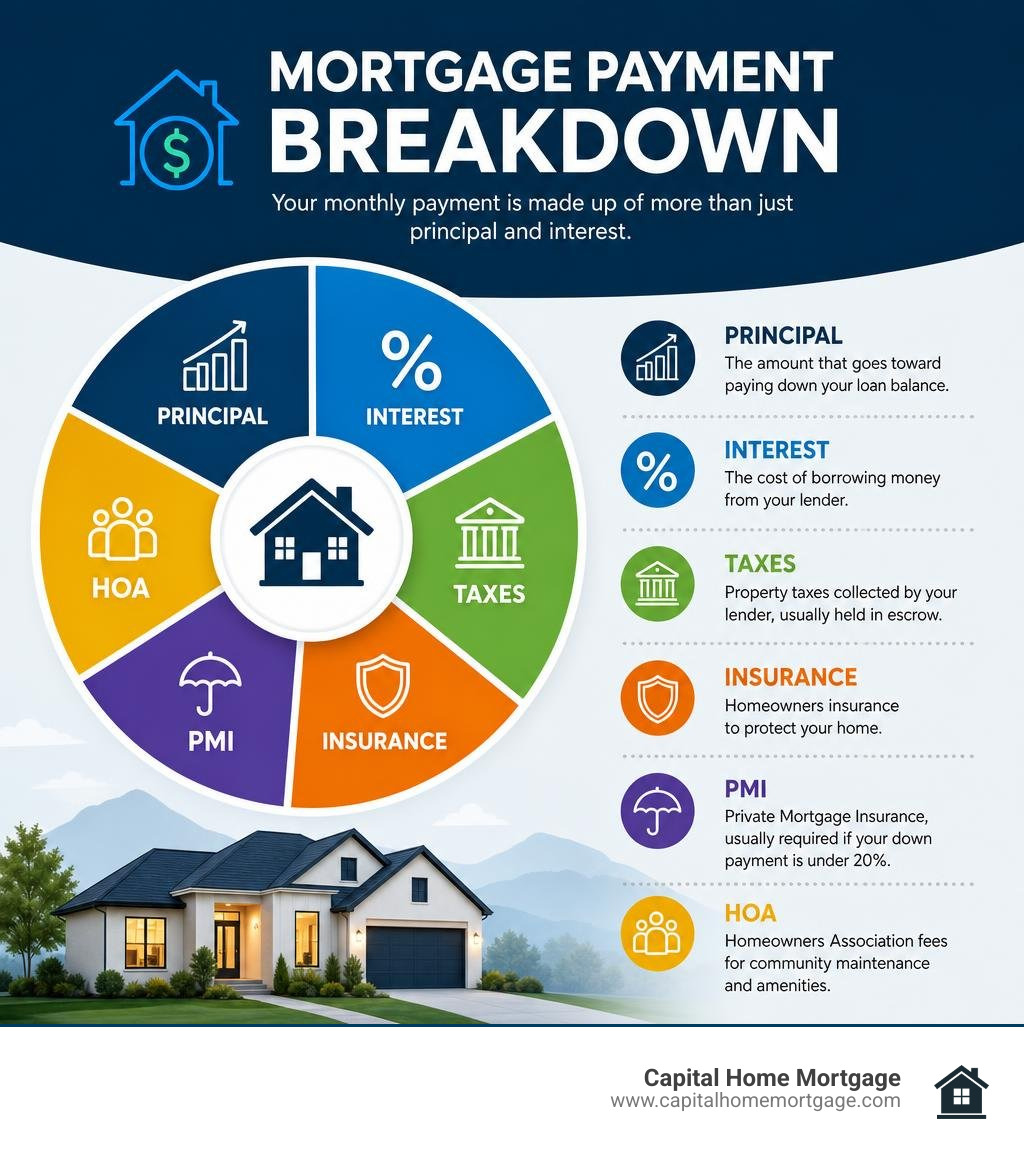
A mortgage calculator gives you a fast estimate of what a home may cost each month. Enter the home price, down payment, interest rate, and loan term. Then add property taxes, homeowners insurance, PMI if required, and HOA dues to see a more realistic monthly budget.
For a complete estimate, include:
- Principal and interest – The loan repayment itself.
- Property taxes and homeowners insurance – Often paid through escrow.
- PMI – Usually required on conventional loans when your down payment is under 20%.
- HOA fees – A separate monthly cost for homes in managed communities.
For example, a $400,000 home with a 20% down payment means an $80,000 upfront investment and a $320,000 loan. At 6.71% on a 30-year term, principal and interest alone would be about $2,067 per month. Taxes, insurance, and other ownership costs can raise the true monthly amount substantially.
I am Dale Gremillion, a manager at Capital Home Mortgage with more than 26 years of experience helping borrowers navigate purchase and refinance loans. I use mortgage calculator scenarios to help buyers compare payments, loan programs, and costs before they make a major decision.
How an Online Mortgage Calculator Estimates Monthly Housing Payments
When browsing real estate listings, it is easy to get caught up in the sticker price of a property. However, what truly determines whether a property fits comfortably into your family’s lifestyle is the actual monthly cash outflow. An online tool estimating monthly payments translates large, abstract purchase numbers into predictable, monthly debt service figures.
A quality digital calculator does far more than divide the loan balance by 360 months. It models the complex math of compound interest, applies the loan-to-value (LTV) ratio to evaluate mortgage insurance triggers, and projects complete amortization schedules across decades of homeownership.
How to Input Loan Variables into a Mortgage Calculator
To generate an accurate calculation, you need to plug in a few foundational metrics:
- Home Purchase Price: The agreed-upon or target sales price of the real estate.
- Down Payment Amount or Percentage: The initial cash equity you contribute upfront. Putting down 20% eliminates private mortgage insurance (PMI) on conventional financing, while lower amounts alter your required reserves.
- Interest Rate: The baseline annual borrowing rate quoted by your lender.
- Loan Term: The duration of the repayment schedule, most commonly structured as 15 or 30 years.
- Ancillary Escrow Costs: Local real estate taxes, hazard insurance, flood coverage, and homeowner association (HOA) dues.

The Standard Amortization Formula Behind the Calculations
The core engine driving any reliable mortgage calculation is the standard fixed-rate amortization formula:
$$M = P \times \frac{r(1+r)^n}{(1+r)^n – 1}$$
Where:
- M = Total monthly principal and interest payment
- P = Initial loan principal balance
- r = Monthly interest rate (annual interest rate divided by 12 months)
- n = Total number of monthly payments across the term (e.g., 360 for a 30-year loan)
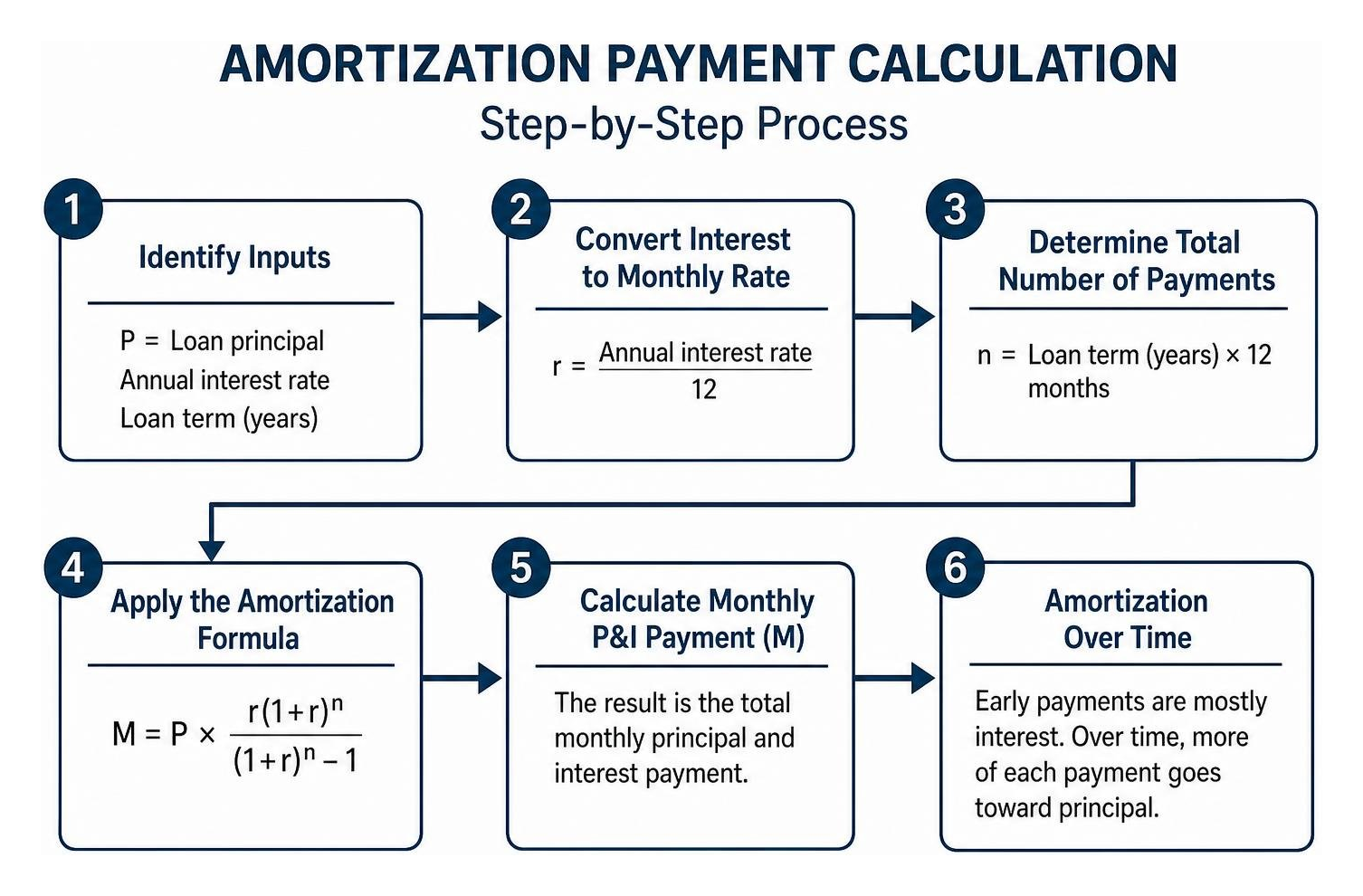
Because of the way this mathematical formula distributes risk, fixed-rate mortgage payments are heavily front-loaded with interest. In month 1 of a 30-year loan, the vast majority of your check covers the lender’s interest charge, with only a modest slice chipping away at the actual loan balance. As the principal diminishes over the years, the interest calculation shrinks, allowing progressively larger portions of your monthly payment to build direct home equity.
Core Components of a Complete PITI Payment
Looking solely at principal and interest (P&I) gives an incomplete picture of housing costs. P&I typically represents only 60% to 70% of what a homeowner actually pays each month. Lenders structure payments around the PITI framework: Principal, Interest, Taxes, and Insurance.
| Expense Category | $400,000 Home (5% Down / $380k Loan) | $400,000 Home (10% Down / $360k Loan) | $400,000 Home (20% Down / $320k Loan) |
|---|---|---|---|
| Down Payment | $20,000.00 | $40,000.00 | $80,000.00 |
| Monthly Principal & Interest (6.71%) | $2,454.58 | $2,325.39 | $2,067.01 |
| Monthly Property Taxes (Est. 1.1%) | $366.67 | $366.67 | $366.67 |
| Monthly Homeowners Insurance | $125.00 | $125.00 | $125.00 |
| Estimated Monthly PMI | $221.67 | $150.00 | $0.00 |
| Total Monthly Escrow & P&I Payment | $3,167.92 | $2,967.06 | $2,558.68 |
Principal and Interest Breakdown
Principal represents the original borrowed balance being repaid to the lender. Interest represents the fee charged by the capital provider for borrowing funds over time. On a $320,000 loan balance financed at 6.71% over 30 years starting in August 2026, your baseline monthly principal and interest payment sits at exactly $2,067.01. Over the life of that 360-month loan, the cumulative principal and interest payments total $744,124.54—which includes $424,124.54 in total lifetime interest charges until the final payoff in August 2056.
Property Taxes and Homeowners Insurance
Across the United States, municipal and county governments levy property taxes to fund local infrastructure, emergency services, and school systems. On average, Americans pay approximately 1.1% of their property’s assessed market value annually in property taxes, though this varies significantly by region. When checking competitive Texas mortgage rates, for example, local property tax assessments often run higher than the national baseline.
Homeowners insurance (hazard insurance) protects the collateral against hazards like fires, storms, and structural damage. Typical hazard policies average between $1,200 and $2,000 annually. Lenders collect one-twelfth of these combined annual tax and insurance bills alongside your monthly loan payment, depositing the funds into an escrow account to disburse payments directly when municipal bills come due.
Private Mortgage Insurance (PMI) and HOA Dues
If you secure a conventional mortgage with less than a 20% down payment, lenders require Private Mortgage Insurance to safeguard against default. Annual PMI costs generally range from 0.3% to 1.9% of the loan amount, depending on your credit tier and down payment size.
Under the federal Homeowners Protection Act, you have the legal right to request PMI removal once your loan principal reaches an 80% loan-to-value ratio based on the original purchase price, and lenders must automatically cancel PMI coverage once your balance reaches 78% LTV.
If you purchase a condominium, townhouse, or single-family residence within a planned development, you may also be subject to Homeowners Association (HOA) dues. These monthly or quarterly dues fund neighborhood amenities, landscaping, and exterior maintenance.

Comparing Loan Terms, Interest Rates, and Repayment Strategies
Choosing the right mortgage structure involves balancing monthly cash flow needs with long-term interest costs. By exploring Texas mortgage calculators, you can see how different terms, rates, and repayment strategies alter your financial obligations over time.
Using a Mortgage Calculator to Compare 15-Year vs. 30-Year Terms
The conventional 30-year fixed-rate mortgage remains the most common home loan structure in the U.S., accounting for 70% to 90% of all residential originations. It provides the lowest mandatory monthly payment by stretching repayment over 360 months.
A 15-year fixed-rate mortgage carries a significantly compressed repayment window. While the monthly payments are higher, 15-year loans typically offer lower interest rates (often 0.50% to 0.75% below 30-year notes) and cut lifetime interest charges by more than half.
- 30-Year Loan on $320,000 at 6.71%: Monthly P&I is $2,067.01, with $424,124.54 in total lifetime interest.
- 15-Year Loan on $320,000 at 6.00%: Monthly P&I is $2,700.34, with $166,061.34 in total lifetime interest.
Choosing a 15-year term saves over $258,000 in interest and builds home equity twice as fast, but requires an additional $633 per month in cash flow.
Extra Principal Payments and Bi-Weekly Schedules
You do not need to commit to a 15-year note to achieve early loan payoff. Adding extra payments directly toward your loan principal accelerates your amortization schedule. Using a tool to model extra mortgage payments shows how even modest extra contributions compound over time.
One popular approach is the bi-weekly payment schedule:
- Instead of making one full monthly payment, you pay half your regular monthly payment every two weeks.
- Because there are 52 weeks in a calendar year, you make 26 half-payments.
- This equals 13 full monthly payments annually—painlessly applying one extra full payment to principal each year and shaving 4 to 6 years off a standard 30-year amortization schedule.
Conventional, FHA, VA, USDA, and Assumable Mortgages
Different mortgage programs suit different financial profiles:
- Conventional Loans: Ideal for borrowers with solid credit scores (620+) and down payments ranging from 3% to 20%+.
- FHA Loans: Backed by the Federal Housing Administration, these require as little as 3.5% down for credit scores of 580 and above, offering flexible underwriting for first-time buyers.
- VA Loans: Guaranteed by the Department of Veterans Affairs, offering 0% down payment financing and no ongoing monthly mortgage insurance for qualified military service members and veterans.
- USDA Loans: Backed by the U.S. Department of Agriculture, providing 0% down financing for eligible suburban and rural homebuyers meeting local income limits.
Reviewing current Arizona mortgage rates helps buyers compare these loan types side by side.
Another option in the current housing market is an assumable mortgage. Roughly 12.2 million active residential mortgages (approximately 23% of all active U.S. home loans) feature assumable clauses, most notably government-backed FHA and VA loans. An assumption allows a qualified homebuyer to take over the seller’s existing mortgage terms, including its original interest rate, remaining balance, and repayment schedule.
Over 6,000 assumptions were completed in 2023. These transactions typically take 45 to 90 days to close, but can secure a below-market borrowing rate if the seller locked in financing during lower-rate cycles.
Beyond the Mortgage: Recurring and Non-Recurring Homeownership Costs
Securing a mortgage is only one part of the homeownership equation. A realistic budget must account for both one-time transactional fees and long-term property upkeep.
Upfront Closing Costs and Lender Fees
Non-recurring closing costs represent the collection of administrative, legal, and financing fees required to finalize a real estate transaction. On a standard $400,000 purchase, closing costs commonly total around $10,000. These fees typically include:
- Lender origination, underwriting, and processing charges
- Third-party real estate appraisal and physical home inspection fees
- Title search and lender/owner title insurance policies
- Prepaid escrow deposits for initial property tax and insurance reserves
- Government recording fees and transfer taxes
When budgeting upfront capital, state-specific tools like our Arizona mortgage calculators help estimate the total cash needed to close beyond just your baseline down payment.
Ongoing Repairs and Annual Cost Inflation
Beyond the monthly mortgage statement, recurring home upkeep requires dedicated budgeting. A reliable rule of thumb is to budget at least 1% of the property’s total value annually for maintenance and repairs. For a $400,000 home, that means setting aside roughly $4,000 per year ($333 per month) for routine maintenance, appliance servicing, and major mechanical repairs like roof replacements or HVAC servicing.
Escrow expenses also tend to increase over time. Local property taxes often adjust upward following municipal reassessments, and insurance premiums can rise based on regional risk factors. Modeling modest annual cost inflation into your long-term calculations ensures your housing budget remains realistic for years to come.
Frequently Asked Questions About Home Loans
When can you remove private mortgage insurance from a conventional loan?
Under the Homeowners Protection Act, you can submit a written request to cancel PMI once your principal balance drops to 80% of the home’s original value. Your lender is legally required to cancel PMI automatically once your loan reaches 78% of the original purchase value, provided your mortgage payments are current.
What is an assumable mortgage and how does it save money?
An assumable mortgage allows a buyer to take over the seller’s current loan terms, including its remaining principal balance, monthly payment structure, and locked-in interest rate. This option is common on FHA and VA loans. It can save buyers thousands of dollars in interest, though the assumption process typically takes 45 to 90 days to close and requires covering the equity gap between the purchase price and the remaining loan balance.
How much down payment is required for first-time buyers?
Down payment requirements vary by loan program. Conventional loans offer options as low as 3% down for eligible first-time buyers. FHA loans require 3.5% down for credit scores of 580+, while VA and USDA loans offer 0% down payment options for eligible applicants. Putting down 20% or more allows conventional borrowers to avoid monthly private mortgage insurance entirely.
Conclusion
Calculating your monthly mortgage payment gives you the clarity you need to shop for a home with confidence. By looking beyond baseline principal and interest to include property taxes, insurance, PMI, and HOA fees, you can build a budget that protects your long-term financial health.
At Capital Home Mortgage, we are a direct, full-service mortgage lender offering purchase, refinance, construction, renovation, FHA, VA, USDA, jumbo, and reverse loans. Because we manage processing and underwriting in-house, we provide quick approvals, on-time closings, and dedicated loan-officer guidance every step of the way.
Run your numbers using our dedicated Mortgage Calculator to explore different down payment scenarios, loan terms, and interest rates, and take the first step toward financing your home today.


