How Chattel Mobile Home Financing Helps You Buy a Home
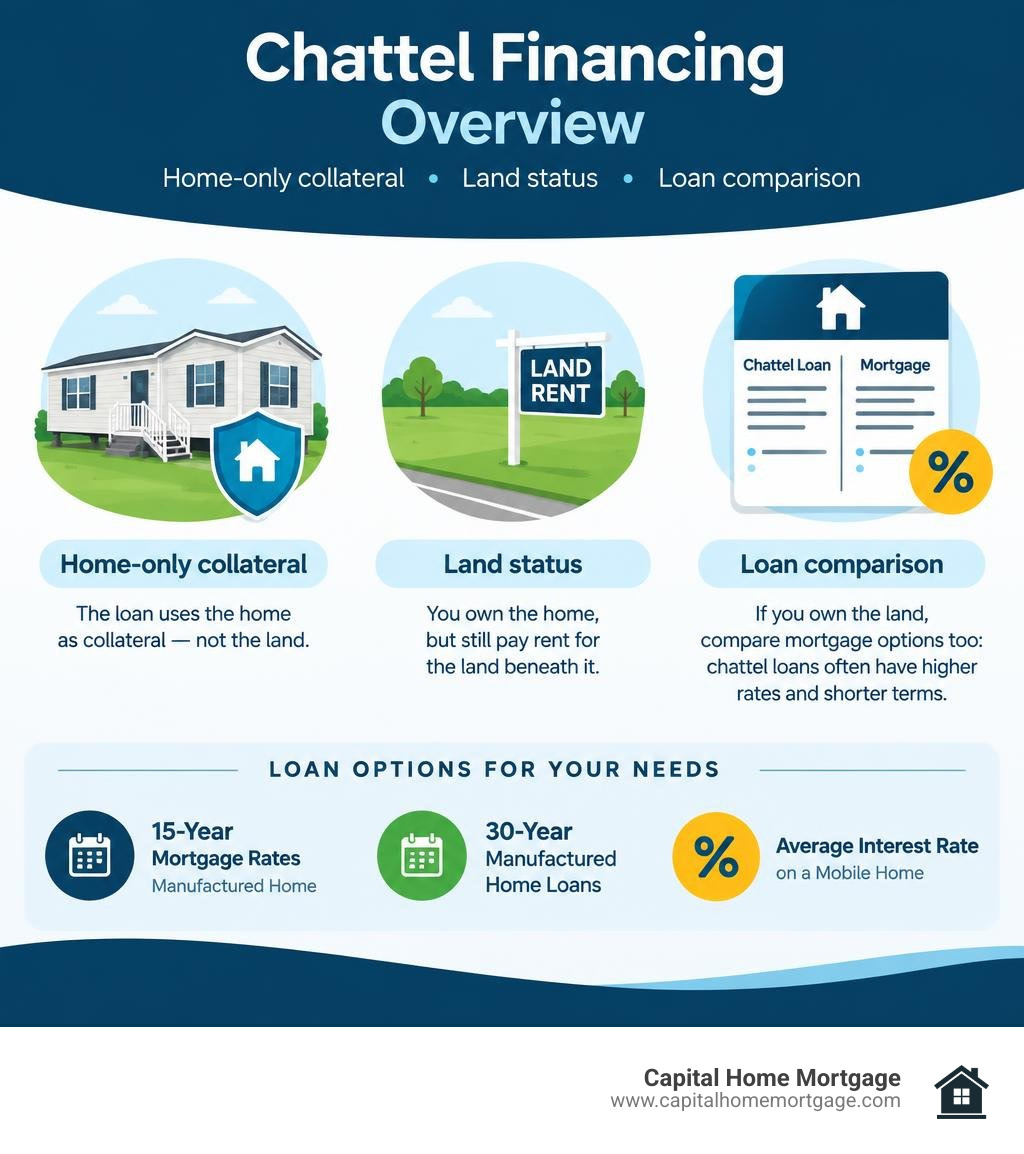
Chattel mobile home financing lets you borrow against the home without using the land as collateral. It can help you buy a manufactured home on a rented lot, where a traditional mortgage may not fit. You own the home and repay the loan, but you still pay rent for the land beneath it.
Before choosing a loan, check whether the home and land are titled together. If you own the land, compare mortgage options too: chattel loans often have higher interest rates and shorter terms.
I’m Dale Gremillion, a manager at Capital Home Mortgage with more than 26 years of experience in mortgage lending operations. I bring that background to this guide to chattel mobile home financing, starting with how the loan works.
Chattel mobile home financing vocabulary:
- 15 year mortgage rates manufactured home
- 30 year manufactured home loans
- average interest rate on a mobile home
What Is Chattel Mobile Home Financing and How Does It Work?

When people hear the word “chattel,” they often wonder if it is an ancient legal term. In simple language, chattel means movable personal property—think of it as personal belongings rather than fixed real estate. When applied to housing, a chattel loan is an agreement where you borrow money to purchase a manufactured or mobile home, using the physical structure itself as the collateral.
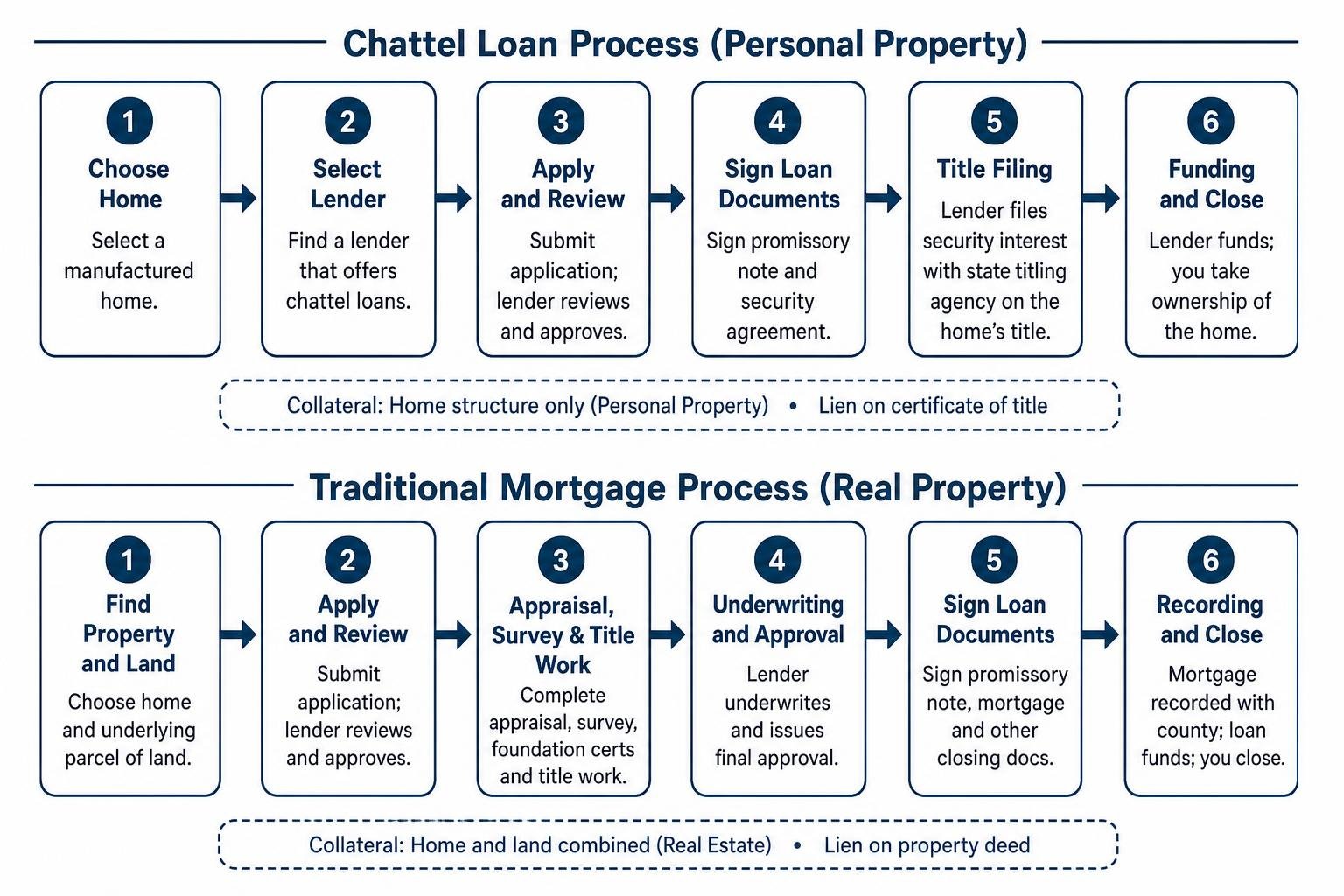
Federal data compiled in the Manufactured Housing Finance: New Insights from the Home Mortgage Disclosure Act Data report shows that approximately 42% of all manufactured home purchase originations are chattel loans. Unlike a traditional mortgage that places a lien on real estate (both the ground and the building attached to it), a chattel loan uses a security agreement to place a lien strictly on the home’s certificate of title.
All manufactured homes built after June 15, 1976, must meet structural, fire safety, and energy efficiency standards established by the Department of Housing and Urban Development (HUD). When you finance a HUD-code home with a chattel mortgage, your lender files a security interest with the appropriate state titling agency (such as a Department of Motor Vehicles or a state housing division), keeping a personal property lien on the structure until the balance is paid in full.
Personal Property vs. Real Estate Collateral
Understanding the legal distinction between personal property and real estate is critical when exploring options for mobile homes in parks.
- Personal Property: When a manufactured home sits inside a land-lease community, mobile home park, or family-owned parcel without a permanent foundation that is legally retired to the land deed, the structure remains titled as personal property. In this setup, you pay monthly lot rent to the park owner for the ground beneath your home while holding a separate title for the home itself.
- Real Property: When you own the underlying parcel of land and legally affix the manufactured home to a permanent foundation system, you can “retire” the vehicle title. The home merges with the land deed, turning the entire property into real estate eligible for conventional or government-backed mortgages.
If you are buying inside a park or on leased acreage, a chattel loan is often the standard financing pathway because the land cannot be pledged to secure the loan.
Key Differences Between Chattel Loans and Traditional Mortgages
Choosing between personal property financing and standard real estate loans impacts your speed, costs, and long-term flexibility. Reviewing 30-year manufactured home financing options shows how different these products can be:
| Feature | Chattel Mobile Home Loan | Traditional Real Property Mortgage |
|---|---|---|
| Collateral Used | Home structure only (Personal Property) | Home and land combined (Real Estate) |
| Average Repayment Term | Shorter (median length of 23 years) | Longer (typically 15 to 30 years) |
| Typical Interest Rates | Higher (median rate of 8.6%) | Lower (median around 4.1% to 4.9%) |
| Closing Process Speed | Often faster (fewer land appraisals/surveys) | Standard (requires title work, surveys, foundation certs) |
| Upfront Processing Fees | Generally lower upfront closing costs | Higher standard closing fees and escrow charges |
| Consumer Protections | Governed by personal property / UCC rules | Protected by RESPA and standard foreclosure statutes |
Financial Costs, Rates, and Terms of Chattel Loans
Because a chattel loan finances only the home and carries higher risk for lenders, the underlying numbers differ significantly from standard mortgages. As of November 2026, market data illustrates major pricing spreads between movable property loans and real estate financing.
Nationwide lending data reveals that the median loan amount for a chattel loan on a manufactured home is $58,672. By comparison, manufactured home mortgages that include land have a median amount of $127,056, while site-built single-family mortgages carry a median size of $236,624. Because chattel loan sizes are smaller and lack land collateral, lenders price them accordingly.
Understanding Interest Rates, HPML Classifications, and Fees
The interest rate spread between loan types is one of the most significant financial factors. Research shows that chattel loans have a median interest rate of 8.6%, compared to 4.9% for manufactured home mortgages and 4.1% for site-built home mortgages.
Due to these elevated rate spreads, an overwhelming 93.8% of chattel loans are classified as Higher-Priced Mortgage Loans (HPMLs). In comparison, only 52.4% of land-and-home manufactured mortgages and 11.1% of site-built mortgages trigger the HPML threshold. Some high-rate chattel loans even trigger Home Ownership and Equity Protection Act (HOEPA) protections, which require strict lender disclosures and restrict balloon payments or excessive upfront points.
While interest rates are higher, chattel loans frequently feature lower upfront processing fees and closing costs because you do not have to pay for land surveys, title insurance policies for real estate, or complex plot recordings.
Comparing Loan Terms and Down Payment Requirements
Repayment periods for personal property financing are notably compressed. Chattel loans carry a median term of 23 years, whereas traditional manufactured home mortgages and site-built loans run for 30 years.
Down payments for chattel financing usually range from 5% to 20%, depending on your credit score, household debt-to-income (DTI) ratio, and the age of the structure. When preparing for an acquisition, evaluating manufactured home down payment costs helps determine how much liquid cash you will need at closing versus financing over the life of the loan.
Pros and Cons of Securing Chattel Financing for a Mobile Home

Before committing to chattel financing, weigh the immediate logistical benefits against the lifetime borrowing expenses.
Major Benefits of Chattel Mobile Home Financing
- Faster Underwriting and Closings: Without the need for real estate title searches, ground environmental tests, or land surveys, chattel loans can often be underwritten and funded in a shorter timeframe.
- Independence from Land Ownership: You can purchase a home in a leased-land park, a retirement subdivision, or family land without needing to purchase the real estate beneath it.
- Unencumbered Land Title: If you already own private land, taking out a chattel loan keeps your land free and clear. If you ever experience financial turbulence, your ground cannot be foreclosed on by the chattel lender.
- Lower Upfront Closing Expenses: You save money on property-related settlement charges, deed transfer taxes, and full-scale real estate title insurance policies.
Risks, Repossession, and Consumer Protection Drawbacks
- Higher Total Borrowing Costs: The elevated interest rates on chattel loans mean you pay significantly more interest per dollar borrowed.
- Weaker Consumer Protections: Traditional mortgages are governed by the Real Estate Settlement Procedures Act (RESPA) and standard judicial or statutory foreclosure timelines. Chattel loans, by contrast, are governed by personal property statutes and the Uniform Commercial Code (UCC). In many jurisdictions, repossession of a personal property home can happen much faster than a traditional real estate foreclosure.
- Difficult Refinance Pathways: Less than 4% of chattel originations are for refinances, compared to 31% of manufactured home mortgages and 44% of site-built mortgages. Finding lenders to refinance an existing chattel note down the road can be challenging.
- Stricter Application Approval Rates: HMDA data indicates that only 27% of manufactured home loan applications result in a funded loan, compared to 74% for site-built residential applications.
Who Uses Chattel Loans and Why Landowners Choose Them
The market for chattel loans serves a broad segment of homeowners across the country. Demographic research demonstrates that Hispanic, Black and African American, American Indian and Alaska Native, and elderly borrowers are more likely than other consumers to utilize chattel loans, even after adjusting for land ownership status.
The lending landscape is also heavily concentrated: the top five lenders originate more than 40% of all manufactured home purchase loans, and they account for nearly 75% of all chattel originations nationwide.
Land Leases, Park Communities, and FHA Title I Alternatives
For buyers in land-lease communities, 55+ mobile home parks, and suburban manufactured housing subdivisions, chattel financing is standard. However, you should also consider whether the park qualifies for government-backed programs such as the FHA Title I loan program, which offers financing for manufactured homes on leased lots with set statutory loan limits ($105,532 for single-section units and $193,719 for multi-section homes).
When shopping in competitive southern markets, studying Texas mobile home financing options and checking regional lending guidelines helps buyers navigate community lot rents, which act as an ongoing housing cost alongside your monthly loan payment.
Why Some Landowners Still Choose Chattel Mobile Home Financing
Interestingly, data shows that roughly 17% of manufactured home borrowers who directly own their land still take out a chattel loan instead of a traditional mortgage. Why would someone choose a higher-rate chattel loan when they own the ground?
- Protecting Family Land: Many landowners inherit generational property and do not want to place a mortgage lien against the land. If the home loan defaults, only the home is repossessed, leaving the acreage intact.
- Speed and Simplicity: A borrower may need immediate housing and choose to bypass months of soil perk tests, zoning clearances, and foundation retrofitting.
- Deed and Zoning Restrictions: Some rural properties have complex deed covenants or agricultural tax exemptions that could be disrupted by recording a residential real estate mortgage against the parcel.
Tax Implications and How to Choose the Right Lender
Tax Deductibility and Personal Property Depreciation
Tax treatment for a chattel-financed manufactured home depends on how you use the home:
- Primary or Secondary Residence: Under IRS rules, if your manufactured home contains sleeping, cooking, and toilet facilities, it can qualify as a primary or secondary home. Even if titled as personal property, the interest paid on the chattel loan may be deductible as qualified mortgage interest on Schedule A (Form 1040), provided you itemize your deductions.
- Local Taxes: Instead of standard real estate property taxes, you will often pay annual personal property taxes, vehicle registration fees, or state decal renewals on the home.
- Commercial or Rental Use: If you purchase the manufactured home as a rental property or business asset, you cannot claim the personal mortgage interest deduction, but you may deduct the loan interest as a business expense and depreciate the physical structure over time.
Always consult a licensed CPA or tax professional to review your specific tax situation.
Steps to Compare and Secure Chattel Loan Options
To find the right financing structure, follow this step-by-step checklist:
- Verify Home and Land Titling: Determine whether the home will sit on leased land or private acreage, and whether the title can or should be converted to real estate.
- Review Community Requirements: If you are buying in a park, verify park approval requirements, lease terms, and historical lot rent escalations.
- Check Credit and Debt Ratios: Pull your credit reports and calculate your debt-to-income ratio to ensure you meet lending thresholds.
- Compare Dedicated Programs: Review specialized manufactured housing loan programs to evaluate whether a chattel loan, FHA Title I, FHA Title II, VA loan, or conventional loan is best for your scenario.
- Shop Multiple Lenders: Compare APRs, origination charges, and early payoff penalties.
Frequently Asked Questions About Chattel Mobile Home Loans
What credit score is needed for a chattel mortgage on a mobile home?
Credit requirements vary by lender, but most chattel programs look for credit scores starting between 580 and 620. Borrowers with scores above 660 generally receive lower interest rate offers and reduced down payment requirements. Lenders also review employment stability and total debt-to-income ratios.
Can you convert a chattel loan into a traditional mortgage later?
Yes. If you own the land beneath the home (or buy the land later), you can complete a legal process called title conversion or real property affixation. This involves placing the home on an approved permanent foundation, removing the axles and hitch, surrendering the vehicle title to your state agency, and recording the home on the real estate land deed. Once completed, you can refinance your existing chattel loan into a traditional 15-year or 30-year real estate mortgage.
Why are interest rates higher on mobile home chattel loans?
Chattel loans carry higher interest rates because they are secured solely by personal property without real estate. Movable structures can depreciate faster than real estate, face higher default and repossession loss rates, and have limited secondary investment market liquidity compared to standard government-backed mortgages.
Conclusion
Chattel mobile home financing provides a viable pathway to homeownership for buyers purchasing on leased land, inside mobile home parks, or for landowners seeking to keep their property unencumbered. While chattel loans offer fast processing and flexible property requirements, their higher interest rates and shorter terms make it vital to explore all available real estate mortgage options before making your final decision.
At Capital Home Mortgage, our direct in-house processing and underwriting give you clear answers, dedicated loan officer support, and on-time closings. Whether you are financing a manufactured home on land or evaluating personal property options, we are here to help you navigate every step of the mortgage process.
Ready to explore your financing options? Explore chattel and manufactured home loan solutions with our dedicated lending team today.