Home Refinance: Compare Rates, Fees, and Real Savings
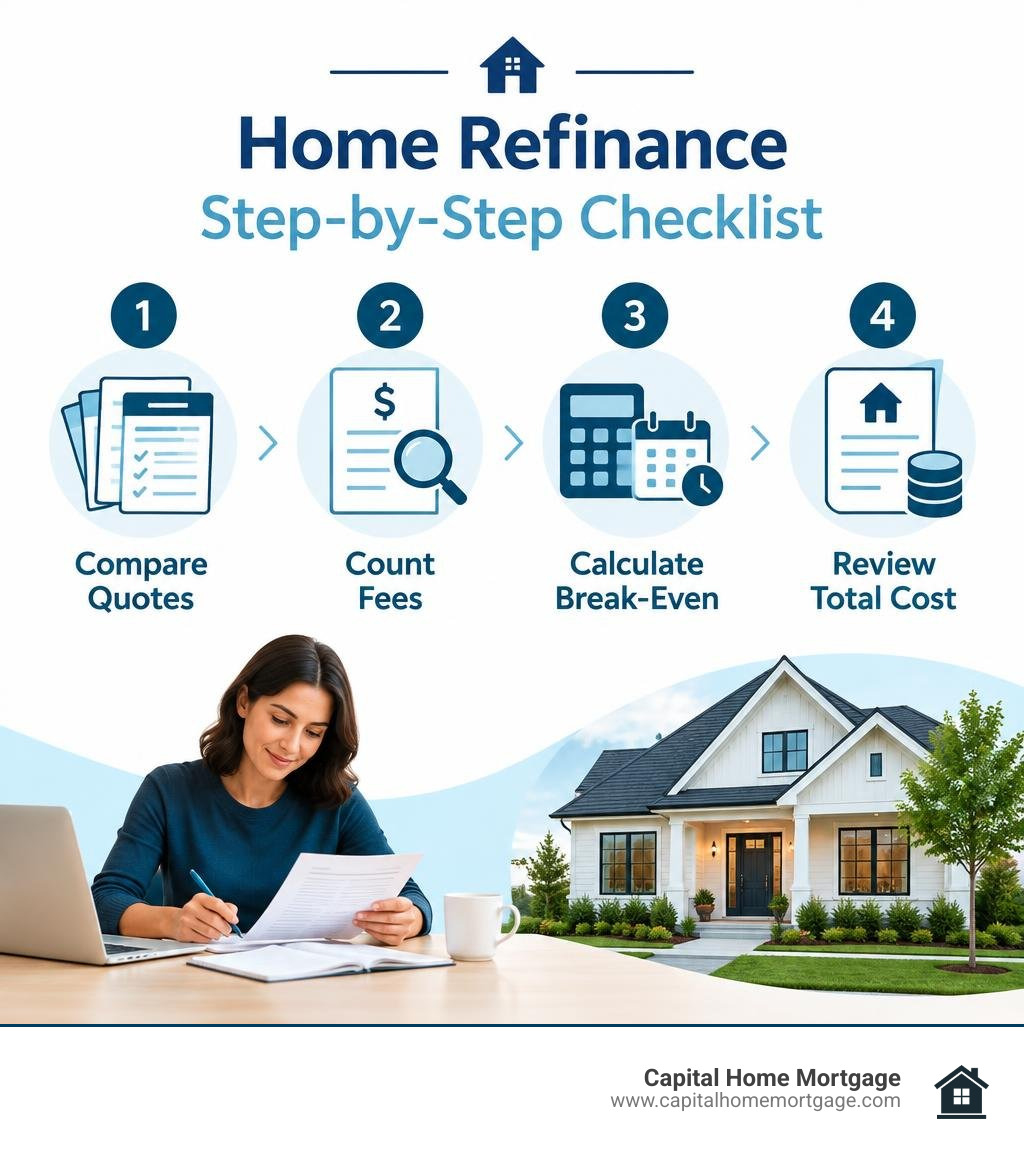
A home refinance replaces your current mortgage with a new loan. To see if it is worth it, get quotes from several lenders for the same loan type and term. Compare the monthly payment, closing costs, and total interest, not just the advertised rate. Then divide your upfront costs by your monthly savings to estimate how many months it will take to break even.
Refinancing may lower your payment, help you pay off your home sooner, or let you use some of your equity. But fees often run 2% to 5% of the new loan amount, and a longer term can cost more in interest even if the payment drops.
I’m Dale Gremillion, a manager at Capital Home Mortgage with over 26 years of experience in mortgage lending operations. I’ve helped support home refinance loans alongside purchase, FHA, VA, and jumbo loans, and this guide will show you what to compare before you choose an offer.
Understanding the Mechanics of a Home Refinance

At its core, a mortgage refinance is not an alteration or add-on to your existing debt; it is a brand-new loan that pays off and replaces your previous mortgage balance entirely. When you secure a new interest rate, change your term from 30 years to 15 years, or extract liquid capital against your home equity, your new lender handles the legal payoff of your initial lien and establishes a fresh repayment schedule.
Understanding official mortgage refinancing options through Fannie Mae helps you see how standard conventional guidelines structure these transactions. Whether you are looking to lower recurring overhead or restructure your debt profile, evaluating the exact mechanics of a replacement loan ensures you choose the right financial pathway.
How Mortgage Refinancing Replaces Your Current Loan
When your refinance application finishes underwriting, your new lender calculates your exact remaining principal balance along with any accrued daily interest on your original debt. During settlement, your new loan funds are wired directly to your previous lender to satisfy that balance in full.
Because we handle our processing and underwriting in-house at Capital Home Mortgage, our direct operational control removes common third-party communication delays, helping you close smoothly and predictably. If you are exploring a mortgage refinance in Texas, our dedicated loan officers coordinate every step from application to payoff verification so you transition seamlessly into your new payment structure.
Rate-and-Term vs. Cash-Out Home Refinance Options
Homeowners generally choose between two primary refinancing structures:
- Rate-and-Term Refinance: Focuses solely on adjusting your interest rate, altering your loan maturity schedule, or both. You do not receive significant cash at closing, aside from incidental adjustments (typically capped at $2,000 or 2% of the loan amount).
- Cash-Out Refinance: Replaces your existing mortgage with a larger loan balance, allowing you to walk away with the difference in a single lump sum of cash.
If you want to tap built-up equity for large home upgrades or consolidating higher-interest consumer debt, setting up a cash-out mortgage refinance in Dallas, TX lets you leverage property appreciation while maintaining a single, predictable monthly mortgage payment.
Converting FHA or Government Loans to Conventional
Many buyers purchase their first home using government-backed programs like FHA loans, which require an upfront mortgage insurance premium (MIP) as well as ongoing monthly premiums. Unlike conventional private mortgage insurance (PMI), which cancels once you reach 20% equity (an 80% loan-to-value ratio), FHA monthly insurance often lasts for the entire duration of the loan.
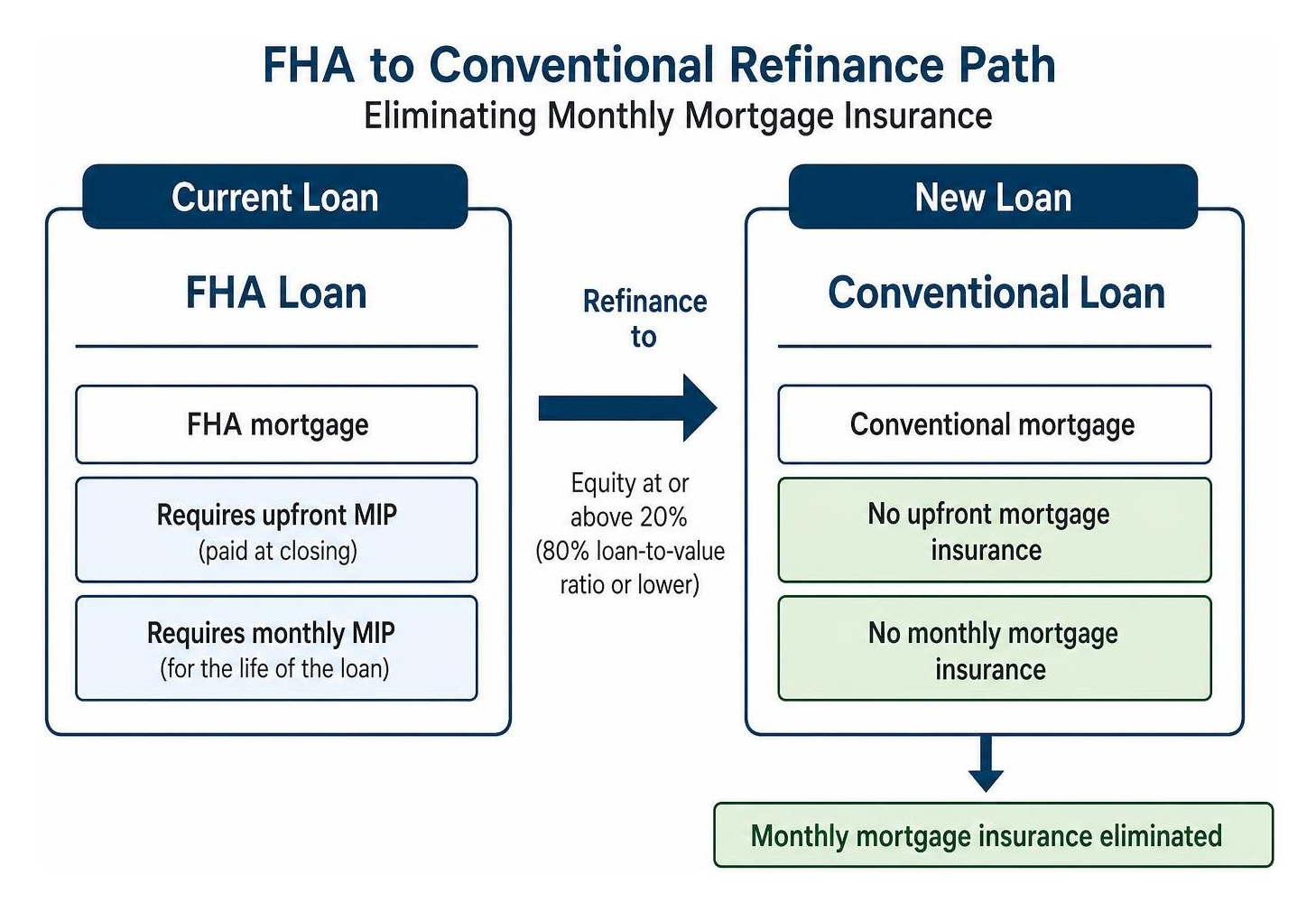
When your property increases in value and your equity crosses that 20% mark, refinancing into a conventional mortgage removes those permanent monthly MIP charges. Homeowners securing a mortgage refinance in Washington frequently use this strategy to lower their monthly payments without needing interest rates to drop drastically.
When Refinancing Makes Financial Sense
Timing is everything in mortgage planning. While lower market rates are the most common reason to refinance, your decision should also account for how long you plan to remain in the property, where you stand in your current amortization schedule, and whether your existing loan has any prepayment restrictions. Reviewing A Consumer’s Guide to Mortgage Refinancings from the Federal Reserve provides valuable consumer context on assessing long-term affordability and overall loan structures.
Evaluating Interest Rate Drops and the 2% Rule
Historically, financial planners relied on the “2% rule,” which suggested refinancing only when market rates fell at least two full percentage points below an existing mortgage rate. While a 2% drop creates undeniable savings, modern loan balances mean that even a 0.50% to 1.00% rate reduction can deliver meaningful relief.
For instance, on a $200,000, 30-year fixed-rate mortgage, reducing your interest rate from 6.0% down to 5.5% lowers your monthly principal-and-interest payment from $1,199 to $1,136. That is a direct savings of $63 per month, $756 per year, and $7,560 over a decade. If you are tracking market changes for a mortgage refinance in California, analyzing smaller rate spreads against your actual closing costs will reveal whether a refinance makes mathematical sense for your budget.
Adjusting Loan Terms from 30-Year to 15-Year Mortgages
Another powerful strategy is shifting from a standard 30-year term to a 15-year repayment window. While your monthly commitment will increase because you are compressing the payoff timeline, 15-year mortgages carry lower base interest rates and dramatically cut lifetime interest expenses.
| Loan Metric | 30-Year Fixed Loan at 6.0% | 15-Year Fixed Loan at 5.5% | Lifetime Difference / Impact |
|---|---|---|---|
| Loan Amount | $200,000 | $200,000 | Baseline Principal |
| Monthly Principal & Interest | $1,199 | $1,634 | +$435 Monthly Investment |
| Total Lifetime Interest | $231,640 | $94,120 | $137,520 Interest Saved |
| Payoff Timeline | 360 Months | 180 Months | 15 Years Faster to Free & Clear |
If a higher fixed payment does not fit your monthly budget, you can achieve similar benefits voluntarily: adding just $50 each month toward the principal of a $200,000, 30-year loan at 6% shortens your payoff window by 3 years and eliminates over $27,000 in interest charges.
Breaking Down Upfront Refinance Costs and Fee Structures
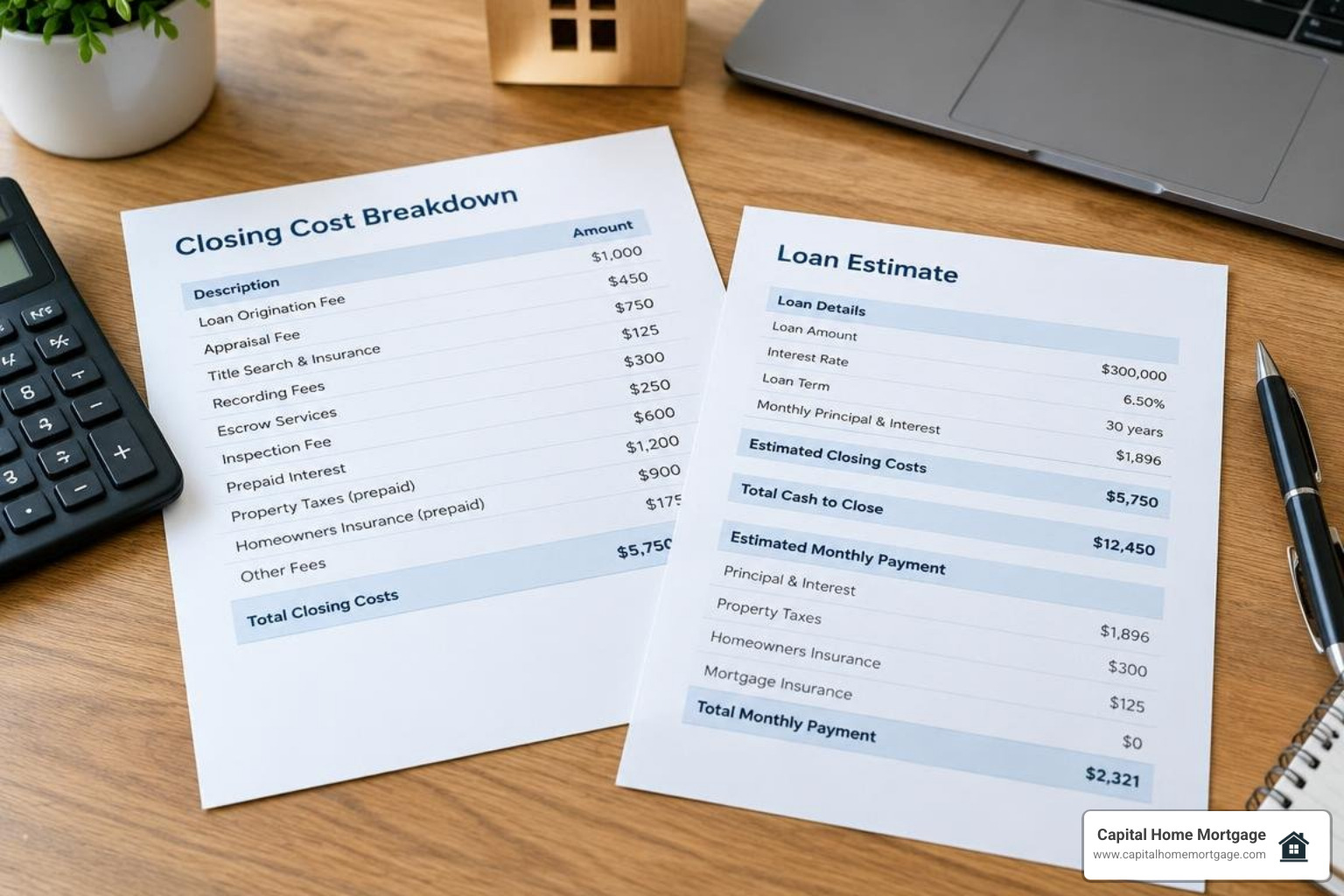
A refinance is not free; total closing costs typically range between 2% and 5% of the new loan amount (and can sometimes reach 3% to 6% depending on local taxes and title charges). Understanding these itemized expenses helps you see where every dollar goes and avoid overpaying for third-party services.
Itemized Closing Costs and Lender Origination Fees
Refinance fees fall into two distinct buckets: lender-specific charges and mandatory third-party fees.
- Lender Origination & Application: Application fees generally run between $75 and $300, while direct loan origination fees average 0% to 1.5% of the total loan principal.
- Appraisal & Property Inspection: Certified independent real estate appraisals cost between $300 and $700, with specialized inspections ranging from $175 to $350.
- Title Search & Lender’s Title Insurance: Settlement agents charge between $700 and $900 for comprehensive title examinations and updated lender policies.
- Closing, Attorney, & Survey Fees: Attorney settlement fees range from $500 to $1,000, while property surveys average $150 to $400 where required.
- Optional Discount Points: Borrowers can buy discount points (1 point equals 1% of the loan amount) to permanently buy down their interest rate.
Evaluating No-Cost Home Refinance Scenarios
Lenders frequently advertise “no-cost” refinances. It is important to know that third parties—such as appraisers, title companies, and county recording offices—never work for free. A “no-cost” transaction simply handles these expenses in one of two ways:
- Rolled-In Closing Costs: The lender rolls your fees directly into your new principal balance, increasing your overall debt and resulting in higher interest charges over time.
- Lender Credits via Premium Pricing: The lender pays your upfront closing costs in exchange for raising your interest rate by 0.25% to 0.50%.
While this structure preserves your out-of-pocket cash today, accepting a higher interest rate or a larger balance increases your total cost over the life of the loan.
Calculating Your Break-Even Period
To determine if refinancing is worthwhile, calculate your break-even point—the exact number of months it takes for your cumulative monthly savings to match your total upfront closing costs:
Break-Even Months = Total Upfront Closing Costs / Monthly Payment Savings
For example, if your total closing costs are $2,500 and your new interest rate saves you $91 per month after taxes, your recovery calculation looks like this:
$2,500 / $91 = 27.47 months
In this scenario, you must remain in the home for at least 28 months to recover your closing expenses. If you plan to sell or move within two years, refinancing will cost you more than it saves.
Cash-Out Refinancing vs. Rate-and-Term Refinancing
When accessing your home’s accumulated equity, it helps to understand how cash-out structures differ from traditional rate-and-term adjustments:
| Feature / Consideration | Rate-and-Term Refinance | Cash-Out Refinance |
|---|---|---|
| Primary Financial Goal | Lower interest rate or adjust term length | Liquidate home equity into lump-sum cash |
| New Principal Balance | Matches existing loan payoff balance | Exceeds existing loan to fund equity cash-out |
| Typical Closing Costs | 2% to 5% of loan balance | 2% to 6% of total new principal |
| Standard Equity Requirement | 3% to 5% minimum equity remaining | 20% minimum equity retained (80% LTV max) |
| Underwriting Scrutiny | Standard debt-to-income verification | Stricter evaluation of DTI, assets, and home value |
Comparing Costs, Interest Rates, and Equity Requirements
A cash-out refinance alters your primary lien, meaning your entire new balance adopts current market pricing. While cash-out interest rates run slightly higher than standard purchase or rate-and-term mortgages, they remain significantly lower than unsecured personal loans or high-interest credit cards.
If you are evaluating equity options with a cash-out mortgage refinance in South Carolina, tapping your equity increases your loan balance and resets your payoff schedule. This makes it essential to run a full cost analysis before moving forward.
Qualifying Criteria, DTI Ratios, and Seasoning Rules
Qualifying for a cash-out refinance requires meeting specific equity and credit standards:
- Credit Score Baseline: Conventional programs typically require a minimum score of 620, while government options like FHA cash-out loans offer added flexibility for lower credit profiles.
- Debt-to-Income (DTI) Ceilings: Most lenders require a maximum DTI ratio of 43%, though strong compensating factors (such as significant cash reserves) can sometimes permit higher thresholds.
- Equity Retention: You must retain at least 20% equity in the property after closing, capping your maximum Loan-to-Value (LTV) ratio at 80%.
- Property Seasoning: Standard conventional guidelines require you to own and live in the property for at least six months before taking cash out against its equity.
Step-by-Step Guide to Shopping and Comparing Lenders
Mortgage quotes can vary widely from one company to the next. Taking time to shop around and systematically compare formal loan disclosures ensures you secure the most competitive rate and lowest possible fee structure.
Gathering Quotes and Reviewing Loan Estimates
Within three business days of submitting an application, every lender must provide an official, standardized three-page Loan Estimate (LE). To accurately compare offers:
- Examine Page 1: Confirm the loan amount, term, base interest rate, and projected monthly payment across all documents.
- Scrutinize Page 2, Section A (Origination Charges): These represent direct lender fees, including underwriting, processing, and discount points. This is where lenders control their pricing.
- Evaluate Section B and C (Services You Cannot/Can Shop For): Look at third-party appraisal, credit, and title costs.
- Review the Annual Percentage Rate (APR) on Page 3: The APR reflects the true annual cost of borrowing by combining your base interest rate with all mandatory finance charges and fees.
Rate Locks, Negotiations, and Closing Requirements
Once you identify the best overall offer, secure a formal written rate lock to protect your quote against market shifts during processing and underwriting. Rate locks typically run for 30, 45, or 60 days.
During this window, you can also ask your title company for a “reissue rate” on your title insurance. If your existing policy was issued within the last few years, title insurers often provide discounts on the new lender’s policy. Finally, review your formal Closing Disclosure (CD) at least three business days before signing to confirm that your final figures match your initial Loan Estimate.
Frequently Asked Questions About Refinancing
How much equity do I need to refinance my mortgage?
For a standard rate-and-term conventional refinance, you can often qualify with as little as 3% to 5% equity (a 95% to 97% LTV). However, holding less than 20% equity means you will pay private mortgage insurance (PMI), which adds an extra 0.2% to 2.0% of the loan amount annually. For cash-out transactions, lenders require you to retain at least 20% equity after your cash extraction.
How does refinancing affect my credit score and taxes?
When you apply, lenders check your credit profile, resulting in a hard inquiry that can temporarily lower your score by a few points. However, your score typically rebounds quickly once you begin establishing on-time payments on the new account.
From a tax perspective, refinance proceeds from a cash-out loan are borrowed debt—not earned income—meaning they are not subject to federal or state income taxes. Additionally, the interest paid on cash-out funds may be tax-deductible if you use the proceeds for capital home improvements that substantially increase your property’s value. Be sure to consult a qualified tax advisor regarding your specific situation.
Can I refinance if I have an existing second mortgage or HELOC?
Yes. If you have an existing Home Equity Line of Credit (HELOC) or second mortgage, you have two options during a refinance:
- Full Consolidation: Combine your primary mortgage balance and your second mortgage balance into a single, larger primary mortgage, simplifying your monthly payments into one loan.
- Subordination: Keep your existing second mortgage in place. To do this, your secondary lienholder must agree to a formal legal “subordination,” allowing your new primary refinance lender to take first lien priority on the property title.
Conclusion
A home refinance is a practical financial tool that can help you lower monthly overhead, pay off your home faster, or access equity for major life goals. Success comes down to looking beyond advertised rates, running an honest break-even analysis, and matching the right loan program to your long-term plans.
At Capital Home Mortgage, we offer a comprehensive lineup of mortgage solutions—including Conventional, FHA, VA, USDA, Jumbo, HUD Native American Home Loans, and Reverse Mortgages. With our dedicated loan officer support and direct in-house processing and underwriting, we deliver quick approvals, competitive pricing, and on-time closings. When you are ready to evaluate your options or review a cash-out mortgage refinance, our experienced lending team is here to guide you every step of the way.