Understanding North Carolina Home Loans and Financing Options
Finding the right mortgage in the Tar Heel State begins with choosing the right loan structure. Most buyers choose between fixed-rate mortgages and adjustable-rate mortgages (ARMs). Fixed-rate terms—typically spanning 15, 20, or 30 years—keep your principal and interest payments predictable for the entire life of the loan. Adjustable-rate mortgages often provide a lower introductory rate for an initial 5, 7, or 10 years before adjusting periodically based on market index benchmarks.
Conforming loan limits set by the Federal Housing Finance Agency (FHFA) establish the ceiling for standard financing across North Carolina counties. When loan amounts exceed these baseline conforming boundaries, jumbo financing steps in to cover higher-priced properties without penalizing your financing terms.
Conventional and Government-Backed North Carolina Home Loans
Different home loan products cater to diverse financial backgrounds, down payment budgets, and property locations:
- Conventional Loans: Conforming mortgages backed by Fannie Mae and Freddie Mac. They allow down payments as low as 3% for qualified first-time buyers. Private mortgage insurance (PMI) is required if you put down less than 20%, but it cancels automatically once you reach 20% to 22% home equity.
- FHA Loans: Insured by the Federal Housing Administration, these loans allow a 3.5% down payment with credit scores starting at 580. They require an upfront mortgage insurance premium (UFMIP) alongside annual mortgage insurance premiums (MIP).
- VA Loans: Guaranteed by the Department of Veterans Affairs for active-duty military, veterans, and eligible surviving spouses. These loans offer 0% down payment financing, no monthly mortgage insurance, and competitive interest rates.
- USDA Rural Housing Loans: Backed by the U.S. Department of Agriculture to support suburban and rural homeownership. These feature 0% down financing for income-qualified buyers purchasing in designated rural areas.
| Loan Program | Minimum Credit Score | Minimum Down Payment | Standard DTI Cap | Key Benefit |
|---|---|---|---|---|
| Conventional | 620 | 3% – 5% | 45% – 50% | PMI is removable after reaching 20% equity |
| FHA | 580 | 3.5% | 45% – 50% | Flexible credit guidelines |
| VA | 580 – 620 | 0% | 45% – 50% | No monthly mortgage insurance |
| USDA | 640 | 0% | 41% – 45% | Zero down payment for eligible rural homes |
State-Specific North Carolina Home Loans and Down Payment Assistance
The North Carolina Housing Finance Agency (NCHFA) provides targeted financing tools for both first-time and move-up buyers. Under the Home AdvantagePLUS Mortgage Program Guide, eligible borrowers can access up to 3% down payment assistance (DPA) paired with competitive fixed-rate FHA, VA, USDA, or conventional mortgages.
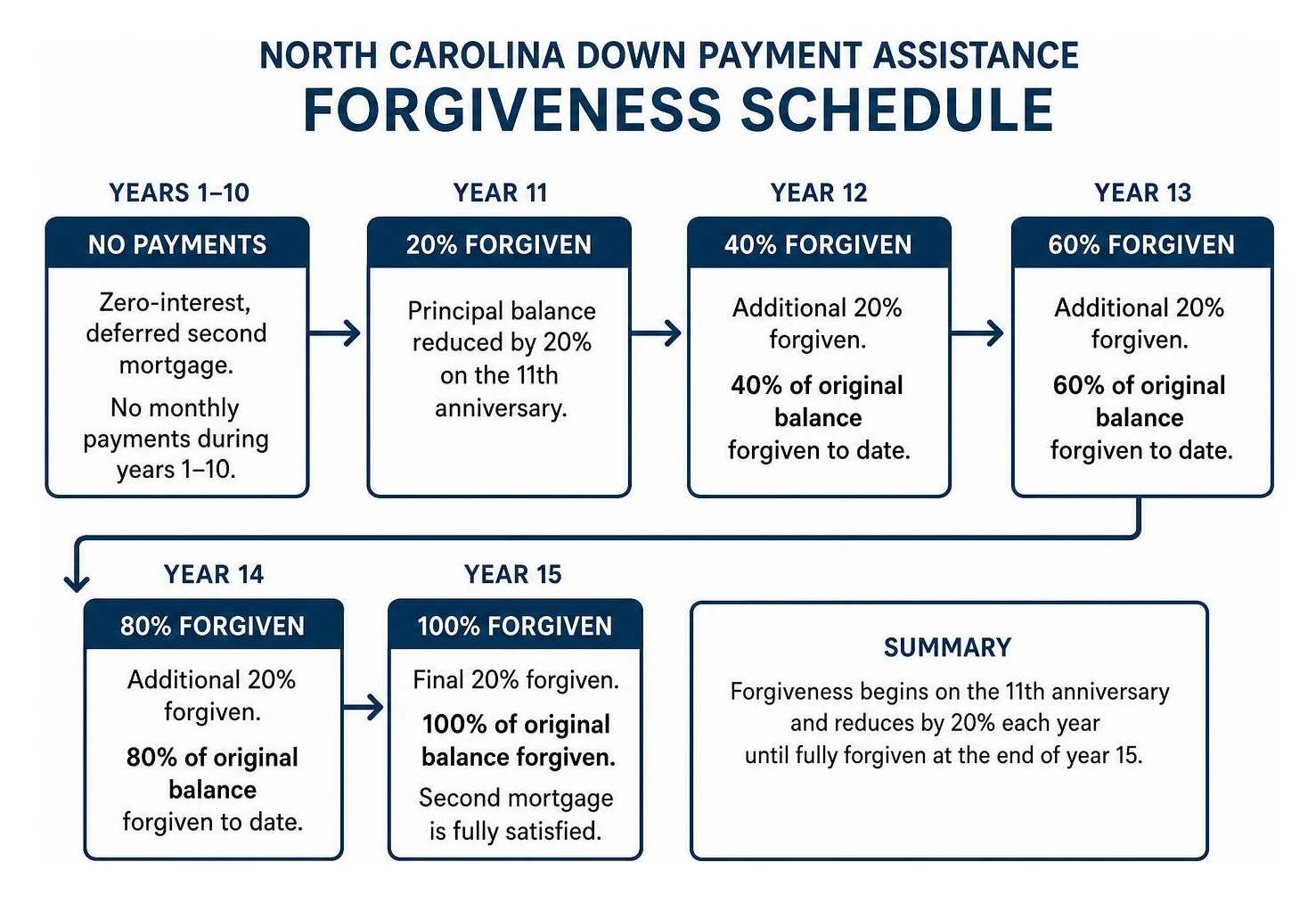
As detailed in the official TIP SHEET, this assistance is structured as a zero-interest, deferred second mortgage. Borrowers make no monthly payments on the second lien during the first decade of ownership. According to the North Carolina Housing Finance Agency Home Ownership Mortgage Program guidelines, principal forgiveness begins on the 11th anniversary of the loan, reducing by 20% each year until the balance is fully forgiven at the end of year 15.
Credit, Income, and Eligibility Standards for State Borrowers
Qualifying for a home loan in North Carolina requires meeting established credit, debt, and income benchmarks. While government products like FHA allow credit scores starting at 580, state-specific programs through the NCHFA set a baseline minimum credit score of 640 (or 660 depending on the underlying underwriting path).
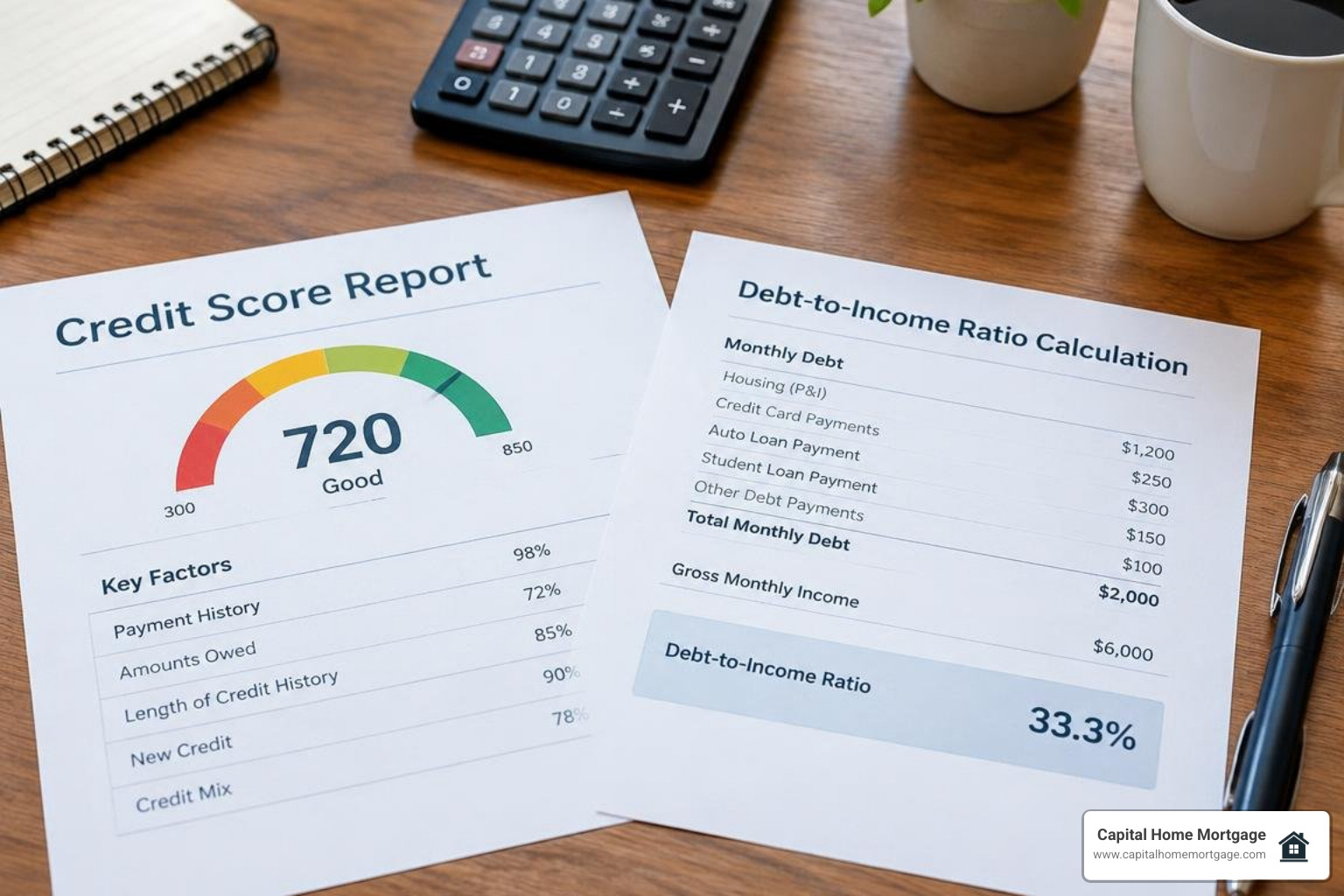
Lenders evaluate your debt-to-income (DTI) ratio to verify affordability:
- DTI Ratio Ceilings: State assistance programs enforce a strict 45% back-end DTI cap. This means your total recurring monthly debts—including car loans, student debt, credit cards, and your proposed mortgage payment—cannot exceed 45% of your gross monthly income.
- Income Caps: County-level median income benchmarks establish upper eligibility limits for state down payment grants and USDA loans.
- Tax Transcript Verification: Lenders verify income through signed federal tax returns and official IRS transcripts to confirm historical earning stability.
Property Restrictions and Purchase Limits
State-supported loan programs and zero-down mortgage options include specific property guidelines:
- Primary Residence Requirement: Properties must serve as the borrower’s principal, owner-occupied residence. Investment properties and commercial conversions are excluded.
- Lot Size Restrictions: State assistance and standard USDA guidelines generally restrict property lot sizes to 5 acres or fewer.
- Purchase Price Limits: State assistance programs apply purchase price limits, capped at $525,000 for standard residential purchases.
- Eligible Property Types: Permitted structures include single-family detached homes, townhomes, planned unit developments (PUDs), and approved condominium communities.
North Carolina Housing Market Dynamics and Regional Loan Trends
North Carolina’s growing economy and steady in-migration make it an appealing destination for new residents and real estate investors alike. The statewide median home price sits near $380,300, providing relative affordability compared to national medians.
A major advantage for North Carolina homeowners is property taxation. The state features a low effective property tax rate of roughly 0.62%, keeping monthly escrow payments lower than in many neighboring states. When budgeting your monthly mortgage obligation, your total housing payment combines principal, interest, county property taxes, and homeowners insurance (PITI).
Triangle and Triad Regional Financing Conditions
The Research Triangle and Piedmont Triad represent two distinct real estate markets:
- The Triangle: Fueled by tech, university, and life science expansion, buyers seeking Raleigh mortgage options and Durham home financing navigate competitive markets with median sales prices near $400,000. Nearby suburban buyers frequently utilize Cary residential mortgage programs to secure custom conventional and jumbo options.
- The Piedmont Triad: Offering balanced housing inventory, buyers exploring Greensboro home loan solutions, Winston-Salem loan programs, or High Point mortgage financing often find attractive entry pricing and strong eligibility for state down payment programs.
Charlotte Metro, Coastal, and Sandhills Housing Markets
Financing dynamics also shift across the state’s southern and coastal regions:
- Charlotte Metro: As a premier national banking center, demand for Charlotte home financing spans starter townhomes to luxury custom builds, with frequent jumbo loan use in Mecklenburg County.
- Coastal Plain: When arranging Wilmington coastal mortgage options, buyers must budget for specialized wind and hail insurance policies alongside standard flood coverage.
- The Sandhills: Centered around Fort Liberty, Fayetteville military home loans see heavy VA loan adoption, offering zero-down financing and fee exemptions for qualified servicemembers.
Closing Costs, Legal Framework, and Borrower Protections
Securing a mortgage involves third-party closing expenses and settlement charges. In North Carolina, typical closing costs average between 2% and 4% of the purchase price.

Key closing cost items include:
- Closing Attorney Fees: North Carolina is an attorney closing state. A licensed real estate attorney conducts the title search, manages settlement funds, and presides over document execution.
- Lender Origination Caps: Under NCHFA program rules, lender origination fees are strictly capped at 1.00%, with ancillary fees limited to $1,300 to protect homebuyer capital.
- Title Insurance and Transfer Taxes: Title policies protect against unknown historical liens, while county excise taxes (transfer stamps) apply at a rate of $1 per $500 of property value ($2 per $1,000).
Foreclosure Laws and the North Carolina Upset Bid System
North Carolina primarily utilizes deeds of trust rather than traditional mortgages, granting lenders a power-of-sale foreclosure remedy. While this enables non-judicial proceedings, state law builds in strong borrower equity safeguards:
- Clerk of Superior Court Hearing: Before a foreclosure sale can occur, the county Clerk of Superior Court conducts a formal hearing to verify the debt, default status, proper notice, and the right to foreclose.
- The 10-Day Upset Bid System: Following the public foreclosure auction, North Carolina law mandates a statutory 10-day upset bid period. Anyone can submit an elevated bid (typically at least 5% higher with a cash deposit), which resets the 10-day clock. This mechanism protects the homeowner’s equity by driving the final sale price closer to true fair market value.
Step-by-Step Loan Preparation and Mistakes to Avoid
A smooth mortgage process requires careful financial preparation:
- Get Fully Pre-Approved Early: Secure a pre-approval backed by verified pay stubs, W-2s, and tax transcripts rather than relying on an unverified pre-qualification estimate.
- Complete Homebuyer Education: First-time buyers using state down payment assistance must complete an approved homebuyer education course before closing.
- Avoid Prohibited DPA Uses: State down payment funds cannot be used to pay repair escrows, negative equity, or realtor commissions.
- Do Not Accumulate New Debt: Opening new credit cards, financing furniture, or purchasing a new vehicle during underwriting changes your DTI ratio and can jeopardize final loan approval.
- Maintain Stable Employment: Avoid changing jobs or shifting compensation structures (e.g., from salaried W-2 to 1099 contractor) while your loan application is active.
Frequently Asked Questions About Mortgages in North Carolina
What credit score is required to buy a home in North Carolina?
For standard FHA loans, the minimum credit score is 580 (with a 3.5% down payment). Conventional loans require a 620 baseline, while state-administered NCHFA assistance programs require a minimum credit score of 640.
How does down payment assistance forgiveness work in North Carolina?
State down payment assistance through the NC Home Advantage program is structured as a 0% interest, deferred second mortgage. You make no monthly payments on the DPA for the first 10 years. Beginning in year 11, the principal balance is forgiven at 20% per year until the balance reaches zero at year 15. If you sell or refinance before year 11, the assistance must be repaid in full.
What are average mortgage closing costs in North Carolina?
Standard closing costs range from 2% to 4% of the total loan amount. These include real estate attorney fees, title insurance, recording fees, state excise taxes, lender origination fees, and initial escrow deposits for county property taxes and homeowners insurance.
Conclusion
Whether you are purchasing your first home in the Piedmont Triad, relocating to the Research Triangle, or buying near the coast, finding the right financing partner makes all the difference. Capital Home Mortgage is a full-service home lender offering FHA, VA, Conventional, USDA, Jumbo, HUD Native American home loans, and Reverse Mortgages.
Our in-house processing and underwriting give you direct communication, quick approvals, on-time closings, and dedicated loan officer support every step of the way. When you are ready to take the next step toward homeownership, explore North Carolina home loans with our team to find the right mortgage for your budget.