
Introduction
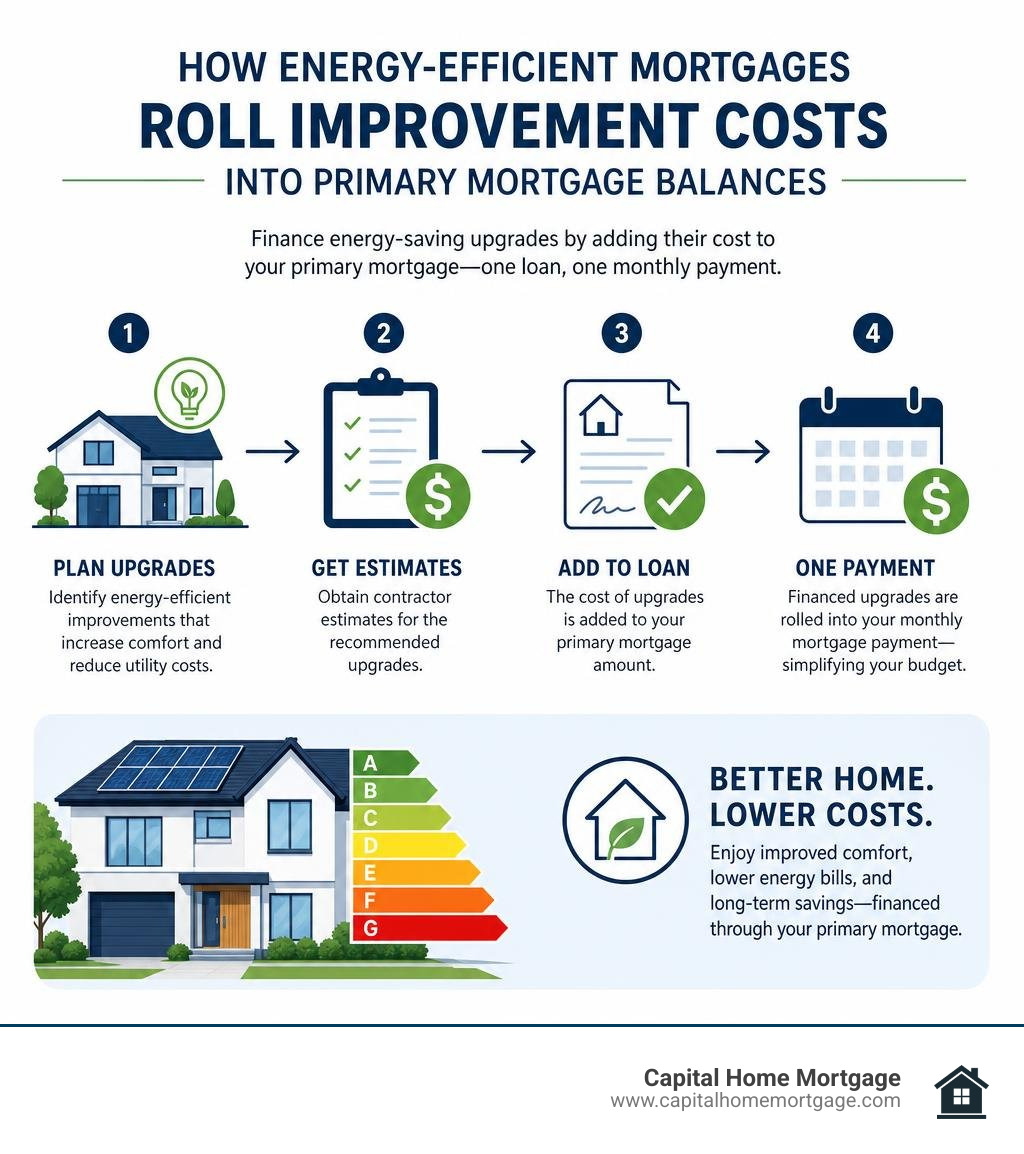
An FHA Energy Efficient Mortgage (EEM) allows homebuyers and homeowners to roll the cost of eligible energy-saving upgrades directly into their purchase or refinance loan without requiring an additional down payment or independently qualifying for the improvement funds. By financing cost-effective improvements—such as high-efficiency heating and cooling, upgraded insulation, or solar installations—borrowers can lower their monthly utility overhead while keeping out-of-pocket costs minimal.
Utility expenses are consistently one of the largest ongoing expenses of homeownership, ranking right behind the primary mortgage payment itself. When shopping for an older home or evaluating your current residence in August 2026, outdated heating and cooling systems, drafty windows, and poor insulation can silently drain your monthly budget. Energy conservation is not just an environmental choice—it is a powerful tool for financial health.
Sustainable financing tools bridge the gap between high upfront installation costs and long-term utility savings. Rather than draining your personal savings or taking on high-interest credit cards or personal loans to install clean energy systems, specialized mortgage options permit buyers to finance green retrofits from day one.
Understanding the FHA Energy Efficient Mortgage Program
The Federal Housing Administration (FHA) Energy Efficient Mortgage (EEM) program allows buyers and homeowners to roll the costs of energy-saving retrofits directly into a purchase or refinance loan. According to official guidelines detailed in HUD’s Energy Efficient Mortgages Program, this financing structure eliminates the need for expensive secondary financing.
The cornerstone of the program is how underwriting is handled:
- Base Loan Qualification: You only need to qualify for the base mortgage amount needed to purchase or refinance the property. You do not have to independently qualify for the additional energy improvement funds.
- The Cost-Effectiveness Test: Every proposed upgrade must demonstrate that its total installation and maintenance cost is less than the present value of the projected utility bill savings over its useful lifespan.
- Energy Savings Value: The underwriting logic assumes the money you save on monthly electricity, gas, and water bills offsets the slight increase in your monthly principal and interest payment.
- No Additional Down Payment: The minimum 3.5% down payment standard for FHA Home Loans is calculated strictly based on the sales price of the home—not the expanded balance including energy upgrades.
How the Energy Package Financing Works
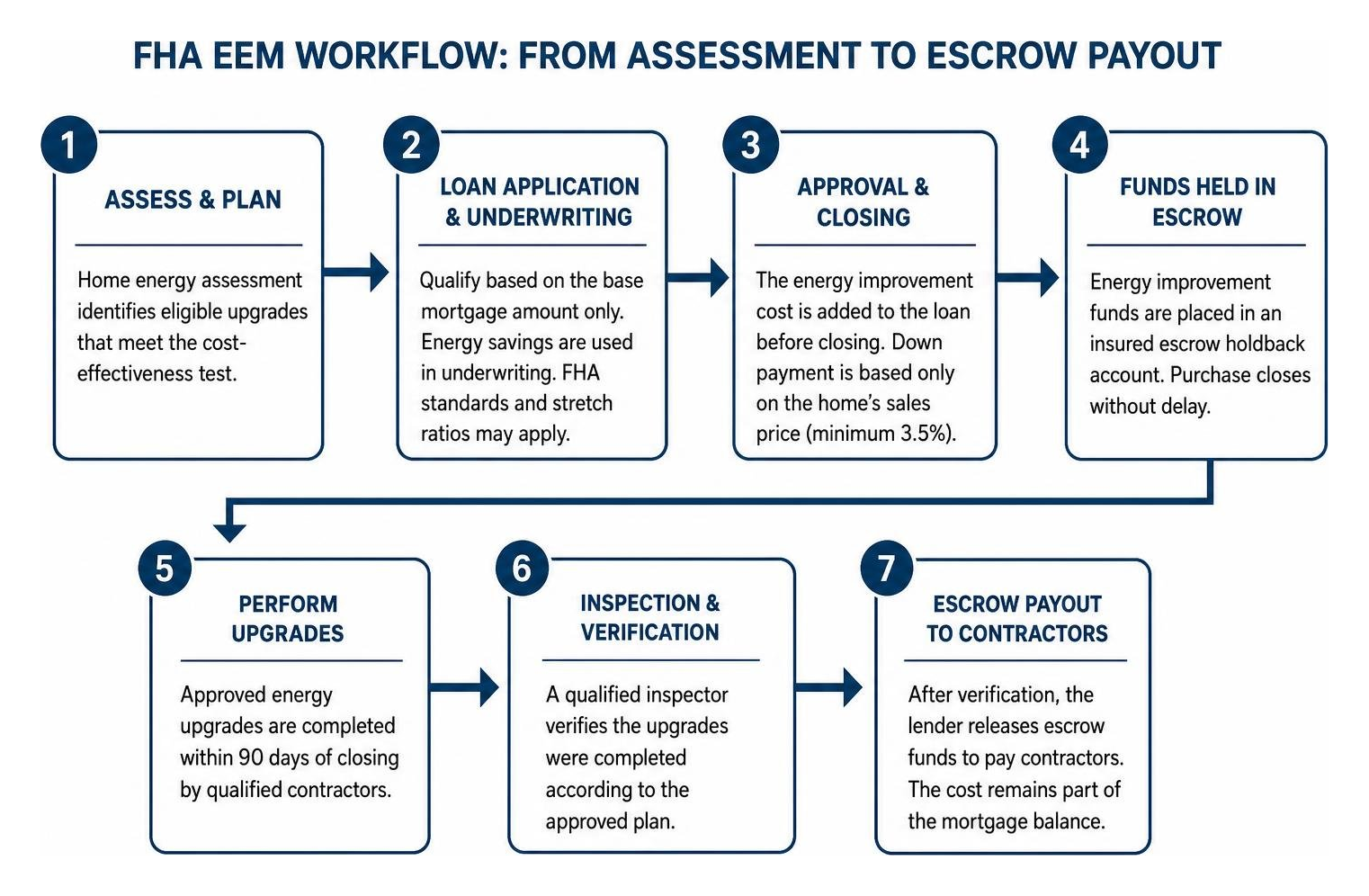
Rather than handing cash to the borrower at closing, the energy improvement funds are deposited into an insured escrow holdback account managed by the lender. This setup ensures the home purchase closes without delay while contractors are lined up to perform the work.
Per the regulatory standards in Section D. Energy Efficient Mortgage Program Overview, all retrofits funded via standard EEM escrows must be completed within 90 days of closing. Once the work is finalized and verified by a qualified inspector, the lender releases the escrowed funds to pay the contractors. Because the energy improvement balance is added to the base loan prior to calculating the upfront mortgage insurance premium (UFMIP), the final loan amount can even exceed standard statutory county FHA loan limits by the exact cost of the approved green package.
FHA Stretch Ratios and Debt-to-Income Rules
Standard FHA underwriting applies debt-to-income (DTI) benchmark ratios of 31% for front-end housing costs and 43% for total back-end debt obligations. However, properties that achieve high energy performance standards qualify for “stretch ratios.”
As outlined in Mortgagee Letter 2015-22, HUD allows qualifying DTI ratios to stretch up to 33% front-end and 45% back-end (a full 2 percentage point increase). To unlock these stretch ratios on an existing home:
- The property must score a 6 or higher on the Department of Energy’s (DOE) 10-point Home Energy Score scale, or
- The borrower must document energy improvements via the EEM escrow process that elevate the property’s score to at least a 6.
Because automated underwriting systems (like TOTAL Mortgage Scorecard) are not built to analyze utility-based adjustments, our Direct Endorsement underwriters validate these calculations manually in-house.
Eligible Improvements and Maximum Financing Limits

An FHA EEM covers a wide range of permanent improvements designed to curb energy waste and lower utility overhead.
Eligible Upgrades Under an FHA Energy Efficient Mortgage
Eligible retrofits include:
- High-efficiency HVAC heat pumps, furnaces, and central air conditioning systems
- Comprehensive duct sealing and ductwork insulation (e.g., boosting to R-6)
- Solar photovoltaic panel systems, solar domestic water heating, and geothermal systems
- ENERGY STAR certified appliances and smart thermostat controls
- High-performance double- or triple-pane replacement windows and insulated exterior doors
- Attic insulation (such as upgrading to R-30 or R-49), wall cavity insulation, and exterior sheathing (R-5)
- Basic weatherization packages including air sealing, weatherstripping, and caulking
Maximum Loan Calculations and Cost-Effectiveness
HUD sets clear parameters for calculating the maximum allowable energy financing. As outlined for Energy Efficient FHA Loans in 2026, the maximum dollar amount that can be added to an FHA mortgage for energy improvements is the lesser of:
- The total actual cost of the cost-effective improvements (verified by an energy assessment), or
- 5% of the lowest among:
- The property’s Adjusted Value (appraised value or sales price, whichever is less)
- 115% of the median single-family home price for the local area
- 150% of the national conforming mortgage loan limit
At a minimum, HUD guidelines permit borrowers to finance up to $4,000 for energy improvements, provided the package passes the lifetime utility savings cost-effectiveness formula.
The Home Energy Assessment and HERS Rating Process
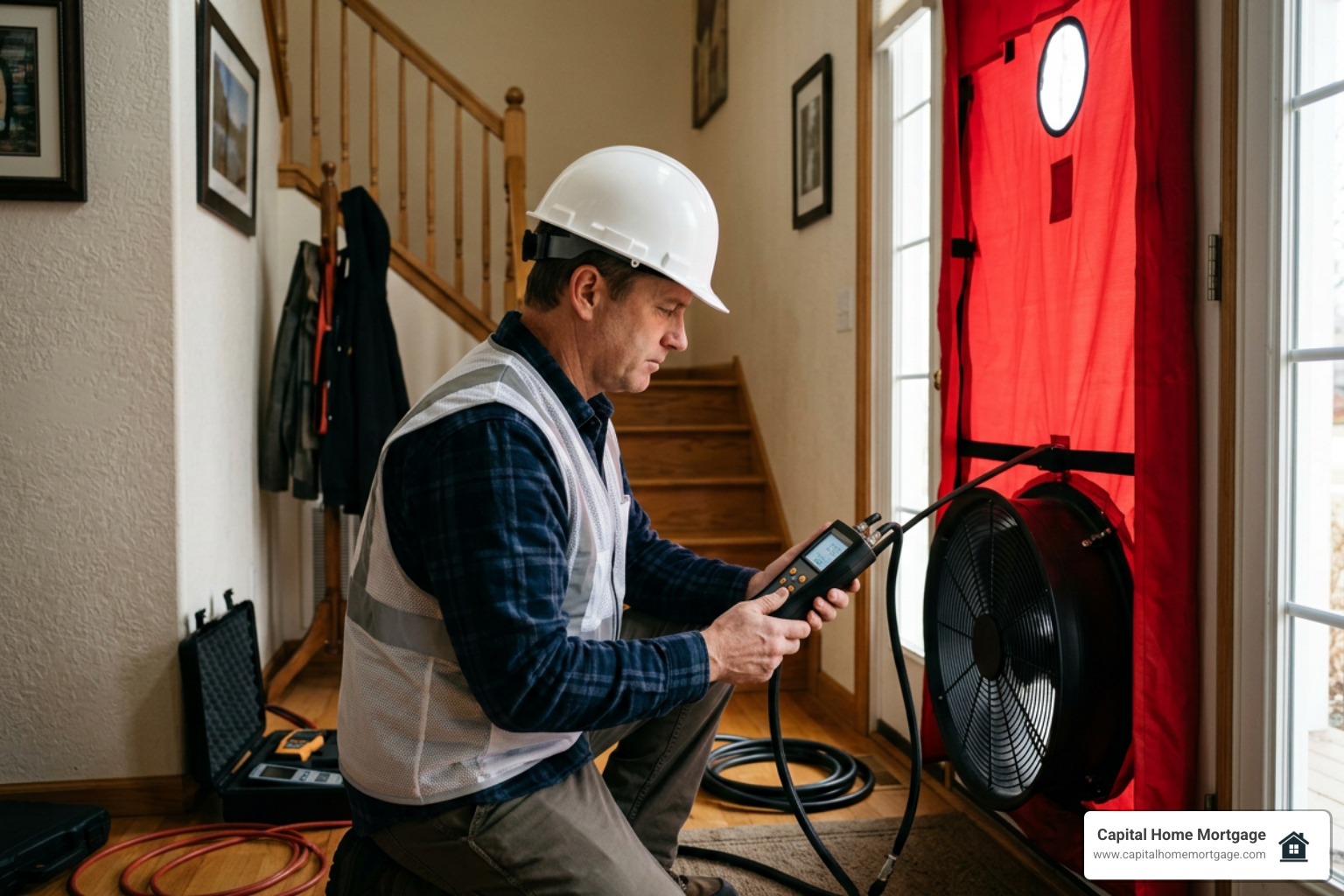
To access EEM financing, a formal physical energy assessment is required. This audit is conducted by an independent Home Energy Rating System (HERS) rater or a certified DOE Home Energy Score assessor.
To preserve integrity throughout underwriting, the energy assessor must be completely independent, with no financial affiliation or business relationship to the property seller, borrower, real estate agent, or improvement contractors.
The Role of the HERS Report in Loan Approval
During the assessment, the rater performs diagnostic evaluations, such as a blower door test and thermal imaging, to generate a comprehensive report. As detailed in the FHA’s Energy Efficient Mortgage (EEM) fact sheet, this document provides:
- The home’s baseline energy consumption and official HERS index rating.
- A prioritized, itemized list of recommended energy upgrades.
- The estimated cost of materials, labor, and installation for each measure.
- The projected annual and lifetime utility cost savings.
- The net present value calculation proving the package meets statutory cost-effectiveness standards.
Up to $200 of the energy assessment inspection fee can often be rolled into the financed mortgage balance if the entire package meets program criteria.
Comparing FHA EEM with Conventional, VA, and Renovation Loans
Borrowers evaluating clean energy financing can choose across various government-backed and conventional mortgage channels. Review the broader federal framework on Energy Efficient Mortgages | ENERGY STAR and compare loan structures across all our Home Loans:
| Loan Program | Improvement Financing Limit | Extra Down Payment Required? | Post-Closing Completion Window |
|---|---|---|---|
| FHA EEM | Lesser of actual cost or 5% of value (up to statutory formula caps; min. $4,000) | No | 90 days |
| VA EEM | Up to $6,000 (based on utility savings/cost calculations) | No | 180 days (6 months) |
| Fannie Mae HomeStyle Energy | Up to 15% of as-completed appraised value | No | 180 days |
| Freddie Mac GreenCHOICE | Up to 15% of as-completed appraised value | No | 180 days |
| USDA Guaranteed Housing | Up to 100% of appraised value for qualified rural properties | No | Varies by lender schedule |
Combining EEM with FHA 203(k) Renovation Loans
If you are purchasing a home that requires extensive structural or cosmetic work alongside energy retrofits, you can combine an EEM with an FHA Section 203(k) loan. Pairing these options through our Renovation Home Loans allows you to stack standard remodeling allowances with dedicated energy-efficiency escrow funds. When combined with a 203(k) loan, HUD extends the post-closing completion window from 90 days to 180 days to accommodate complex construction timelines.
VA and USDA Energy Financing Alternatives
Military veterans and active service members can leverage the VA Energy Efficient Mortgage, which allows borrowers to add up to $3,000 in energy upgrades based on bid costs alone, or up to $6,000 if projected utility savings exceed the added mortgage expense. Rural buyers utilizing USDA Single Family Housing Guaranteed Loans can access up to 100% financing for energy-saving installations. Additionally, conventional programs like Fannie Mae HomeStyle Energy permit homeowners to refinance and pay off existing, high-interest Property Assessed Clean Energy (PACE) liens.
Step-by-Step Guide to Securing Your Energy-Efficient Loan
Navigating an energy-efficient mortgage is straightforward when handled by an experienced direct lender. For regular updates on loan programs and underwriting insights, check our Blog.
How to Apply for an FHA Energy Efficient Mortgage
- Get Pre-Approved with an FHA-Approved Lender: Partner with a direct lender to determine your base purchase or refinance qualification and confirm eligibility parameters.
- Schedule the Home Energy Assessment: Hire an independent, certified HERS rater to inspect the property, identify energy leaks, and calculate the Energy Savings Value.
- Collect Licensed Contractor Bids: Gather detailed estimates for materials and labor for the specific retrofits identified in the HERS report.
- Direct Endorsement Underwriting Review: Our in-house underwriting team verifies the cost-effectiveness worksheet, approves the base loan, and structures the escrow holdback amount.
- Loan Closing and Escrow Setup: Sign your final loan documents at closing. Your purchase or refinance is finalized, and the improvement funds are placed into the lender’s escrow account.
- Complete Installations & Release Escrow: Contractors complete the installations within 90 days. A post-work inspection confirms completion, Form HUD-92300 is filed, and final escrow checks are disbursed.
Frequently Asked Questions About Energy Efficient Mortgages
Can you perform the energy improvement work yourself with sweat equity?
Under FHA guidelines, a lender may authorize you to perform the installation labor if you demonstrate the professional skills, equipment, and time required to complete the job satisfactorily. However, “sweat equity” labor costs cannot be reimbursed in cash, and borrowers cannot receive cash back at closing. Financed allowances cover only verified material expenses.
How much does a HERS energy assessment cost and can it be financed?
A professional HERS rating or Home Energy Score assessment generally costs between $300 and $800 depending on the property’s size and geographic location. Under FHA guidelines, up to $200 of this audit fee can be financed directly into the mortgage balance as part of the overall cost-effective energy package.
Does an FHA EEM require a second property appraisal?
No. An FHA EEM does not require a second appraisal or an “as-completed” valuation. The original appraisal sets the base property value, and the allowable energy improvement funds are added directly on top of the mortgage balance without requiring re-appraisal.
Conclusion
Upgrading a home’s efficiency is one of the most reliable ways to permanently lower utility overhead while enjoying a more comfortable, climate-resilient living environment. Because the FHA allows you to roll these improvements into a single primary mortgage without triggering additional down payment requirements, going green is accessible for purchase and refinance borrowers alike.
At Capital Home Mortgage, our direct, full-service mortgage lending platform handles processing and underwriting entirely in-house. This gives you clear communication, direct underwriter access, and on-time closings. Whether you are exploring Texas construction home loans and energy-efficient financing or modernizing an existing home with green retrofits, our dedicated loan officers are here to guide you every step of the way. Contact Us today to discuss your energy-efficient financing options.


