

Understanding Pre-Approval vs. Pre-Qualification in NC
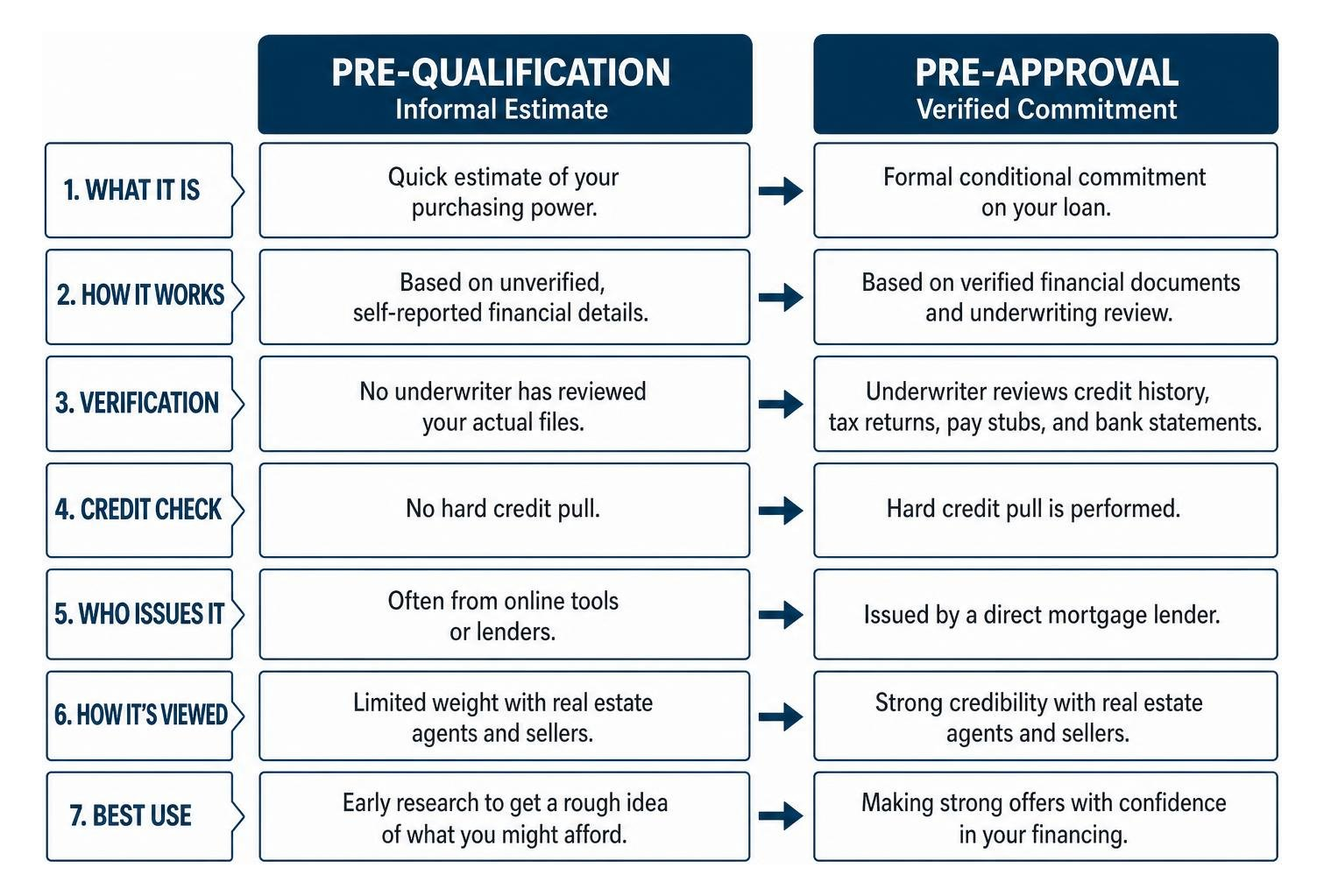
To secure a North Carolina mortgage pre-approval without hassle, start by checking your credit scores and debt-to-income ratio, gathering your required income and asset records, and submitting a complete application for underwriting review. This verified pre-approval gives you a conditional commitment from a direct mortgage lender, while a pre-qualification is only an informal estimate based on unverified, self-reported financial details.
A pre-qualification gives you a rough idea of what you might afford, but no underwriter has reviewed your actual files, and no hard credit pull has occurred. A pre-approval, by contrast, is a formal conditional commitment from a direct mortgage lender. During this process, our underwriting team conducts a thorough underwriting review of your credit history, tax returns, pay stubs, and bank statements. In North Carolina real estate transactions, contracts typically involve non-refundable due diligence fees paid directly to the seller upon going under contract. Because your hard-earned money is on the line the moment an offer is accepted, having a verified pre-approval ensures you do not risk your due diligence funds on financing that might fall through.
Why You Need a North Carolina Mortgage Pre-Approval in Today’s Market
North Carolina continues to attract new residents across its dynamic metropolitan and coastal regions. According to Federal Housing Finance Agency (FHFA) data, the FHFA House Price Index recorded a steady 2.5% annual home price growth across North Carolina for the four quarters ending in Q2 2026, alongside a 0.4% quarterly index change. Meanwhile, broader economic reference markers—such as the MIRS Transition Index, which stood at 6.51 as of August 2026—remind buyers that securing clear financing terms early is essential in navigating interest rate environments.
Whether you are looking at competitive properties in Mecklenburg County and need Charlotte home loans, or exploring the Research Triangle with Raleigh home loans, sellers expect buyers to present fully vetted pre-approval letters before considering an offer. A formal pre-approval proves that you have verified buying power, allowing your offer to stand out against competing bids from day one.
Key Differences: Pre-Qualification vs. Pre-Approval
To visualize how these two stages differ, review the breakdown below:
| Feature | Pre-Qualification | Pre-Approval |
|---|---|---|
| Financial Review | Self-reported financial data | Verified financial documents & assets |
| Credit Check | Soft inquiry or self-reported | Hard credit inquiry across major bureaus |
| Underwriting Input | None | Automated underwriting system (AUS) review |
| Seller Confidence | Low (indicative only) | High (verified conditional commitment) |
| Turnaround Time | Minutes to a few hours | 24 to 48 business hours |
| Offer Strength | Rarely accepted in hot markets | Standard requirement for credible offers |
Borrowers seeking state-specific housing resources can also review NCHFA homebuyer pre-approval guidance to understand how state housing initiatives complement standard lender pre-approvals across North Carolina communities.
Step-by-Step Guide to North Carolina Mortgage Pre-Approval
Securing your pre-approval does not have to be an overwhelming ordeal. By breaking down the process into structured steps, you can move from gathering paperwork to holding a verified pre-approval letter quickly and seamlessly.
Step 1: Check Credit Scores and Debt-to-Income Ratios
Your financial profile forms the bedrock of your loan application. Lenders examine two primary indicators during initial screening: your credit score and your debt-to-income (DTI) ratio.
Lenders use standard DTI guidelines—often referenced as the 28/36 rule—as a baseline:
- Front-End Ratio (28%): Your proposed housing payment (principal, interest, property taxes, homeowners insurance, and any HOA fees) should ideally not exceed 28% of your gross monthly income.
- Back-End Ratio (36% to 45%+): Your total monthly debt obligations (housing expenses plus student loans, auto loans, minimum credit card payments, and personal loans) should generally stay below 36% to 45%, depending on the specific loan program and automated underwriting findings.
You can run your own figures beforehand using interactive mortgage calculators to see how different price ranges, down payment amounts, and monthly liabilities impact your purchasing power.
Documents Required for North Carolina Mortgage Pre-Approval
When you apply, having an organized digital folder of your records speeds up the review process significantly. Here is the standard checklist of documentation required for a complete pre-approval:
- Income Verification:
- W-2 statements from the past two consecutive tax years
- Federal tax returns (Form 1040, including all schedules) for the past two years if self-employed, commissioned, or owning rental properties
- Most recent 30 days of consecutive pay stubs showing year-to-date earnings
- Documentation of additional income (e.g., child support, alimony, social security, or pension awards, where applicable)
- Asset and Reserve Verification:
- Complete bank statements (all pages) for the last two months for checking, savings, and money market accounts
- Recent quarterly statements for investment, retirement (401k, IRA), or brokerage accounts
- Gift letters and paper trails if a portion of your down payment or closing costs is being gifted by a family member
- Personal Identification & Housing Records:
- Legible copy of a government-issued photo ID (driver’s license, passport, or military ID)
- Social Security card or official tax documentation displaying your SSN
- Rental history contacts or landlord verification records for the previous 12 to 24 months if currently renting
Step 3: Select the Right Loan Program and Apply
Every homebuyer comes with unique financial goals. Choosing the right financing structure ensures your monthly payment and initial cash outlay fit your budget:
- Conventional home loans: Ideal for borrowers with strong credit scores (typically 620+) and flexible down payments ranging from 3% to 20% or more.
- FHA home loans: Excellent for first-time buyers or those with moderate credit scores (down to 580) requiring a 3.5% down payment.
- VA home loans: Designed for eligible active-duty service members, veterans, and surviving spouses, offering zero down payment and no monthly mortgage insurance.
- USDA home loans: Tailored for eligible suburban and rural properties across North Carolina, featuring 100% financing (zero down payment) for income-qualified households.
For consumer peace of mind, make sure your mortgage provider is properly licensed by checking NCCOB mortgage licensing regulations, which ensures your lender complies with North Carolina consumer financial protection laws.
Critical Mistakes That Can Derail Your NC Pre-Approval
Receiving your pre-approval letter is an exciting milestone, but pre-approval is conditional. The financial picture you presented must remain consistent all the way to the closing table. Avoid these common missteps:

- Changing Jobs or Income Structures: Switching from a salaried position to a 100% commission or 1099 independent contractor role just before or during home shopping can restart income verification clocks and jeopardize your approval.
- Financing Major Purchases: Buying a new car, purchasing appliances on credit, or financing new furniture introduces new monthly debt obligations that skew your debt-to-income ratio.
- Opening or Closing Credit Lines: Applying for new credit cards triggers hard inquiries and alters your credit utilization ratios, potentially dropping your score below loan program minimums.
- Depositing Undocumented Cash: Lenders must verify the source of all funds used for your down payment and closing costs. Large cash deposits without a clear paper trail cannot be used and create unnecessary underwriting delays.
- Letting Your Pre-Approval Expire Without Updating Files: Most pre-approval letters remain valid for 60 to 90 days. If your search extends past this window, keep your recent paystubs and bank statements organized so your lender can refresh your letter without delays.
Frequently Asked Questions About NC Mortgage Pre-Approval
How long does a mortgage pre-approval last in North Carolina?
A standard mortgage pre-approval is typically valid for 60 to 90 days. Because credit reports, paystubs, and bank statements age over time, lenders require updated documentation to ensure your financial situation and qualifying interest rates remain aligned with your loan parameters. Updating an active pre-approval is usually quick if your employment, income, and debts have remained stable.
What minimum credit score is needed for mortgage pre-approval in North Carolina?
Minimum credit score thresholds depend on the specific loan program you select:
- Conventional Loans: Generally require a minimum FICO score of 620.
- FHA Loans: Allow scores down to 580 with a 3.5% down payment (or 500–579 with a 10% down payment).
- VA Loans: Many lenders seek a 580 to 620 baseline, though the VA itself does not set a hard minimum score.
- USDA Loans: Typically require a 640 credit score for automated underwriting approval.
Does getting pre-approved hurt your credit score?
Applying for a pre-approval involves a hard credit inquiry, which may temporarily dip your credit score by a few points (often 5 points or fewer). However, credit scoring models incorporate a 14 to 45 day rate-shopping window. During this period, all mortgage-related credit inquiries are grouped and treated as a single inquiry for scoring purposes, allowing you to shop for financing terms without compounding credit penalties.
Conclusion
A well-prepared mortgage pre-approval gives you clarity, confidence, and leverage when house hunting across North Carolina. Rather than wondering what you can afford or worrying about transaction delays, taking the time to verify your finances upfront ensures you can place competitive offers the moment the right home hits the market.
At Capital Home Mortgage, we operate as a direct, full-service lender. With our dedicated in-house processing and underwriting team, we eliminate the red tape, deliver fast pre-approvals, and work closely with your real estate agent to keep your home purchase on track.
Ready to begin your journey toward homeownership? Connect with our team to secure your verified North Carolina mortgage pre-approval today.


