How a Conventional Loan Refinance Works
A conventional loan refinance replaces your current mortgage with a new loan. You might refinance to lower your rate, change your loan term, remove mortgage insurance, or borrow against your home equity. Your current loan does not have to be conventional.
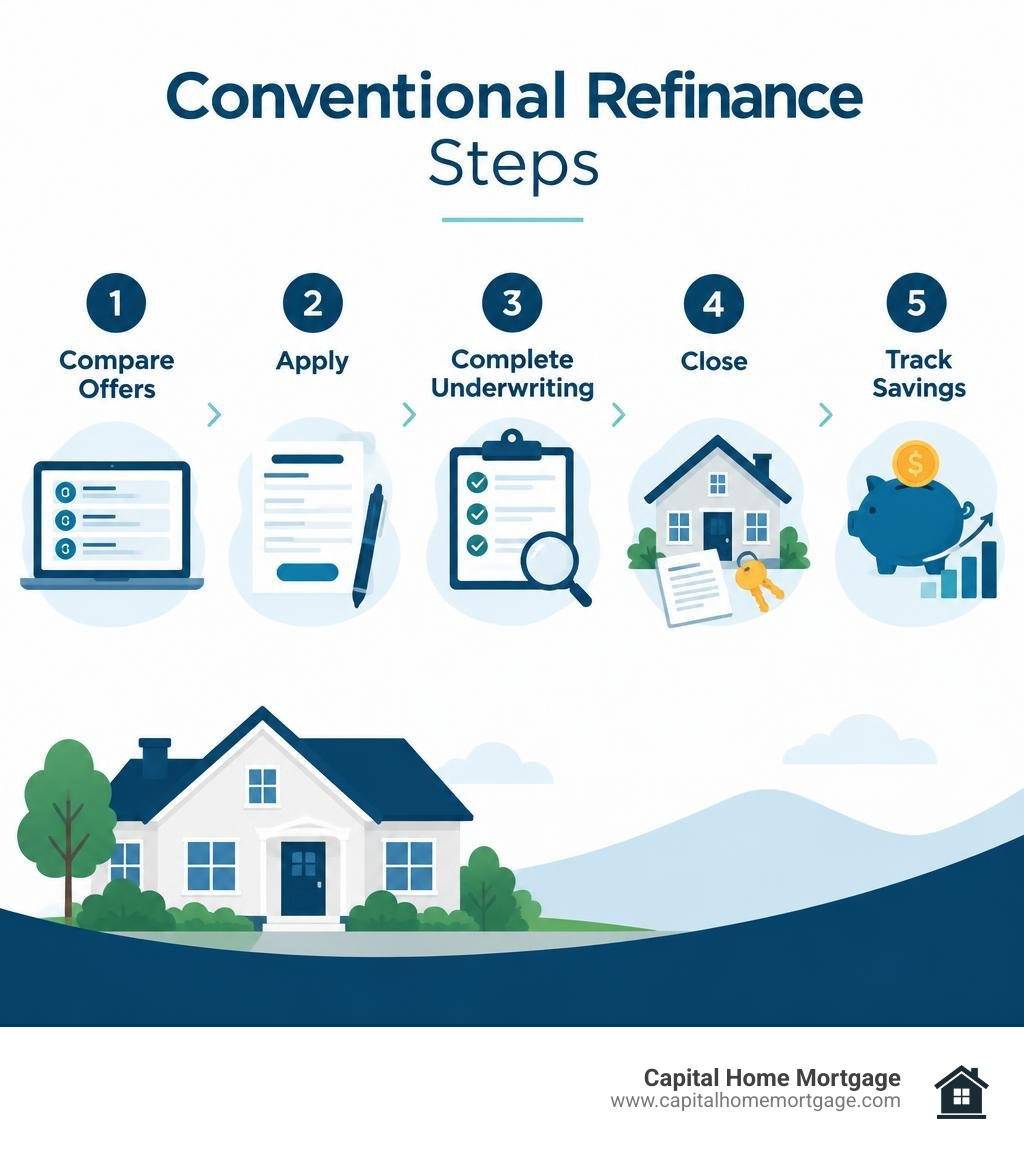
To decide whether it is worth doing, compare offers from several lenders. Look at the new monthly payment, closing costs, and total interest, not just the rate. Then divide your upfront costs by your monthly savings to see how long it may take to break even.
I’m Dale Gremillion, a manager at Capital Home Mortgage with more than 26 years of experience in mortgage-lending management. I’ll help you understand the conventional loan refinance process and the trade-offs to check before you apply.
What Is a Conventional Loan Refinance and How Does It Work?
At its core, refinancing means trading your existing debt structure for a new promissory note with updated terms, a fresh interest rate, and a reset amortization schedule. Because conventional mortgages are not directly insured by the federal government, they adhere to standards set by Fannie Mae and Freddie Mac (the government-sponsored enterprises, or GSEs).
Understanding these foundational conventional mortgage basics helps clarify why conventional loans remain the gold standard for homeowners across the country. Whether you purchased your home with an FHA, VA, USDA, or an older conventional mortgage, you can replace it with a new conventional loan as long as you meet current underwriting criteria.
| Feature | Conventional Refinance | FHA Refinance | VA Refinance | USDA Refinance |
|---|---|---|---|---|
| Backing Agency | Fannie Mae / Freddie Mac | Federal Housing Admin. | Dept. of Veterans Affairs | Dept. of Agriculture |
| Max Primary LTV (Rate/Term) | 95% – 97% | 97.75% | 100% | 100% |
| Mortgage Insurance | Cancelable PMI (at 80% LTV or less) | Lifetime MIP (most loans) | No Monthly Insurance | Annual Guarantee Fee |
| Upfront Funding Fees | None | 1.75% Upfront MIP | 0.5% – 3.3% Funding Fee | 1.00% Upfront Fee |
| Property Eligibility | Primary, 2nd Home, Investment | Primary Residence Only | Primary Residence Only | Primary Rural Only |
| Minimum Credit Benchmark | 620 (740+ for best pricing) | 580 (typical floor) | No official min (often 620) | 640 preferred |
Because we handle our processing and underwriting in-house at Capital Home Mortgage, we review these loan distinctions directly with our borrowers to establish clear timelines and avoid third-party delays.
How Conventional Refinances Differ from Government-Backed Loans
Government-backed mortgages serve vital roles for initial home purchases, but their refinancing structures carry programmatic constraints. FHA loans require an upfront mortgage insurance premium (UFMIP) alongside monthly mortgage insurance premiums (MIP) that typically persist for the life of the loan if you put down less than 10%. USDA mortgages also mandate upfront and annual guarantee fees, and VA loans require specific military entitlement and funding fees.
In contrast, established conventional refinance guidelines offer significant structural flexibility. Conventional refinances:
- Allow private mortgage insurance (PMI) to be cancelled once your equity reaches 20%.
- Finance second homes and 1- to 4-unit investment properties (government programs restrict these).
- Eliminate mandatory upfront government funding fees.
- Allow you to pay off secondary liens, such as tax liens or mechanics’ liens, subject to loan structure rules.
Rate-and-Term vs. Cash-Out Refinancing Structures
Refinancing falls into two primary structural categories, each treated differently by automated underwriting systems:
- Rate-and-Term Refinance: Often called a “no cash-out” refinance by Freddie Mac or a “limited cash-out” refinance by Fannie Mae, this option changes your interest rate, adjusts the loan term (e.g., from 30 years to 15 years), or eliminates PMI. You cannot take out substantial equity; Fannie Mae caps cash back to the borrower at the lesser of 2% of the new loan amount or $2,000 (Freddie Mac limits it to 1% or $2,000).
- Cash-Out Refinance: This option allows you to tap your accumulated home equity to receive a lump sum at closing. You can use these funds for home improvements, high-interest debt consolidation, or other financial goals. Because lenders take on higher risk when equity is withdrawn, choosing a cash-out refinance typically adds a pricing adjustment, resulting in an interest rate roughly 0.250% to 0.500% higher than a comparable rate-and-term structure.
2026 Conventional Refinance Eligibility, Limits, and Rates
Navigating the market requires a clear view of current interest benchmarks and conforming regulations. As of August 14, 2026, the average conventional 30-year fixed refinance rate was 6.819% (6.891% APR), with 15-year fixed terms averaging around 6.168% (6.262% APR). Throughout late 2026, conforming 30-year fixed rates have fluctuated between 6.70% and 7.05% depending on credit quality, loan-to-value (LTV) ratios, and property occupancy.

2026 Conforming Loan Limits and High-Cost Areas
The Federal Housing Finance Agency (FHFA) adjusts conforming loan limits annually to match national home price changes. For 2026, standard baseline limits and designated high-cost ceilings for conventional mortgages are:
- 1-Unit Single-Family Home: Standard baseline of $832,750 | High-cost ceiling up to $1,249,125
- 2-Unit Duplex: Standard baseline of $1,066,250 | High-cost ceiling up to $1,599,375
- 3-Unit Triplex: Standard baseline of $1,288,800 | High-cost ceiling up to $1,933,200
- 4-Unit Fourplex: Standard baseline of $1,601,750 | High-cost ceiling up to $2,402,625
If your required loan balance exceeds your county’s conforming ceiling, the loan moves into jumbo mortgage territory, which requires separate underwriting guidelines and asset reserves.
Credit Score, Maximum DTI, and Qualifying Standards
Qualifying for a conventional refinance depends on three main factors:
- Credit Score: The baseline qualifying floor is 620. Borrowers with credit scores of 740 and above secure the most favorable interest rates and lowest loan-level price adjustments (LLPAs).
- Debt-to-Income (DTI) Ratio: Most conventional refinances cap your total monthly debt obligations (housing costs plus revolving debts, student loans, and auto notes) at 45% of your gross monthly income. This threshold can extend to 50% for borrowers with strong cash reserves or lower LTV ratios.
- Special GSE Programs: Relief programs like Fannie Mae’s RefiNow and Freddie Mac’s Refi Possible help eligible lower-income borrowers with primary residences qualify with DTI ratios up to 65% and waived minimum credit score requirements under specific criteria.
Equity Requirements, PMI Removal, and Seasoning Rules
Your loan-to-value ratio (LTV) measures your outstanding loan balance against your property’s current appraised market value.

Maximum LTV guidelines for conventional refinances vary by property occupancy and purpose:
- Primary Residence (Rate-and-Term): Up to 97% LTV if the existing mortgage is owned by Fannie Mae; otherwise 95% LTV.
- Primary Residence (Cash-Out): Maximum 80% LTV (you must retain at least 20% home equity).
- Second Home (Rate-and-Term): Up to 90% LTV.
- Second Home (Cash-Out): Maximum 75% LTV.
- Investment Property (Rate-and-Term): Up to 75% LTV for 1-unit properties; 70% for 2- to 4-unit buildings.
- Investment Property (Cash-Out): Maximum 75% LTV for single-unit properties; 70% for multi-unit properties.
When preparing your refinance application, our direct underwriting team will review the following standard documentation:
- Most recent 30 consecutive days of pay stubs showing year-to-date earnings.
- W-2 forms covering the past two calendar years.
- Federal tax returns (1040s with all schedules) for the past two years if self-employed or claiming rental income.
- Two consecutive months of complete asset statements (checking, savings, investment accounts).
- Your latest mortgage statement, property tax bill, and active homeowners insurance declaration page.
Eliminating Private Mortgage Insurance (PMI)
When you purchase a home with less than 20% down, conventional loans require private mortgage insurance. Conventional PMI generally costs between 0.30% and 1.10% of the loan amount annually, depending on credit score and down payment percentage. Reviewing this guide to average PMI rates shows how removing mortgage insurance can lower your monthly housing expenses.
Unlike FHA mortgage insurance, conventional PMI is completely cancelable:
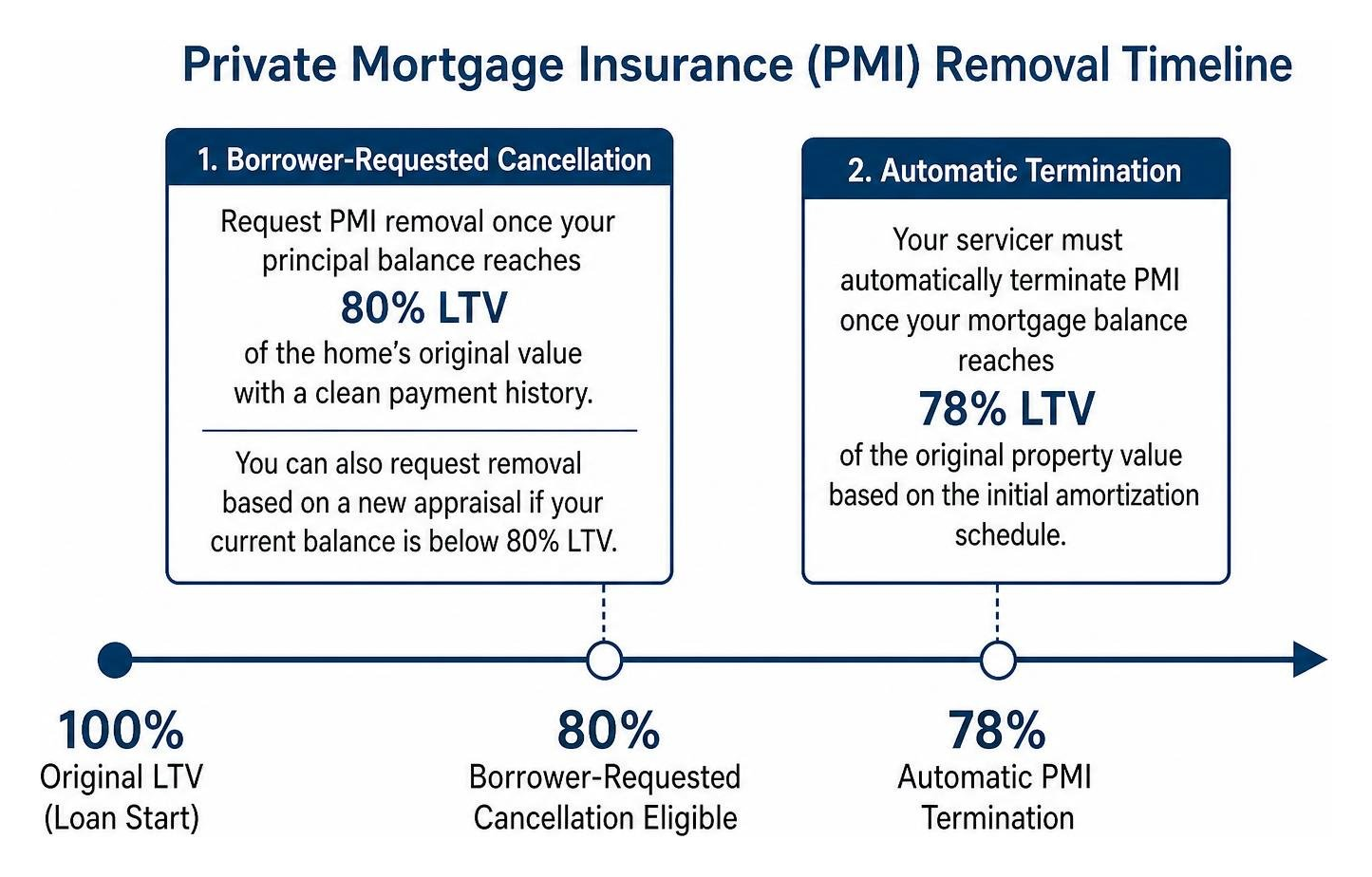
- Borrower-Requested Cancellation: You can request PMI cancellation in writing once your principal balance reaches 80% of the home’s original value, provided your payment history is clean. You can also request removal based on a new appraisal if market appreciation and home improvements bring your current balance below 80% LTV.
- Automatic Termination: Under the federal Homeowners Protection Act, your servicer must automatically terminate PMI once your mortgage balance reaches 78% of the original property value based on the initial amortization schedule.
Loan Seasoning and Timing for a Conventional Loan Refinance
Seasoning refers to the required waiting period between mortgage transactions:
- Rate-and-Term Refinancing: Fannie Mae requires you to make at least six consecutive monthly payments on your current mortgage before the new note date if you are refinancing an existing conventional loan.
- Cash-Out Refinancing: Fannie Mae and Freddie Mac generally require the existing first mortgage to be seasoned for at least 12 months, and you must have held title to the property for at least six months prior to the new disbursement date.
- Delayed Financing Exception: If you purchased a property entirely with cash (such as at an auction or via cash reserve assets), you do not have to wait six to twelve months. Under the delayed financing rule, you can execute a cash-out refinance immediately after closing, provided you document the original cash transaction source and confirm no initial mortgage lien existed.
Refinance Closing Costs and Break-Even Analysis
Refinancing is an investment to lower your long-term housing costs. Evaluating the transaction means balancing closing expenses against your monthly payment reduction.
| Loan Amount | Estimated Closing Costs (3%) | Monthly P&I Savings | Break-Even Timeline | 5-Year Net Savings |
|---|---|---|---|---|
| $250,000 | $7,500 | $165 / mo | 45.4 Months | $2,400 |
| $380,000 | $11,400 | $255 / mo | 44.7 Months | $3,900 |
| $500,000 | $15,000 | $335 / mo | 44.7 Months | $5,100 |
| $650,000 | $19,500 | $440 / mo | 44.3 Months | $6,900 |
Examining practical rate-and-term refinance math shows that a homeowner reducing their rate from 7.50% to 6.50% on a $380,000 balance saves roughly $255 per month in principal and interest. With $11,400 in closing costs, the investment breaks even in less than 45 months.
Typical Closing Costs and Fee Breakdowns
Closing costs on a conventional refinance typically total between 2% and 4% of the new loan amount. These fees cover several services:
- Lender Origination and Underwriting: Covers loan preparation, processing, underwriting, and administrative document creation.
- Third-Party Appraisal: A licensed appraiser evaluates your property’s current market value and physical condition (often $500–$800, unless Fannie Mae or Freddie Mac issues an automated appraisal waiver).
- Title Search and Lender’s Title Insurance: Verifies clear ownership history and protects the new lender against title defects, recording issues, or unrecorded liens.
- Prepaid Items and Escrow Reserves: Prorated daily mortgage interest, real estate taxes, and homeowners insurance premiums placed in escrow.
Calculating Your Refinance Break-Even Point
Calculating your break-even point is straightforward: divide your total net out-of-pocket closing costs by your monthly principal and interest savings. For example, if your closing costs are $11,400 and you save $255 per month, your break-even period is about 45 months.
When using a calculator for monthly mortgage payments, be sure to separate your principal and interest savings from property taxes and homeowners insurance, which remain relatively constant regardless of refinancing.
Reviewing your mortgage amortization schedule also shows how resetting your loan term impacts overall interest. If you are seven years into a 30-year mortgage and refinance into a new 30-year note, your monthly payment will decrease, but you add seven additional years of interest payments. Choosing a 20-year or 15-year term helps lock in savings without extending your debt timeline.
Evaluating When to Refinance Your Mortgage
Refinancing works best when the financial benefits outweigh the upfront transaction fees and fit your long-term housing plans.
Strategic Reasons to Refinance in 2026
- Lowering Your Rate from Recent Highs: If you closed your mortgage during peak rate cycles in 2023 or 2024 at 7.50% to 8.25%, securing a new rate near current 2026 averages can lower your monthly payments and reduce lifetime interest.
- Eliminating FHA Mortgage Insurance: Rising home values allow many homeowners with FHA loans to refinance into a conventional loan at 80% LTV, removing monthly MIP payments without taking on new debt.
- Securing a Fixed Rate Before an ARM Resets: If you have an adjustable-rate mortgage approaching its first adjustment date, converting to a conventional fixed-rate loan protects against payment volatility.
- Shortening Your Loan Term: Transitioning from a 30-year mortgage to a 15-year fixed loan helps build equity faster and can reduce total interest costs over the life of the loan.
When a Conventional Loan Refinance Is Not Worth It
Refinancing is not always the best financial move. It may not make sense if:
- You Have a Sub-5% Interest Rate: Homeowners who secured rates between 2.50% and 4.50% prior to 2022 should generally keep their existing primary mortgage. Refinancing your entire loan balance into a higher market rate will likely increase your total interest expense and monthly payment.
- You Plan to Move Soon: If you expect to sell your home within the next two to three years, you likely will not reach the break-even point needed to recover your closing costs.
- You Are Deep into Your Existing Amortization: If you have paid down a mortgage for 18 years, most of your monthly payment now goes toward principal reduction. Refinancing into a new 30-year loan resets the amortization schedule, meaning early payments will once again be dominated by interest charges.
Frequently Asked Questions About Conventional Refinancing
What is the maximum cash-back allowed on a rate-and-term conventional refinance?
Under Fannie Mae guidelines, cash returned to the borrower at closing cannot exceed the lesser of 2% of the new refinance loan balance or $2,000. Under Freddie Mac guidelines, cash back is restricted to the lesser of 1% or $2,000. Any remaining funds above these thresholds reclassify the transaction as a cash-out refinance, which carries different pricing adjustments and lower LTV maximums.
Can I refinance an existing FHA or VA mortgage into a conventional loan?
Yes. You can refinance any residential loan program into a conventional mortgage provided you meet standard conventional credit, DTI, and equity requirements. This strategy is frequently used by FHA borrowers to eliminate monthly mortgage insurance once their property has reached 20% equity.
How does the delayed financing exception work for cash home purchases?
The delayed financing rule allows real estate buyers who purchase a property entirely with cash to complete a cash-out refinance immediately, without waiting for the standard six-month title holding period. You must provide a Settlement Statement proving no initial financing was used, verify the original source of funds, and ensure the new loan amount does not exceed the purchase price plus allowable closing costs.
Conclusion
Refinancing your home is a strategic financial decision that depends on your interest rate, home equity, and long-term plans. Whether your goal is to lower your monthly payments, remove private mortgage insurance, shorten your loan term, or tap accumulated home equity, comparing your break-even timeline helps ensure the numbers work in your favor.
At Capital Home Mortgage, our direct lending platform, in-house processing, and dedicated underwriting teams help you navigate every stage of the process efficiently. If you are looking to lower your monthly payments or explore cash-out mortgage refinance options, connect with one of our experienced loan officers today to review customized loan scenarios for your home.