
Current FHA ARM Rates Today: Overview and Market Benchmarks
As of August 2026, introductory fha arm rates today range from 5.37% to 6.31%, sitting roughly 0.50% to 1.00% lower than standard 30-year fixed FHA loans (which average between 6.11% and 6.31%).
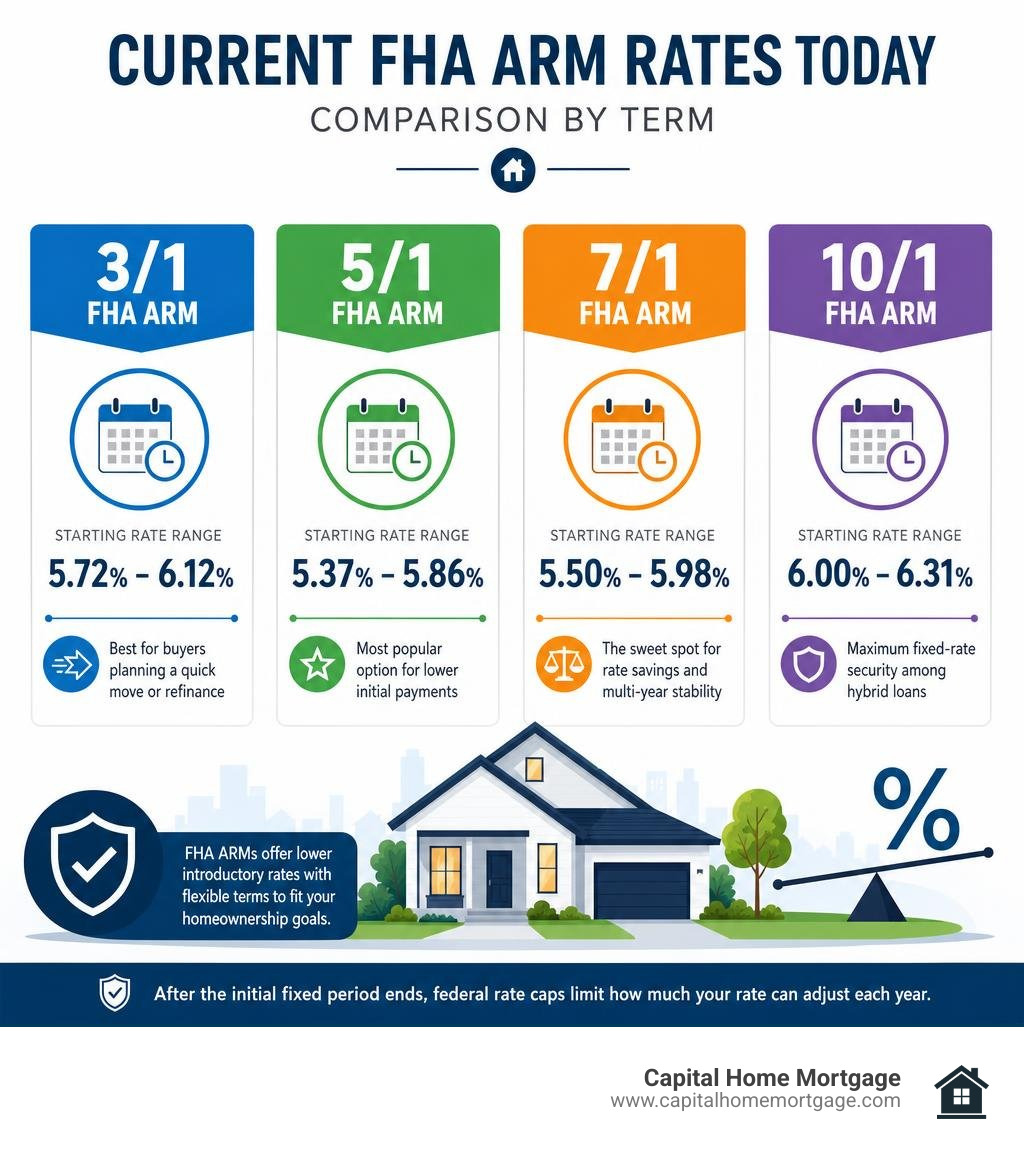
Here is where starting rates stand across the primary FHA ARM terms:
- 5/1 FHA ARM: 5.37% – 5.86% (Most popular option for lower initial payments)
- 7/1 FHA ARM: 5.50% – 5.98% (The sweet spot for rate savings and multi-year stability)
- 3/1 FHA ARM: 5.72% – 6.12% (Best for buyers planning a quick move or refinance)
- 10/1 FHA ARM: 6.00% – 6.31% (Maximum fixed-rate security among hybrid loans)
An FHA adjustable-rate mortgage (backed by HUD’s Section 251 program) gives you an affordable entry rate with just 3.5% down. After your initial fixed period ends, federal rate caps strictly limit how much your interest rate can adjust each year.
I’m Dale Gremillion, a manager at Capital Home Mortgage with over 26 years of mortgage experience helping homebuyers evaluate fha arm rates today to find their best financing fit. Let’s look at how these rates compare across terms, how adjustment caps protect your monthly budget, and when an ARM makes the most financial sense.
Fha arm rates today word roundup:
Understanding FHA ARM Rates Today and Current Term Structures

While roughly 92% of households carry standard fixed-rate mortgages, the remaining 8% leverage adjustable-rate mortgages (ARMs) to capture upfront savings. When broader interest rate environments remain elevated, opting for an FHA adjustable-rate loan allows buyers to secure lower introductory payments without sacrificing the flexible underwriting guidelines of the Federal Housing Administration.
Administered under HUD’s Section 251 program, FHA ARMs combine accessible qualification rules with regulated adjustment mechanisms. According to recent industry benchmarks, including the current ARM mortgage rates report for Aug. 24, 2026 – Money Street News, the spread between fixed and hybrid loans offers tangible monthly relief. Borrowers reviewing FHA ARM Rates: Compare 2026 & Save | Gerald often find that saving 0.50% to 1.00% on their starting interest rate creates significant breathing room in their household budget during the initial years of homeownership.
How FHA ARM Rates Today Compare by Term Length
Hybrid ARMs are defined by two numbers: the first indicates how many years the initial interest rate remains fixed, while the second reveals how often the rate can adjust after that period expires. On an FHA ARM, adjustments occur once every 12 months after the introductory window closes.
| Loan Term | Initial Fixed Period | Adjustment Frequency | Introductory Rate Range (August 2026) | Primary Advantage |
|---|---|---|---|---|
| 3/1 FHA ARM | 3 Years | Annually (Every 1 Year) | 5.72% – 6.12% | Short-term holding strategy |
| 5/1 FHA ARM | 5 Years | Annually (Every 1 Year) | 5.37% – 5.86% | Lowest starting interest rate |
| 7/1 FHA ARM | 7 Years | Annually (Every 1 Year) | 5.50% – 5.98% | Balanced stability and savings |
| 10/1 FHA ARM | 10 Years | Annually (Every 1 Year) | 6.00% – 6.31% | Long-term payment protection |
The 5/1 ARM remains the primary choice for borrowers seeking the lowest possible starting rate. A 0.50% rate discount on a $300,000 mortgage saves approximately $100 to $125 per month, which equals over $6,000 to $7,500 in cumulative interest savings over the initial 5-year fixed phase. Meanwhile, the 7/1 ARM acts as a reliable middle ground for families seeking seven years of predictable housing costs before facing market adjustments.
FHA ARMs vs. Fixed-Rate and Conventional ARM Products
Comparing government-insured ARMs to conventional adjustable and fixed-rate products highlights key differences in pricing, borrower qualifications, and market indices.
Conventional ARMs have largely transitioned to six-month adjustment cycles (such as 5/6, 7/6, or 10/6 structures) tied to the Secured Overnight Financing Rate (SOFR). In August 2026, benchmark conventional averages include:
- 5/6 Conforming SOFR ARM: 6.284%
- 5/6 Jumbo SOFR ARM: 5.982%
- 7/6 Conforming SOFR ARM: 6.439%
- 7/6 Jumbo SOFR ARM: 6.314%
- 10/6 Conforming SOFR ARM: 6.807%
- 10/6 Jumbo SOFR ARM: 6.359%
- 30-Year Fixed FHA Loan: 6.11% – 6.31%
FHA ARMs generally provide lower introductory rate tiers than standard 30-year fixed loans and conforming conventional ARMs, especially for borrowers carrying moderate credit scores. Whether exploring FHA Home Loans California or evaluating options in other competitive housing markets, government-backed ARMs provide lower entry barriers and predictable annual rate adjustment caps.
How FHA Section 251 ARMs and Rate Caps Function

FHA adjustable-rate loans operate under strict federal guidelines to protect borrowers from sudden payment spikes. The core rules established by HUD for FHA Adjustable Rate Mortgages dictate how rates reset once the introductory term concludes.
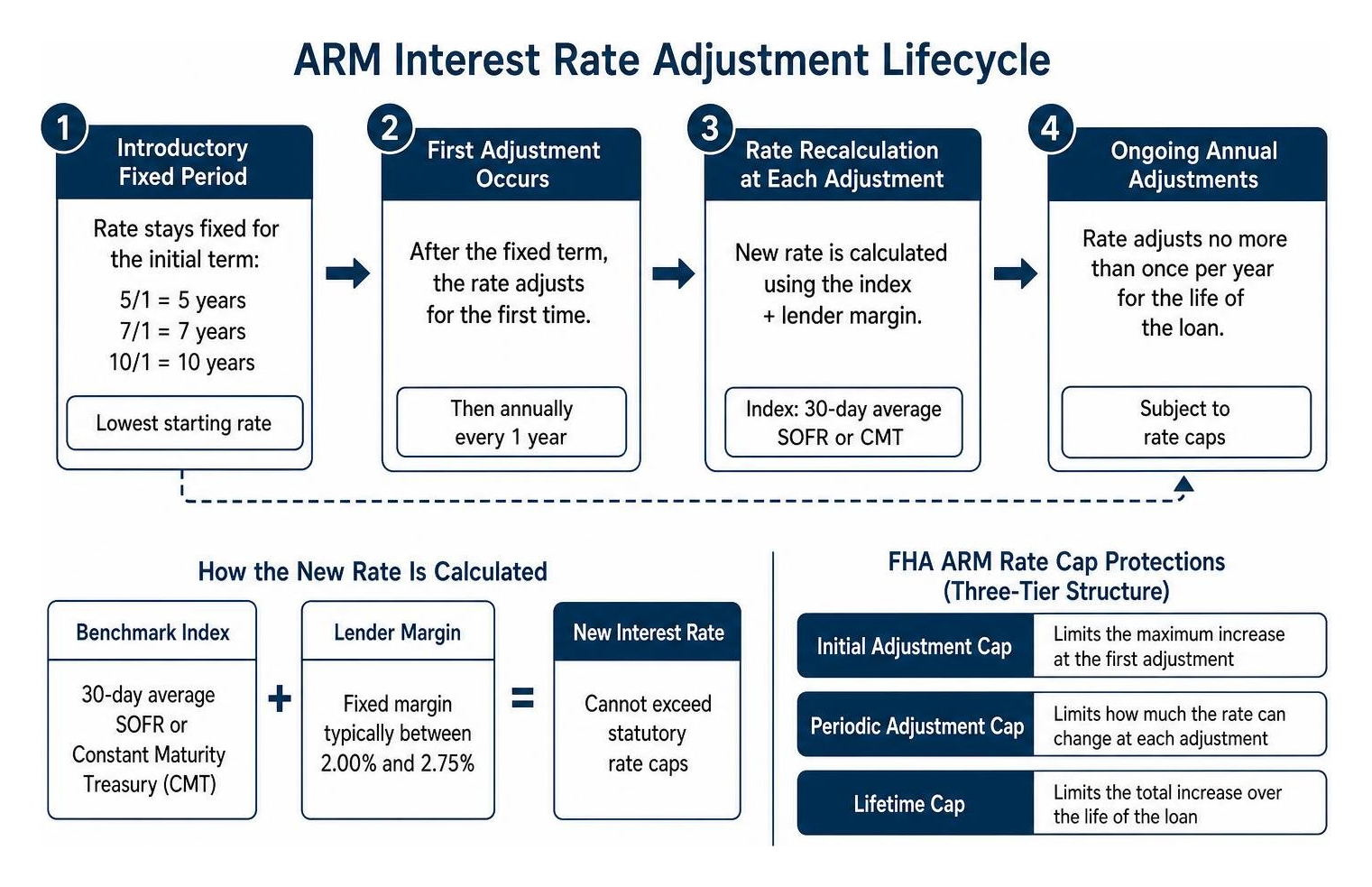
When an FHA ARM resets, the new rate is calculated by adding a fixed lender margin (typically between 2.00% and 2.75%) to an underlying benchmark index, such as the 30-day average SOFR or Constant Maturity Treasury (CMT) index. However, the resulting rate cannot exceed specific statutory rate caps.
Rate Cap Protections and SOFR Index Adjustments
Rate caps establish legal limits on how much your interest rate can move upward or downward. FHA ARMs utilize a three-tiered protective cap structure:
- Initial Adjustment Cap: Restricts how much the interest rate can change during the very first reset cycle. For 1-year, 3-year, and 5-year FHA ARMs, this cap is strictly limited to 1 percentage point (or 2 percentage points depending on the specific program pool). For 7-year and 10-year ARMs, initial changes cannot exceed 2 percentage points.
- Subsequent (Annual) Adjustment Cap: Limits annual fluctuations for all subsequent reset years to 1% or 2% above or below the previous year’s rate.
- Lifetime Adjustment Cap: Sets an absolute ceiling on the interest rate for the entire life of the loan. FHA Section 251 rules mandate that the lifetime rate cannot rise more than 5 to 6 percentage points above the original introductory rate.
To further safeguard homeowners, federal regulations require lenders to send written notices at least 25 days before an interest rate adjustment changes the monthly payment amount, giving you ample time to budget for any shift.
Qualification Criteria and Down Payment Thresholds
Qualifying for an FHA ARM follows standard FHA underwriting guidelines:
- Credit Score: A minimum FICO score of 580 qualifies for the maximum financing option of 3.5% down. Applicants with credit scores between 500 and 579 are eligible with a minimum 10% down payment.
- Debt-to-Income (DTI) Ratios: Automated underwriting systems generally permit back-end DTI ratios up to 43% to 50%, depending on compensating factors such as cash reserves or residual income.
- Mortgage Insurance Premiums (MIP): Like all FHA purchase loans, Section 251 ARMs require an Upfront Mortgage Insurance Premium (UFMIP) of 1.75% of the base loan balance (which can be financed into the loan) and an annual MIP paid monthly across the loan term.
- Owner-Occupancy: Properties financed through Section 251 must serve as the borrower’s primary residence. Eligible property types include single-family homes, 2-to-4 unit properties, approved condominiums, and manufactured homes.
Borrowers applying for programs like FHA Home Loans Hialeah benefit from these accessible entry guidelines, which remain far more forgiving of lower credit profiles than conventional loan programs.
Evaluating When an Adjustable-Rate Mortgage Makes Financial Sense
An adjustable-rate mortgage is a strategic financial tool designed for specific ownership timelines. While fixed-rate mortgages prioritize long-term predictability, ARMs reward borrowers whose life plans align with the introductory fixed period.
Navigating FHA ARM Rates Today for Maximum Household Savings
Choosing an FHA ARM makes practical sense in several common scenarios:
- Starter Home Buyers: If you plan to live in your first home for 3 to 5 years before upgrading to accommodate a growing family, a 5/1 ARM locks in discounted payments for the entire time you reside in the property.
- Relocating Professionals: Homeowners who anticipate job transfers or military relocations within a 5-to-7-year window can capitalize on the lower introductory rate without ever experiencing an interest rate reset.
- Elevated Rate Environments: During market cycles where fixed rates are high, taking an ARM provides lower initial monthly payments, freeing up cash flow while you prepare to refinance when broader macroeconomic conditions improve.
For example, buyers utilizing FHA Home Loans Seattle in dynamic real estate markets can apply their initial interest savings toward accelerated principal reduction or home improvements.
Refinancing and Risk Mitigation Strategies
Holding an ARM does not lock you into future market volatility. If interest rates decrease or your property appreciates, you can refinance your loan before the initial fixed window closes.
The FHA Streamline Refinance program provides an efficient pathway to convert an adjusting FHA ARM into a stable 30-year or 15-year fixed loan. Streamline refinances frequently waive extensive credit checks, income verifications, and property appraisals, reducing closing timelines and administrative burdens. Building an emergency reserve during your low-rate introductory years also ensures that even if you choose not to refinance, your household budget can comfortably absorb annual cap adjustments.
Frequently Asked Questions About FHA ARMs
How much can an FHA ARM rate adjust in a single year?
Under HUD Section 251 guidelines, an FHA ARM interest rate cannot increase by more than 1 to 2 percentage points in any single adjustment period, depending on whether you hold a 3/1, 5/1, 7/1, or 10/1 product. Furthermore, the rate cannot climb more than 5 to 6 percentage points above your starting introductory rate over the entire life of the mortgage.
Can you convert an FHA adjustable-rate mortgage to a fixed-rate loan?
Yes. Homeowners can refinance an FHA ARM into a fixed-rate mortgage at any time. Borrowers can use the FHA Streamline Refinance program to switch into a fixed FHA loan with minimal documentation, or refinance into a conventional fixed loan once they have accumulated at least 20% home equity to eliminate mortgage insurance premiums.
What credit score is needed to qualify for an FHA ARM?
You need a minimum credit score of 580 to qualify for an FHA ARM with the standard 3.5% down payment. Borrowers with credit scores between 500 and 579 may still qualify by making a minimum down payment of 10%. Applicants with credit scores above 700 typically secure the most favorable introductory interest rates and lender margins.
Conclusion
FHA adjustable-rate mortgages provide an effective way to lower your initial monthly housing payments while benefiting from government-mandated rate caps and flexible credit requirements. Whether you are purchasing your first home or navigating an evolving housing market, matching your ownership horizon to a 5/1 or 7/1 ARM can generate thousands of dollars in early interest savings.
At Capital Home Mortgage, we are a direct, full-service mortgage lender offering purchase, refinance, and government-backed lending solutions across our nationwide branch network. Because we handle our processing and underwriting directly in-house, we provide fast approvals, transparent communication, and dedicated loan officer support from application through closing.
If you are ready to explore your mortgage options and compare today’s adjustable-rate terms, contact our experienced lending team at FHA Home Loans to get started today.


