
Start With the Right Bank Loan for House Construction
A bank loan for house construction is short-term financing that pays your builder in stages as work is completed. To choose the right option, compare a one-time-close construction-to-permanent loan with a construction-only loan, get preapproved before finalizing plans, and work with a licensed builder your lender can approve.
Unlike a standard mortgage, which funds the purchase of a completed home in one payment, a construction loan uses scheduled draws. The lender typically inspects the site before releasing each draw, often four to six times during the build. Construction terms usually last a year or less, and rates may be about one percentage point higher than a typical 30-year mortgage rate.
Your land, approved plans, builder contract, down payment, credit profile, and a realistic budget all matter. Many lenders look for credit around 680 or above and a down payment near 20%, though programs and lender rules vary. A one-time-close loan can be especially useful because it converts into a permanent mortgage after completion without requiring a second closing.
I am Dale Gremillion, a manager at Capital Home Mortgage with more than 26 years of experience in mortgage operations and home-loan guidance. In this guide, I will explain how a bank loan for house construction works so you can prepare for the build, the approval process, and the move-in mortgage.
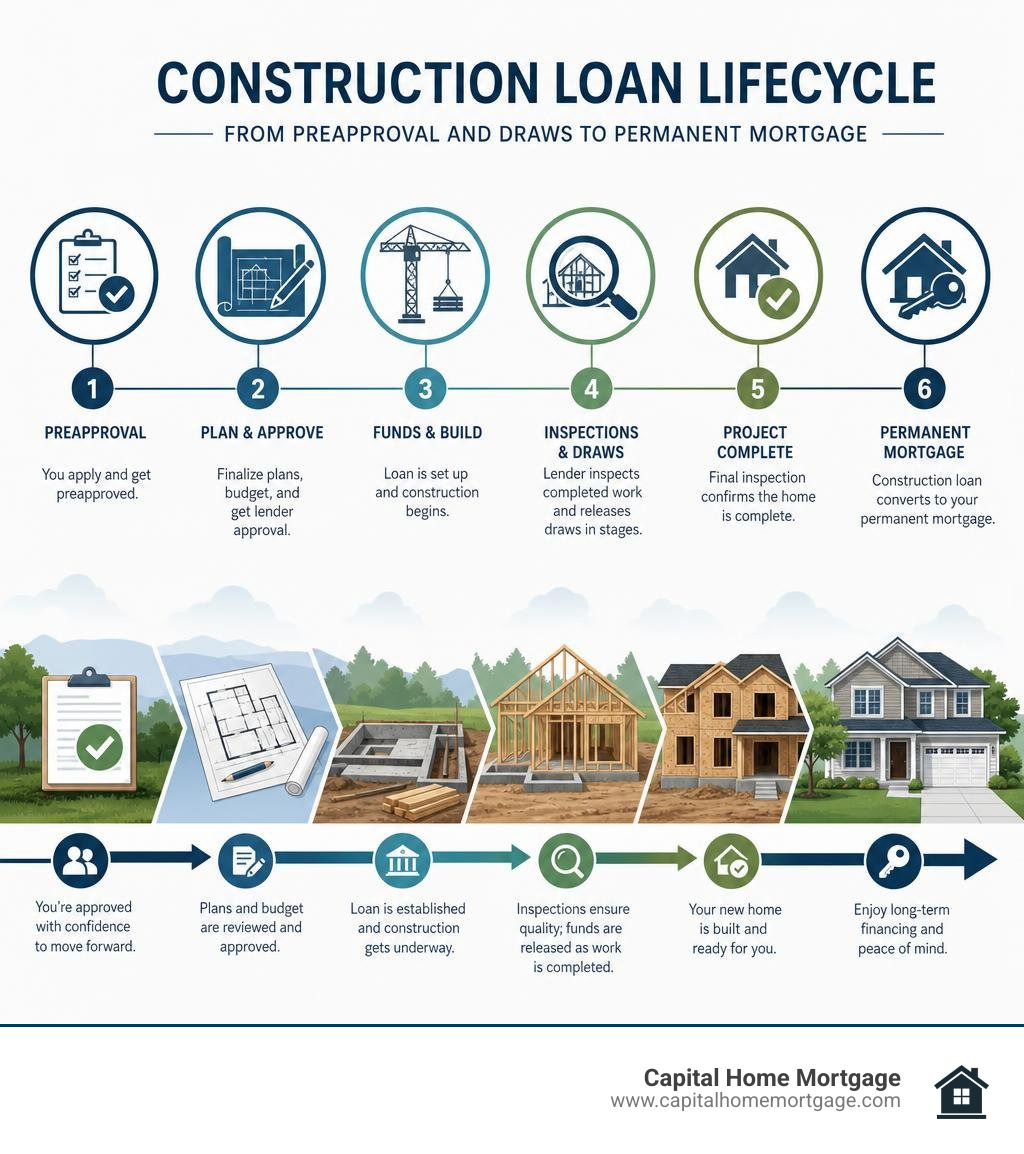
Bank loan for house construction terms made easy:
Understanding How a Bank Loan for House Construction Works
Financing a ground-up build is fundamentally different from purchasing an existing property. When you buy a move-in-ready home, the lender uses the physical structure as immediate collateral. If a borrower defaults on day one, the bank can repossess an intact, marketable asset. With a new build, the collateral is initially just a patch of dirt and a stack of blueprints. This creates a higher level of collateral risk for the lender.
To manage this risk, lenders structure construction home loans as short-term, interim financing—typically lasting 12 months or less. Instead of delivering a lump sum at closing, the bank distributes funds incrementally as the home takes shape.
During the active building phase, borrowers are generally not required to make full principal-and-interest payments. Instead, monthly payments are interest-only, calculated strictly on the total amount disbursed to date rather than the entire approved loan amount. Many borrowers also set up an interest reserve account within the loan balance, which automatically finances these monthly interest payments throughout the build period so you aren’t paying two full housing payments while your home is under construction.

Covered Project Expenses and Excluded Costs
A construction loan covers hard construction costs and specific soft costs directly related to establishing the physical structure. Understanding what can and cannot be rolled into the loan is critical for budgeting your cash reserves.
Covered project expenses include:
- Land acquisition (purchasing the lot as part of the construction package)
- Site preparation, excavation, clearing, and grading
- Foundation pouring, concrete work, and framing lumber
- Major mechanical systems: plumbing, HVAC, electrical, and roofing
- Subcontractor and general contractor labor costs
- Building permits, impact fees, and municipal utility connection charges
- Permanent interior finishes (flooring, drywall, cabinetry, countertops, and fixed appliances)
Excluded expenses that typically require out-of-pocket payment:
- Standalone architect fees and professional engineering designs created prior to loan closing
- Interior decorator and design consulting services
- Detached, non-essential luxury outbuildings not included in the original approved master appraisal
- Moveable furniture, window treatments, and standard home decor
- Living expenses during construction (such as short-term rental leases)
Milestone Draw Schedules and Site Inspections

Rather than paying the builder upfront, lenders utilize a structured milestone draw schedule. Funds are held in escrow and disbursed only when verified construction phases reach completion.
Before each draw is released, the lender dispatches an independent, licensed construction inspector to verify that the work meets quality benchmarks and adheres to the submitted architectural plans. Over the course of a typical build, you can expect four to six lender inspections.
A standard draw timeline often looks like this:
- Draw 1: Site preparation, excavation, and foundation completion.
- Draw 2: Framing, exterior sheathing, roof trusses, and rough window/door installation.
- Draw 3: Rough-in mechanicals (electrical wiring, plumbing lines, HVAC ductwork) and insulation.
- Draw 4: Drywall installation, interior trim, cabinetry, and initial painting.
- Draw 5: Final finishes, fixture installation, flooring, and mechanical trim-outs.
- Draw 6 (Final): Issuance of the Certificate of Occupancy and completion of all punch-list items.
Prior to releasing payments to the builder, the title company performs title updates to ensure no mechanics liens have been filed by unpaid subcontractors or material suppliers. This protects both the borrower and the lender from unexpected encumbrances on the property.
Construction Loan Interest Rates and Repayment Terms
Because of the short-term nature and elevated default risk of unfinished properties, construction loan interest rates are typically variable and benchmarked against the prime rate. On average, construction rates sit about one percentage point higher than standard 30-year fixed purchase mortgage rates.
During construction, your interest accrues exclusively on the cumulative unpaid principal balance. For instance, if your total approved construction limit is $500,000, but only $100,000 has been disbursed across the first two draws, you will only owe monthly interest on that $100,000.
Once construction is officially complete and the local municipality issues a final Certificate of Occupancy, the short-term construction financing phase ends. At this stage, the loan must either be paid in full or transitioned into an amortized permanent mortgage spanning 15 to 30 years.
Major Types of Residential Construction Financing
Choosing the proper loan product determines how many times you must close, the total closing fees you will pay, and your exposure to market rate fluctuations while construction is underway.
One-Time Close vs Two-Time Close Structures
The two primary frameworks for new builds are construction-to-permanent loans (one-time close) and standalone construction loans (two-time close).
With a one-time close loan, you apply, qualify, and close once. The construction financing automatically converts into a long-term, permanent mortgage once the home is finished, locking in your permanent rate upfront and eliminating a second round of closing costs. To explore how this works in specific markets, consider reviewing our regional programs such as One-Time Close Construction Loans San Antonio, One-Time Close Construction Loans College Station, One-Time Close Home Loans Columbia SC, or One-Time Close Construction Loans Skyline Properties.
Conversely, a two-time close involves securing a short-term construction note first, followed by a completely separate refinance or “end loan” once construction wraps up. This requires paying dual closing costs, undergoing two separate underwriting reviews, and facing interest rate risk if market rates rise during your build.
| Feature | One-Time Close (Construction-to-Permanent) | Two-Time Close (Construction-Only) |
|---|---|---|
| Closings Required | Single closing before breaking ground | Two distinct closings (pre-build & post-build) |
| Closing Costs | Single set of settlement fees | Dual settlement and origination fees |
| Interest Rate Risk | Permanent rate locked upfront | Exposed to rate changes during construction |
| Re-qualification | No requalification upon completion | Must requalify financially for the permanent end loan |
| Best For | Borrowers seeking certainty and cost savings | Complex custom projects requiring mid-build modifications |
For additional regional resources, we also provide options such as Construction Home Loans South Carolina, Construction Home Loans Minnesota, Construction Home Loans Tennessee, and Construction Home Loans.
Specialized Programs: Renovation, Government-Backed, and Owner-Builder
Beyond standard conventional construction loans, several government-backed and specialized loan options exist to fit various borrower situations:
- FHA Construction Loans: Allows down payments as low as 3.5% with flexible credit guidelines for qualified buyers building a primary residence.
- VA Construction Loans: Offers eligible military service members and veterans the ability to build with 0% down payment financing under a single-close structure.
- USDA Construction Loans: Provides 100% financing for new builds in eligible rural areas through programs supported by USDA Rural Development.
- Renovation Loans (FHA 203(k) / Fannie Mae HomeStyle): Designed for properties that require major structural overhauls or substantial updates, wrapping the purchase price and renovation costs into one loan.
- Owner-Builder Loans: Strictly regulated programs where the borrower serves as the general contractor. Most institutional lenders prohibit this unless the borrower is a full-time, licensed, and insured general contractor by trade.

Preparing for Approval and Managing Construction Risks
Securing financing for a home that does not yet exist requires thorough documentation and clear risk management.

Requirements to Secure a Bank Loan for House Construction
Lenders evaluate both your personal financial standing and the viability of your construction project.
Essential qualification criteria:
- Credit Score: A minimum credit score of 680 is standard, though certain specialized programs may permit scores down to 620.
- Down Payment: Expect to provide 20% down for conventional construction loans, though government programs (FHA/VA) allow lower down payments for qualified borrowers.
- Debt-to-Income (DTI) Ratio: Total monthly debt obligations (including the future housing payment) should ideally stay under 43% to 45%.
- Contingency Reserve Fund: Lenders generally require a built-in contingency buffer—typically 5% to 10% of total construction costs—to absorb unforeseen material price increases or site complications.
- Builder’s Risk Insurance: A mandatory insurance policy protecting the structure against fire, severe weather damage, theft, and vandalism during active construction.
Essential documentation checklist:
- Two years of personal and business tax returns, W-2s, and recent pay stubs
- Two to three months of asset statements showing funds for down payment and reserves
- A fully executed builder contract outlining fixed costs and milestone timelines
- Comprehensive architectural blueprints, structural engineering reports, and floor plans
- Detailed line-item budget specifications (materials, labor, allowances)
- Proof of builder credentials: state contractor license, general liability insurance, and workman’s compensation coverage
Step-by-Step Guide to Apply for a Bank Loan for House Construction
- Select a Vetted, Licensed Builder: Choose an established general contractor with verified references, financial stability, and active licensing.
- Get Preapproved with a Direct Lender: Establish your realistic borrowing capacity before spending money on custom blueprints.
- Finalize Blueprints and Cost Breakdowns: Collaborate with your architect and builder to finalize buildable plans, a line-item budget, and a realistic draw schedule.
- Submit for Underwriting and “Subject-To” Appraisal: The lender orders an appraisal that assesses the projected value of the completed home based on the land and architectural plans (“subject to completion”).
- Close Loan and Break Ground: Once underwriting confirms builder approval and appraisal valuation, closing occurs, initial permits are pulled, and construction starts.
Throughout Texas, we serve prospective builders across many communities, including Construction Home Loans Dallas, Construction Home Loans Fort Worth, Construction Home Loans Austin, Construction Home Loans Houston, Construction Home Loans Stephenville, Construction Home Loans Corpus Christi, Construction Home Loans Laredo, Construction Home Loans Amarillo, Construction Home Loans Odessa, Construction Home Loans El Paso, Construction Home Loans Abilene, Construction Home Loans Wichita Falls, Construction Home Loans Waco, Construction Home Loans San Angelo, Construction Home Loans San Marcos, Construction Home Loans Tyler, Construction Home Loans Galveston, Construction Home Loans Round Rock, Construction Home Loans Texarkana, Construction Home Loans McAllen, Construction Home Loans Killeen, Construction Home Loans Lubbock, Construction Home Loans Midland, Construction Home Loans Beaumont, and Construction Home Loans Brownsville.
We also offer specialized regional financing programs, including Construction Home Loans Hialeah FL, Construction Home Loans Chattanooga, Construction Home Loans Memphis, Construction Home Loans Nashville, and Construction Home Loans Delaware Newark. You can also review state-specific strategies such as How to Qualify for a Construction Loan in Florida or How One-Time Construction Loans Work in Arizona.
Frequently Asked Questions About House Construction Financing
How does owning the land affect the construction loan process?
If you already own your building lot outright, the accumulated equity can serve as your down payment credit. The lender appraises the land alongside the proposed construction blueprints to establish the combined future property value.
If there is an existing loan balance on the lot, the construction loan can pay off the underlying land balance at closing and roll the remaining equity into the project. That lenders carefully review unimproved land to ensure access to essential utilities like power, water, and road infrastructure.
What happens if the construction project takes longer than expected?
Construction delays can happen due to severe weather, supply shortages, or permitting hold-ups. If a project exceeds its initial 12-month timeline, you should notify your lender immediately.
Most lenders can issue short-term loan extensions (typically 30 to 90 days), though extensions may involve administrative fees and continue your monthly interest-only payments. Maintaining clear communication between your general contractor and your loan officer helps prevent unexpected funding pauses.
Can a borrower act as their own general contractor on a build loan?
Most residential mortgage lenders do not permit borrowers to act as their own general contractor (often called an owner-builder loan). Lenders require a licensed, third-party general contractor to oversee the build to ensure local code compliance, budget adherence, and timely execution.
Exceptions are rare and generally limited to borrowers who hold an active, verifiable general contracting license, carry commercial liability insurance, and have documented experience managing comparable residential builds.
Conclusion
Building your custom home from the ground up gives you complete control over your floor plan, materials, and living space. Navigating construction draw schedules, site inspections, and permanent conversion is straightforward when you work with an experienced direct lending team.
At Capital Home Mortgage, we manage every stage of your build through in-house processing and underwriting. This hands-on approach ensures quick draw turnaround times, transparent communication, and a smooth transition into your long-term permanent mortgage. Whether you are building on private land or in a planned community, explore our options for Construction Home Loans Texas or connect with our mortgage specialists at Capital Home Mortgage to start building your dream home today. If your plans involve manufactured or factory-built options, we also provide specialized solutions such as Chattel Home Loans.


