
Estimate Your Average PMI Rate Before You Buy
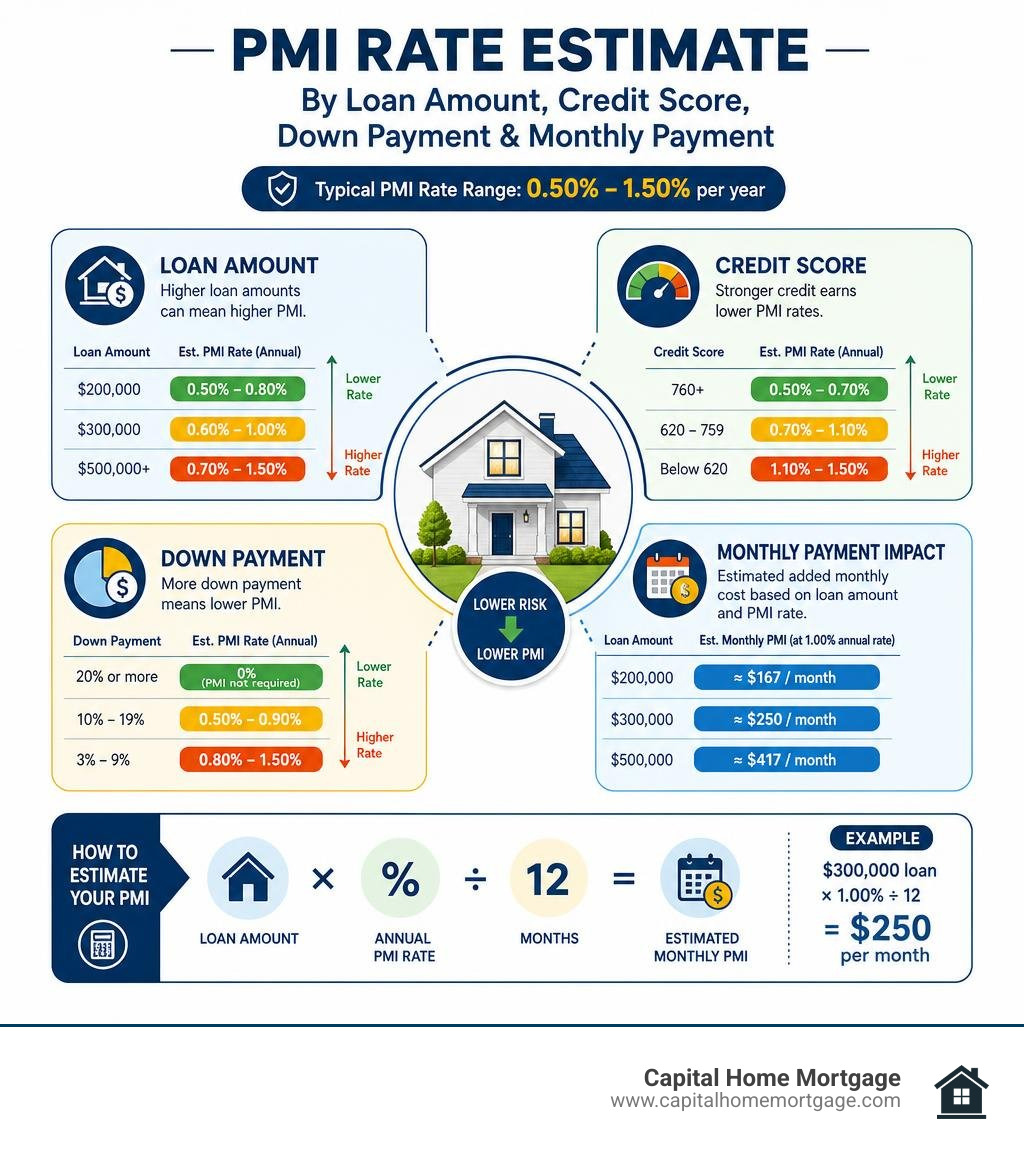
The average PMI rate in 2026 is usually about 0.46% to 1.50% of the mortgage amount per year. For a quick estimate, multiply your loan amount by the annual PMI rate, then divide by 12. A $300,000 loan at a 1% rate, for example, would add about $250 per month.
Your actual cost depends most on your credit score and down payment. Strong credit and a larger down payment usually mean a lower rate, while a smaller down payment means a higher loan-to-value ratio and often higher PMI.
PMI is generally required on a conventional loan when you put down less than 20%. It protects the lender, not you, but it can help you buy sooner with as little as 3% down. The good news: unlike FHA mortgage insurance in many cases, conventional PMI can usually be removed once you reach enough equity.
I’m Dale Gremillion, a manager at Capital Home Mortgage with more than 26 years of experience helping borrowers compare loan options and understand costs such as the average PMI rate. Next, let’s look at what PMI rates look like in 2026 and why two buyers can pay very different amounts for the same home.
What Is the Average PMI Rate in 2026?
When purchasing a home with a conventional loan, the annual premium yield for private mortgage insurance represents a percentage of your original loan balance divided into monthly installments. While market rates fluctuate, the typical annual rate for most conventional borrowers hovers between 0.50% and 1.50%, with the national average sitting around 0.60% to 0.90% for standard prime buyers.
Understanding conventional mortgage basics makes it easier to see how private mortgage insurance acts as a bridge. It allows lenders to issue loans with as little as 3% down without taking on catastrophic default risk. Private mortgage insurers price this risk using detailed risk matrices. According to Urban Institute research on mortgage insurance, average in-force premium yields across private insurers have become significantly more competitive over the past decade, dropping to roughly 39.4 basis points across overall agency portfolios.
Private mortgage insurance is unique because you pay the premium, but the policy insures the lender against financial loss if you default. Despite that dynamic, PMI serves as a powerful financial lever. Rather than spending five to ten years renting while saving a massive cash cushion, buyers can leverage mortgage insurance to purchase immediately and build real estate equity.
Understanding the Average PMI Rate by Credit Score
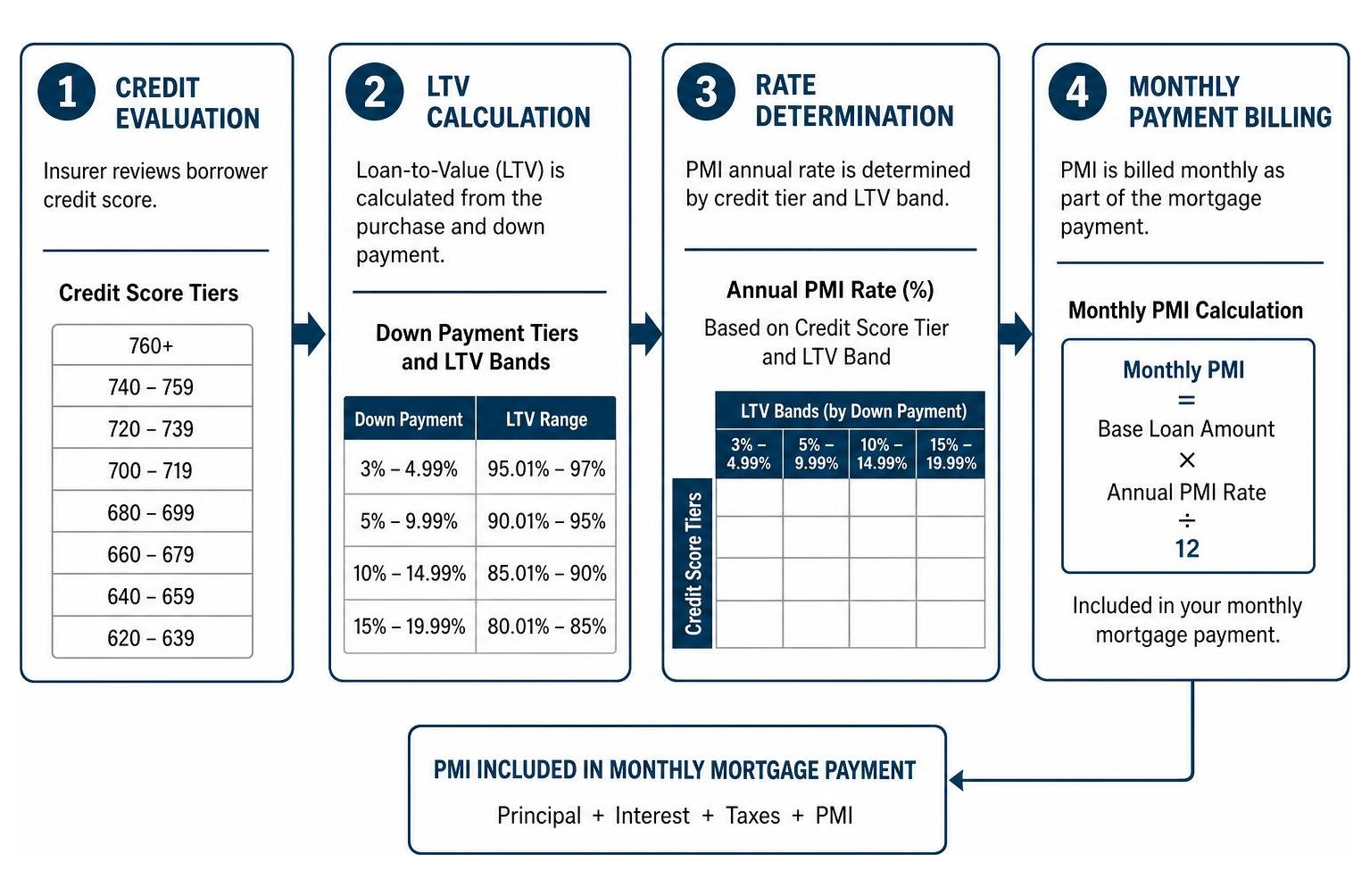
Your credit score is the single most influential pricing factor insurers evaluate when calculating your rate. Insurers group borrowers into risk tiers where pricing cliffs occur, most notably below the 740 and 660 FICO score thresholds.
A borrower with pristine credit represents a statistically lower default risk, allowing insurers to discount the annual rate substantially. Conversely, lower credit tiers require higher coverage depth to offset risk, driving monthly costs upward.
| Credit Score Tier | 3%–5% Down (95.01%–97% LTV) | 5%–10% Down (90.01%–95% LTV) | 10%–15% Down (85.01%–90% LTV) | 15%–19.9% Down (80.01%–85% LTV) |
|---|---|---|---|---|
| 760+ | 0.55% – 0.65% | 0.46% – 0.55% | 0.30% – 0.40% | 0.19% – 0.28% |
| 740 – 759 | 0.70% – 0.85% | 0.58% – 0.70% | 0.40% – 0.50% | 0.25% – 0.35% |
| 720 – 739 | 0.90% – 1.05% | 0.75% – 0.88% | 0.50% – 0.62% | 0.32% – 0.42% |
| 700 – 719 | 1.05% – 1.25% | 0.88% – 1.02% | 0.60% – 0.75% | 0.40% – 0.52% |
| 680 – 699 | 1.25% – 1.45% | 1.05% – 1.20% | 0.75% – 0.90% | 0.50% – 0.65% |
| 660 – 679 | 1.45% – 1.70% | 1.20% – 1.40% | 0.90% – 1.10% | 0.62% – 0.80% |
| 640 – 659 | 1.70% – 2.05% | 1.45% – 1.75% | 1.15% – 1.40% | 0.80% – 1.05% |
| 620 – 639 | 1.95% – 2.25% | 1.65% – 1.95% | 1.35% – 1.65% | 0.95% – 1.25% |
Down Payment Tiers and LTV Ratios
Loan-to-Value (LTV) measures the ratio between your mortgage balance and the appraised value of the property. If you buy a $400,000 home and put down $20,000 (5%), your loan amount is $380,000, creating an LTV of 95%.
Insurers evaluate LTV in distinct risk bands:
- 95.01% to 97% LTV (3% to 4.99% Down): Carries the highest default risk. Insurers typically require 35% coverage depth on the loan, resulting in the highest premium rates.
- 90.01% to 95% LTV (5% to 9.99% Down): Standard coverage depth drops to 30% or 25%, resulting in a noticeable decrease in annual rates.
- 85.01% to 90% LTV (10% to 14.99% Down): Standard coverage depth sits around 25%, providing moderate pricing relief.
- 80.01% to 85% LTV (15% to 19.99% Down): Coverage depth drops to 12%, offering the lowest possible rates before PMI disappears completely at 80% LTV.
How to Calculate Your Monthly PMI Cost and Payment
Calculating your monthly mortgage insurance payment is straightforward once you know your annual rate percentage and base loan amount. The universal mathematical formula is:
$$\text{Monthly PMI} = \frac{\text{Base Loan Amount} \times \text{Annual PMI Rate}}{12}$$
For instance, if your loan amount is $350,000 and your risk profile yields an annual PMI rate of 0.72%:
- Multiply $350,000 by 0.0072 = $2,520 (annual PMI premium).
- Divide $2,520 by 12 months = $210 per month.
This monthly fee is collected alongside your principal, interest, real estate property taxes, and homeowners insurance (often abbreviated as PITI + PMI) in your standard escrow account.
How Loan Amount Impacts the Average PMI Rate
Because PMI is calculated directly as a percentage of your balance, total borrowing power directly influences the dollar amount you pay each month. Choosing conventional options like putting 3 percent down maximizes upfront cash retention, but increases the principal balance subject to the insurance rate multiplier.
On high-balance or conforming jumbo loans, a 1% rate generates a much larger monthly expense than on smaller entry-level properties. As a general rule of thumb, expect to pay roughly $30 to $70 per month for every $100,000 borrowed, depending on your credit standing.
Monthly Payment Scenarios for $300,000, $400,000, and $500,000 Loans
To illustrate how credit score tiers and loan balances interact in the real world, let’s examine estimated monthly and annual costs across three common mortgage amounts based on a 5% down payment (95% LTV).
$300,000 Home Purchase (5% Down = $285,000 Loan Amount)
- Excellent Credit (760+ FICO | ~0.48% Rate): $114/month ($1,368/year)
- Good Credit (700–719 FICO | ~0.95% Rate): $225/month ($2,707/year)
- Fair Credit (640–659 FICO | ~1.55% Rate): $368/month ($4,417/year)
$400,000 Home Purchase (5% Down = $380,000 Loan Amount)
- Excellent Credit (760+ FICO | ~0.48% Rate): $152/month ($1,824/year)
- Good Credit (700–719 FICO | ~0.95% Rate): $300/month ($3,610/year)
- Fair Credit (640–659 FICO | ~1.55% Rate): $490/month ($5,890/year)
$500,000 Home Purchase (5% Down = $475,000 Loan Amount)
- Excellent Credit (760+ FICO | ~0.48% Rate): $190/month ($2,280/year)
- Good Credit (700–719 FICO | ~0.95% Rate): $376/month ($4,512/year)
- Fair Credit (640–659 FICO | ~1.55% Rate): $613/month ($7,362/year)
Over a five-year holding period before reaching 20% home equity, a borrower with a 760+ score on a $400,000 purchase pays approximately $9,120 in cumulative PMI, whereas a borrower in the 640 tier pays roughly $29,450. Improving your credit score prior to loan origination provides substantial long-term savings.
Conventional PMI vs. FHA MIP and Other Insurance Types

When financing a home with a low down payment, homebuyers frequently weigh conventional loans against government-insured options like FHA loans. According to a USMI report on mortgage insurance affordability, private mortgage insurance enabled over 800,000 households to buy homes while saving an average of $48,000 in upfront down payment requirements compared to a full 20% down payment.
However, the cost structure and duration between conventional PMI and FHA Mortgage Insurance Premiums (MIP) differ substantially.
Comparing Conventional PMI with FHA Mortgage Insurance
FHA loans charge two distinct forms of insurance: an Upfront Mortgage Insurance Premium (UFMIP) equal to 1.75% of the base loan amount (usually rolled into the loan balance), plus an Annual MIP rate (typically 0.55% for most 30-year purchase loans with 3.5% down).
FHA MIP rates are largely flat across all credit bands. This makes FHA loans attractive for buyers with credit scores below 660. For buyers with credit scores of 720 and above, conventional PMI is almost always significantly cheaper on a monthly basis.
More importantly, if you put down less than 10% on an FHA loan, FHA MIP remains in place for the entire 30-year life of the loan. The only way to remove it is to sell the property or refinance into a conventional mortgage. Conventional PMI, by contrast, automatically cancels once you build 22% equity.
Borrower-Paid, Lender-Paid, and Single-Premium PMI
Private mortgage insurance can be structured in several distinct ways depending on your financial goals:
- Borrower-Paid Monthly PMI (BPMI): The most common execution (accounting for over 90% of policies). You pay a monthly fee added to your mortgage payment until your equity reaches the removal threshold.
- Lender-Paid Mortgage Insurance (LPMI): The lender pays the mortgage insurance fee upfront in exchange for charging you a higher base mortgage note rate (typically 0.25% to 0.75% higher). While this results in a single monthly payment, that higher interest rate is permanent and cannot be dropped when you reach 20% equity unless you refinance.
- Single-Premium PMI (SPMI): You pay the entire mortgage insurance cost upfront as a single lump-sum closing fee (or finance it into the loan). This eliminates monthly insurance costs, but the upfront cash is generally non-refundable if you move or refinance within a few years.
- Split-Premium PMI: Combines a partial upfront cash fee at closing with a reduced monthly payment thereafter.
For borrowers exploring low upfront options or buying a house with no deposit, understanding these structural distinctions ensures you select the right balance of upfront liquidity versus recurring monthly cost.
Strategies to Remove PMI and Lower Your Housing Costs
One of the greatest benefits of conventional mortgage insurance is that it is temporary. You are never permanently locked into paying monthly PMI for the life of your mortgage.
The 80% and 78% LTV Cancellation Milestones
Federal consumer protections under the Homeowners Protection Act of 1998 (HPA) clearly define your rights regarding PMI cancellation on primary single-family residences:
- Borrower-Requested Cancellation (80% LTV): You have the legal right to submit a written request to your mortgage loan servicer to cancel PMI on the date your loan balance reaches 80% of the original purchase value based on your standard amortization schedule or through early principal prepayments.
- Automatic Termination (78% LTV): Your loan servicer is legally required to automatically terminate PMI on the date your principal balance is scheduled to reach 78% of the original value according to the initial amortization schedule, provided your payments are current.
- Final Midpoint Termination: If your loan balance has not reached 78% due to forbearance or modifications, PMI must automatically terminate once you hit the exact midpoint of your loan term (e.g., month 180 of a 30-year mortgage).
To qualify for early borrower-requested cancellation at 80% LTV, servicers require:
- A written cancellation request submitted directly to your mortgage servicer.
- A good payment record with no payments 30 days past due in the previous 12 months.
- No payments 60 days past due in the previous 24 months.
- Proof that the property value has not declined below the original purchase price (often verified via an automated valuation model or broker price opinion).
- Certification that no subordinate liens or second mortgages exist against the property.
Accelerating Equity Through Payments and Reappraisals
You do not have to wait 5 to 8 years for standard loan amortization to eliminate PMI. Homeowners routinely accelerate their path to 20% equity through two primary methods:
- Making Additional Principal Payments: Adding extra principal toward your monthly mortgage payment directly reduces the loan balance. For example, paying an extra $150 to $200 per month toward principal on a $400,000 mortgage can shorten your PMI timeline by two to three years, saving thousands in unnecessary premiums.
- Requesting Reappraisal Based on Market Appreciation: If home values in your neighborhood have risen sharply or you have completed major structural renovations (such as adding square footage, remodeling a kitchen, or finishing a basement), your home equity may already exceed 20%. Most servicers allow you to order a formal appraisal through their approved panel (typically costing $400 to $600). If your loan balance is 80% or less of the newly appraised current market value, your servicer can remove PMI immediately.
Frequently Asked Questions About Mortgage Insurance
Is paying PMI better than waiting to save a 20% down payment?
In most housing markets, paying PMI to purchase a home sooner is mathematically advantageous compared to waiting years to save a 20% down payment. If home prices appreciate at a modest 3% to 5% annually, a $400,000 home could increase in value by $12,000 to $20,000 in a single year.
If you delay your purchase for three years to save an additional $60,000, you risk being priced out of the neighborhood or paying significantly more for the same house. Paying $150 to $250 a month in temporary PMI allows you to lock in today’s purchase price, establish fixed monthly housing expenses, and capture home appreciation directly.
Are PMI payments tax-deductible in 2026?
Yes. Private mortgage insurance premiums are tax-deductible for eligible homeowners who itemize their deductions on federal tax returns, treated under the same tax provisions as mortgage interest.
This deduction is subject to adjusted gross income (AGI) phase-out limits established by federal tax law. Homeowners should consult a qualified certified public accountant (CPA) or tax professional to review their specific filing status and determine whether itemizing deductions offers greater tax savings than the standard deduction.
Can you avoid PMI without putting 20% down?
Yes, several mortgage programs and structural financing techniques allow qualified borrowers to purchase a home without paying traditional monthly PMI:
- VA Loans: Guaranteed by the U.S. Department of Veterans Affairs, VA loans offer 0% down payment financing with zero monthly mortgage insurance for eligible active-duty service members, veterans, and surviving spouses.
- Piggyback Mortgages (80-10-10 Loans): This structure pairs a standard 80% first mortgage with a 10% second mortgage (such as a home equity loan) and a 10% cash down payment, bypassing PMI entirely.
- Lender-Paid Mortgage Insurance (LPMI): The lender absorbs the insurance cost upfront in exchange for a slightly higher base mortgage interest rate.
- Specialized Community Lending Programs: Certain state and proprietary loan programs offer reduced or zero-PMI options for qualified first-time buyers meeting specific income and location criteria.
Conclusion
Understanding your average PMI rate gives you complete clarity when budgeting for a home purchase. Rather than viewing mortgage insurance as an obstacle, seasoned homebuyers leverage PMI as a strategic tool to access homeownership years ahead of schedule, build lasting equity, and protect their liquid emergency savings.
At Capital Home Mortgage, we operate as a direct, full-service mortgage lender offering a comprehensive suite of home loan products, including conventional, FHA, VA, USDA, jumbo, construction, and refinance loans. Because we manage all processing and underwriting directly in-house, our team delivers fast pre-approvals, competitive pricing, on-time closings, and dedicated loan officer support every step of the way.
Ready to see how low your monthly payment could be? Use our interactive mortgage payment calculator to test down payment scenarios, or connect with a Capital Home Mortgage loan specialist today to receive a personalized, transparent rate quote tailored to your financial goals.


