What Is a Renovation Mortgage and How Does It Work?
A renovation mortgage is a specialized lending product designed to fund both the purchase price (or existing loan balance during a refinance) and the cost of property improvements through a single closing. Traditional home loans base their maximum borrowing limit on the home’s current appraised market value. If a property has a leaking roof, failing plumbing, or cracked foundation walls, a standard appraiser may deem the home uninhabitable, causing traditional financing to fall through immediately. In contrast, renovation financing bases the total loan amount on the home’s projected after-repair value (ARV)—what the property will be worth once all planned improvements are completed.
Buying a home that needs major work can feel daunting. According to industry surveys, 42% of homeowners have at least one regret about buying their current home, with unexpected maintenance and repair costs topping the list of complaints. When you consider that only 47% of Americans say they can comfortably cover a $1,000 emergency expense out of pocket, paying for structural overhauls or a full kitchen remodel with cash simply isn’t an option for most buyers. A single-loan financing package solves this dilemma by wrapping acquisition and repair costs into one manageable monthly payment.
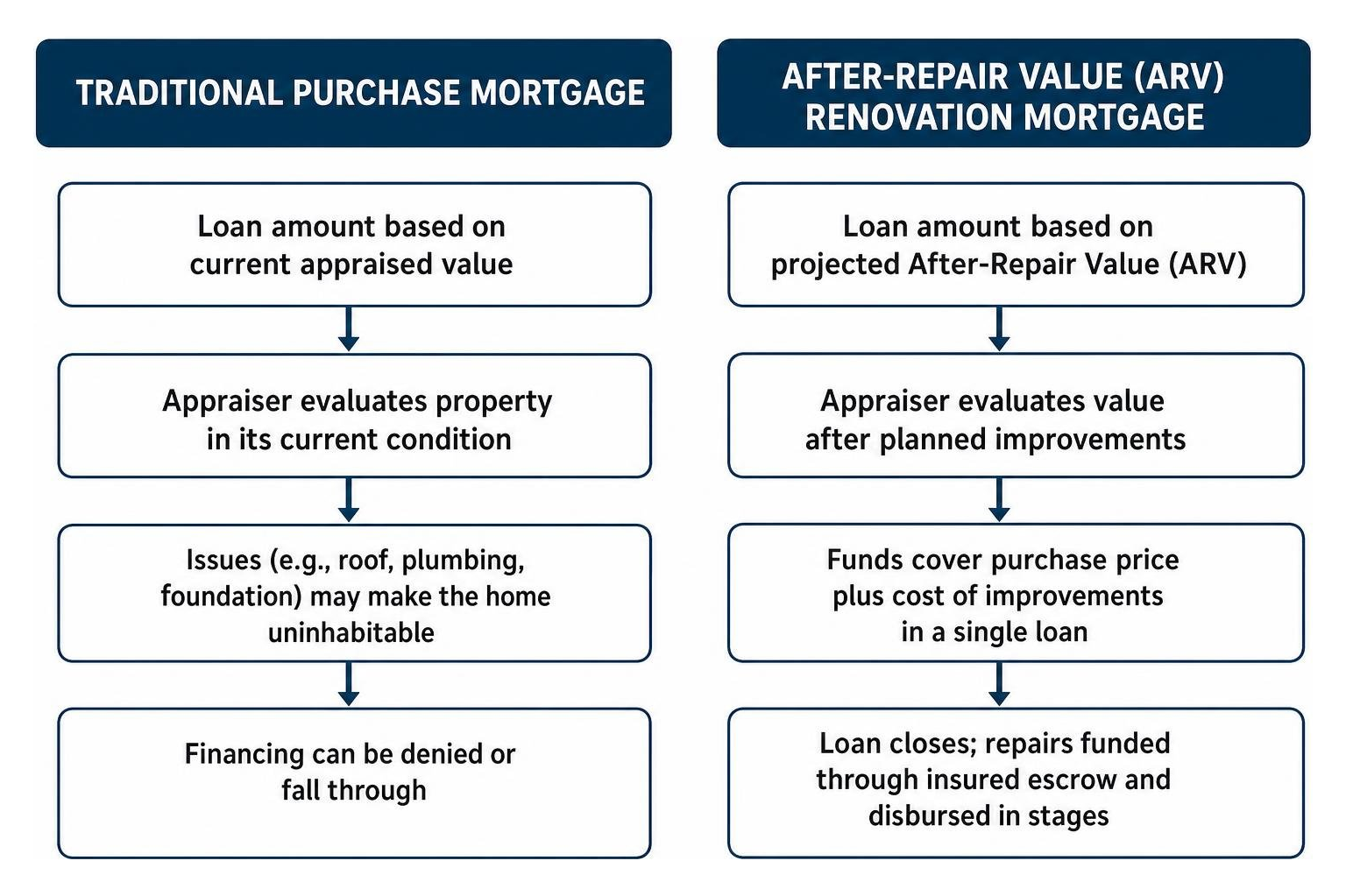
When your loan closes, the seller is paid the agreed purchase price, and the remaining funds allocated for repairs are placed into an insured custodial escrow account. As your licensed contractor completes predefined milestones, funds are disbursed in stages following third-party inspections.
If the home requires severe structural repairs that render it uninhabitable during construction, select loan programs even allow you to finance up to six months of principal, interest, taxes, and insurance (PITI) payments directly into the loan balance. This mortgage payment escrow prevents you from carrying double housing costs while living elsewhere during construction. To explore how this compares against alternative financing routes, you can review this Bankrate guide to home improvement financing.
Primary Types of Renovation Financing Programs
Whether you are looking to purchase an outdated fixer-upper or upgrade your existing residence, choosing the right loan program depends on your credit profile, property type, and the extent of the planned construction.
Fannie Mae HomeStyle and Conventional Programs
The Fannie Mae HomeStyle Renovation loan is one of the most flexible conventional options available on the market. It allows borrowers to finance up to 75% of the property’s after-repair value for renovations, with down payments as low as 3% (up to a 97% loan-to-value ratio) for primary residences.
Unlike government-insured options, HomeStyle financing can also be used for second homes and single-unit investment properties (typically requiring 10% to 15% down). Furthermore, the scope of eligible repairs is virtually limitless. You can finance luxury additions like swimming pools, extensive landscaping, structural expansions, and detached accessory dwelling units (ADUs).
While most work requires a licensed and insured general contractor, Fannie Mae allows do-it-yourself (DIY) repairs on single-family primary residences for up to 10% of the as-completed value, covering documented material costs. All projects are subject to the standard 2026 FHFA conforming loan limit of $832,750 for single-family homes in baseline areas, rising up to $1,249,125 in designated high-cost markets. You can review official program parameters via the Fannie Mae HomeStyle Renovation guidelines.
Government-Backed FHA, VA, and USDA Renovation Loans
Government-backed programs provide accessible financing for buyers with lower credit scores or smaller down payments:
- FHA 203(k) Standard: Designed for heavy structural repairs, major room additions, and uninhabitable properties. It requires a minimum project cost of $5,000 and features a low 3.5% down payment requirement with credit score thresholds starting at 580.
- FHA 203(k) Limited: Intended for non-structural, cosmetic updates (such as new flooring, cabinet refacing, or HVAC replacement) up to a maximum repair budget of $75,000. For an in-depth breakdown of these guidelines, read our guide on how to finance home repairs with an FHA 203k loan.
- VA Renovation Loan: Tailored for eligible active-duty military personnel, veterans, and surviving spouses, offering up to 100% financing (zero down payment). Renovation caps are generally set around $50,000 for non-structural livability upgrades.
- USDA Rural Repair Mortgages: Available in designated rural areas to help low-to-moderate-income buyers purchase and repair homes that do not meet standard safety codes.
Energy-Efficient and Green Home Renovation Programs
Borrowers can also pair renovation financing with energy-efficiency incentives. Programs like Energy Efficient Mortgages (EEM) allow you to roll the cost of cost-effective energy upgrades—such as solar installations, air-source heat pumps, advanced thermal insulation, and high-efficiency windows—into your primary loan balance without requiring a separate appraisal.
Investing in green home upgrades can yield long-term utility savings while increasing overall home value. Learn more about how these initiatives work in our breakdown of government-backed energy efficient mortgages.
Eligibility Criteria and Underwriting Requirements
Qualifying for a rehabilitation loan requires evaluating both your personal finances and the construction feasibility of the project. Lenders review standard debt-to-income (DTI) ratios (typically capped between 43% and 50%), credit score thresholds, and employment stability.
Additionally, because renovation lending carries distinct operational risks, underwriters require a built-in contingency reserve—usually between 10% and 20% of the estimated construction budget—to absorb unexpected structural defects, material price fluctuations, or permit delays. To see how these standards compare to ground-up builds, explore our overview of construction loan underwriting requirements.
Choosing the Right Renovation Mortgage Loan Program
Selecting the right program comes down to property condition, occupancy status, and your long-term goals:
| Loan Program | Minimum Down Payment | Minimum Credit Score | Eligible Properties | Best For |
|---|---|---|---|---|
| Fannie Mae HomeStyle | 3% (Primary) / 10-15% (Other) | 620+ | Primary, Second Home, Investment | Luxury upgrades, ADUs, and investment properties |
| FHA 203(k) Standard | 3.5% | 580+ | Primary Residences Only | Major structural overhauls and uninhabitable homes |
| FHA 203(k) Limited | 3.5% | 580+ | Primary Residences Only | Cosmetic improvements up to $75,000 |
| VA Renovation | 0% | 620+ (typical) | Primary Residences Only | Eligible military buyers needing moderate repairs |
Step-by-Step Renovation Mortgage Application Process

Navigating a renovation loan requires coordination between you, your lender, and your general contractor:
- Mortgage Pre-Approval: Determine your purchasing power based on income, assets, and credit profile.
- Property Acquisition and Contractor Bids: Locate your property and hire a licensed, insured contractor to provide a detailed, itemized bid detailing material and labor costs.
- Feasibility Review & As-Completed Appraisal: A certified appraiser evaluates the property plans to determine the future ARV. For Standard 203(k) loans, an independent HUD consultant conducts a project feasibility study.
- Underwriting and Loan Closing: Our in-house underwriting team processes the full credit and construction package, funding the purchase price to the seller and depositing construction funds into an escrow custodial account.
- Construction & Draw Schedule Inspections: Work begins within 30 days of closing. As the contractor hits specific milestones, a neutral inspector verifies completion, releasing funds per the draw schedule.
- Final Inspection and Completion Certificate: Once all work is finished within the required 12-month window, a final inspection is performed, title updates verify no mechanic’s liens exist, and remaining escrow funds are finalized.
Frequently Asked Questions About Home Renovation Loans
Can a renovation loan cover mortgage payments if the property is uninhabitable?
Yes. If the home has severe structural damage, missing utilities, or ongoing hazardous remediation that prevents you from living there safely, programs like Fannie Mae HomeStyle and Standard FHA 203(k) allow you to finance up to six months of principal, interest, taxes, and insurance (PITI) directly into your mortgage. This payment reserve protects your household cash flow by eliminating the burden of paying rent and a mortgage at the same time.
How are contractor payments and draw schedules managed during construction?
Renovation loan funds are never given directly to the borrower as a lump sum. Instead, funds sit in a dedicated escrow account and are disbursed via a staged draw schedule (typically 3 to 5 installments). Before any draw is released, a third-party inspector visits the site to ensure the work matches the initial architectural specifications. Once validated, title updates are completed to ensure no mechanics’ liens are present, and funds are disbursed via joint check or direct transfer to the contractor.
Can homeowners complete DIY work using a renovation mortgage?
DIY work is heavily restricted on most programs to ensure structural safety and protect property collateral. FHA 203(k) and VA programs strictly mandate licensed, bonded general contractors for all work. However, the Fannie Mae HomeStyle program permits DIY renovations on single-family primary residences, capped at a maximum of 10% of the home’s as-completed value. Sweat equity is not compensated; the loan will only reimburse documented out-of-pocket material expenses after an official inspection confirms proper installation.
Conclusion
Renovating an outdated or distressed property allows you to build substantial home equity while customizing a living space to fit your exact lifestyle. By pairing purchase and construction costs into one loan, you eliminate the stress and elevated costs of managing separate financing arrangements after closing.
At Capital Home Mortgage, our direct in-house processing and underwriting ensure that complex renovation files move quickly without bureaucratic red tape. Our dedicated loan officers walk you through contractor validation, appraisal reviews, and escrow management from application to final inspection. Contact our team today to explore your options for Capital Home Mortgage renovation financing and turn your fixer-upper into your dream home.